
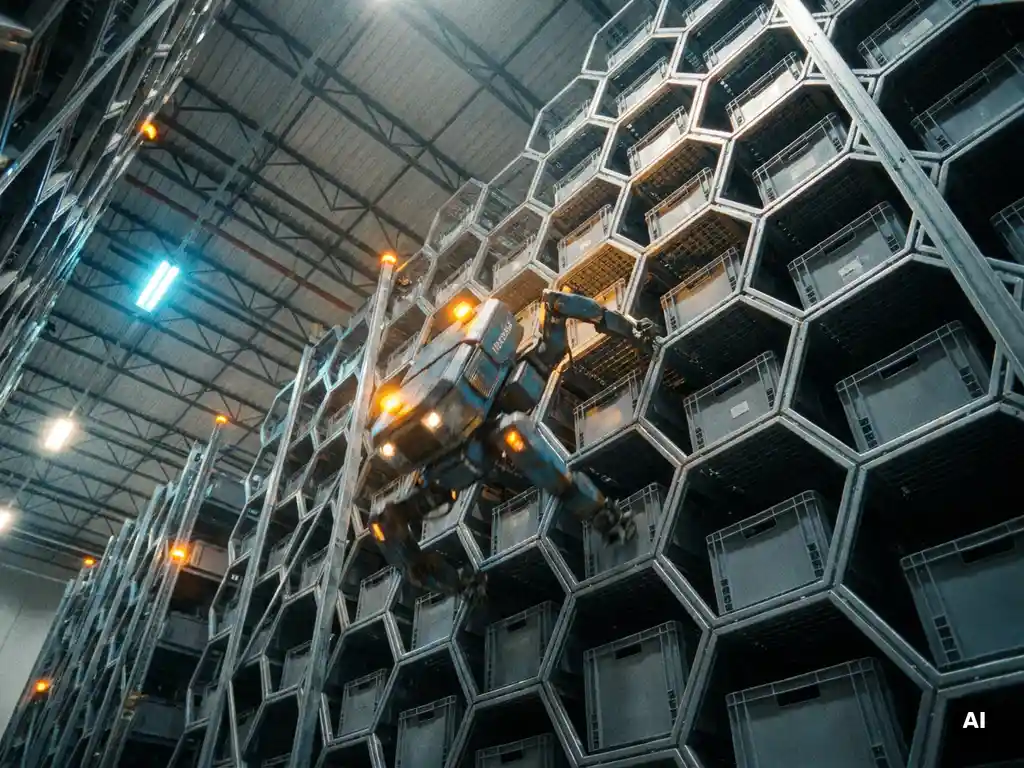
Edge computing plays a critical role in real-time warehouse operations by processing data locally, at or near the robots and sensors themselves, rather than routing every decision through a remote cloud server. This eliminates the round-trip latency that would otherwise slow down robot coordination, safety responses, and inventory updates. The sections below unpack the specific questions engineers most often ask when evaluating edge computing for automated warehouse environments.
How does edge computing reduce latency in warehouse robot coordination?
Edge computing reduces latency in warehouse robot coordination by processing movement commands, collision avoidance logic, and path-planning decisions on local hardware rather than sending data to a central cloud and waiting for a response. In a dense robotic system where dozens of autonomous units operate simultaneously, even a 50-millisecond delay per decision compounds into measurable throughput loss and safety risk.
In a distributed AS/RS environment, robots need to negotiate space in real time. When one unit changes its path due to an obstacle or a priority order, adjacent units must adjust within milliseconds. A cloud-dependent architecture introduces unpredictable network delays that make this kind of tight coordination unreliable. Edge nodes deployed within the warehouse infrastructure respond in single-digit milliseconds, keeping robot swarms synchronized without requiring a constant high-bandwidth cloud connection.
The practical benefit is not just speed but consistency. Latency spikes, even brief ones, can cause robots to queue unnecessarily, reducing throughput during peak periods. Local processing keeps response times stable regardless of internet traffic or cloud server load, which is especially valuable during high-volume fulfillment windows when throughput pressure is greatest.
What warehouse tasks actually require real-time processing?
Real-time processing in a warehouse is required for any task where a delayed response causes a physical consequence: robot collision avoidance, dynamic path rerouting, tote tracking during active retrieval cycles, safety zone monitoring, and load balancing across concurrent robot operations. These tasks cannot tolerate the variability of cloud round-trips.
Inventory updates and order management, by contrast, are latency-tolerant. Whether a WMS reflects a completed pick in 200 milliseconds or two seconds rarely affects physical operations. This distinction matters because it defines what must run at the edge versus what can safely run in the cloud or on a central server.
Tasks that demand edge-level response times
- Collision avoidance: Robots operating in shared horizontal corridors must detect and respond to each other’s positions continuously
- Vertical access coordination: In tower-based AS/RS systems, climber units entering and exiting storage columns must be sequenced with zero tolerance for timing errors
- Safety zone enforcement: When a human enters a restricted area, the system must halt nearby robots within milliseconds
- Dynamic order prioritization: Resequencing active robot tasks based on order urgency requires instant recalculation of movement queues
Tasks that can tolerate higher latency
- Inventory level reporting to external WMS platforms
- Shift performance analytics and throughput dashboards
- Predictive maintenance data aggregation
- Order batch planning and wave release
How does edge computing work alongside warehouse management systems?
Edge computing and warehouse management systems (WMS) operate at different layers of the control stack. The edge layer handles real-time physical execution, while the WMS handles inventory logic, order management, and business rules. The two communicate through APIs, with the edge layer reporting completed actions upward and receiving high-level task assignments downward.
This separation of concerns is intentional and important. A WMS is not designed to respond in milliseconds; it is designed to manage data integrity, order flow, and reporting across the entire operation. Asking a WMS to also coordinate robot movements in real time would overload it and introduce dangerous latency into physical processes.
In practice, the WMS releases an order to the warehouse control system, which passes individual tasks to the edge layer. The edge layer then handles all the physical sequencing, robot dispatching, and confirmation before reporting completion back up the chain. This architecture keeps each layer focused on what it does best, and it means the WMS does not need to be replaced or heavily modified when the physical automation layer changes or scales.
Standard API integration is the key enabler here. Systems that expose well-documented interfaces allow edge controllers to connect to a wide range of WMS platforms without custom development, reducing deployment time and long-term maintenance overhead.
What happens to warehouse operations when connectivity is lost?
When connectivity to a central server or cloud platform is lost, a warehouse with edge computing continues operating because the edge layer holds all the logic needed to run active robot tasks locally. Robots keep moving, retrievals continue, and safety systems remain active. Only tasks that depend on new orders from the WMS, such as starting new pick waves, are paused until connectivity is restored.
This resilience is a core reason why edge computing has become a design requirement rather than an optional enhancement in serious warehouse automation deployments. A system that stops when the internet drops is not suitable for high-availability operations.
The edge layer typically buffers completed transaction data locally during a connectivity outage and syncs it back to the WMS once the connection is restored. This ensures inventory accuracy is maintained without requiring operators to manually reconcile picks. The duration of autonomous operation during an outage depends on how much task queue the edge system holds locally, but well-designed implementations can sustain normal operations for extended periods without any upstream connection.
What are the infrastructure requirements for edge computing in a warehouse?
The infrastructure requirements for edge computing in a warehouse include local processing hardware (edge servers or ruggedized compute nodes) positioned close to the automation equipment, a reliable local area network with low-latency switching, and software that separates real-time control logic from cloud-dependent functions. The physical environment, temperature, dust, and vibration also shape hardware selection.
Unlike cloud infrastructure, edge hardware must survive the warehouse floor environment. Industrial-grade edge servers with passive or filtered cooling are typically preferred over standard rack servers. Network design matters equally: a flat, poorly segmented network introduces contention that undermines the latency benefits edge computing is meant to deliver. Dedicated VLANs or software-defined networking segments for robot communication are standard practice in well-engineered deployments.
One factor that simplifies edge infrastructure in modern AS/RS systems is the elimination of in-rack electrification. When the storage structure itself carries no embedded electronics, cabling, or powered components, the edge compute layer only needs to communicate with the robots themselves, not with dozens of distributed rack-mounted sensors or motors. This reduces the number of endpoints the edge network must manage and lowers the overall complexity of the installation.
Power redundancy is another practical requirement. Edge nodes that lose power during operations can leave robots mid-task. Uninterruptible power supplies for edge compute hardware are a standard safeguard, and their cost is modest relative to the operational risk they eliminate.
How does edge computing support scalable AS/RS throughput?
Edge computing supports scalable AS/RS throughput by enabling parallel robot coordination without creating a centralized processing bottleneck. As more autonomous units are added to the system, the edge layer distributes task management across the robot fleet rather than routing every decision through a single controller. This means throughput scales with the number of robots rather than hitting a ceiling imposed by central compute capacity.
In a distributed AS/RS architecture, the absence of centralized cranes or fixed vertical conveyors means there is no single mechanical point of failure, and the control architecture should mirror that same principle. If the software coordination layer has a single bottleneck, the distributed hardware advantage is partially negated. Edge computing, when properly implemented, keeps the control layer as distributed as the physical layer.
The relationship between edge processing and throughput scaling is also relevant during peak demand. Adding robots to handle a volume surge only delivers the expected performance gain if the control system can coordinate the larger fleet without degradation. Edge nodes that are sized and networked to handle the maximum planned fleet size ensure that throughput scales linearly as robots are added, which is the operational promise of a well-designed scalable AS/RS.
For engineers evaluating warehouse automation systems, the edge computing architecture is worth scrutinizing as carefully as the mechanical specifications. A system with excellent hardware but a centralized, cloud-dependent control layer will underperform its rated throughput under real-world network conditions.
How Hexxabotics supports real-time warehouse operations
Hexxabotics is built around the same distributed, resilient principles that make edge computing effective in warehouse environments. The system is designed to support real-time data processing requirements in warehouse operations through an architecture that eliminates centralized bottlenecks at both the mechanical and software levels.
- Distributed robot coordination: Hexxabots operate as independent autonomous units, enabling parallel task execution without dependency on a central crane or conveyor
- No in-rack electrification: The passive steel structure reduces the number of networked endpoints, simplifying edge infrastructure and lowering failure risk
- Independent scalability: Storage capacity and throughput scale separately, meaning edge compute resources can be sized and expanded in line with robot fleet growth
- Standard API integration: The Hexxabotics Control System connects to external WMS platforms through standard interfaces, fitting cleanly into the layered architecture that edge computing depends on
- Resilient by design: Distributed operation means no single point of failure, at the hardware level or the control level, supporting continuous operations even when individual units are offline
If you are evaluating edge computing AS/RS options for a high-density fulfillment environment, explore how the Hexxabotics architecture is engineered to meet real-time warehouse operation demands at hexxabotics.com.