
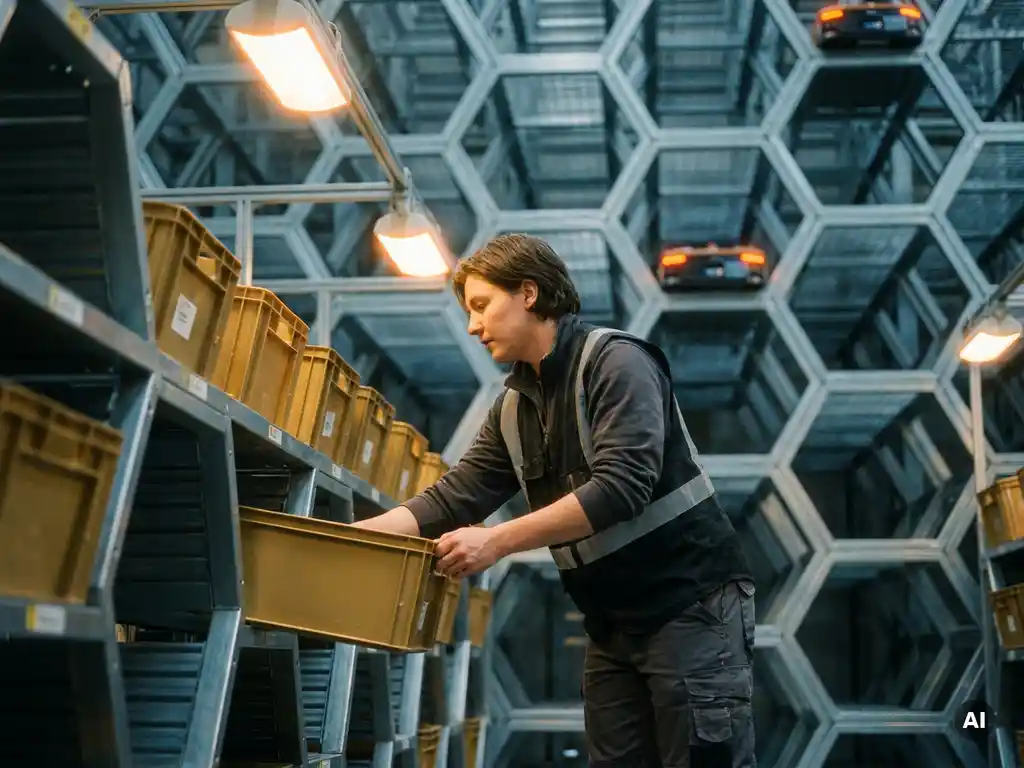
Ergonomics in warehouse layout planning means designing the physical environment so that workers can perform their tasks safely, efficiently, and without unnecessary physical strain. The goal is to match the demands of the job to the capabilities of the human body, reducing injury risk while maintaining or improving productivity. This article unpacks the most important ergonomic questions engineers and operations planners face when designing or upgrading a warehouse.
What are the biggest ergonomic risk factors in a warehouse environment?
The biggest ergonomic risk factors in a warehouse environment are repetitive motion, awkward postures, manual lifting of heavy or bulky loads, excessive walking distances, and prolonged standing on hard surfaces. These factors are often present simultaneously, which compounds the physical toll on workers over time and increases the likelihood of musculoskeletal injuries.
Manual handling is consistently the leading contributor to warehouse injuries. When workers repeatedly lift, lower, carry, push, or pull loads without mechanical assistance, the cumulative strain on the spine, shoulders, and joints builds quickly. The risk increases sharply when loads are heavy, when the lift originates from floor level or above shoulder height, and when the worker must twist or reach during the movement.
Repetitive motion is a separate but related risk. Order picking, in particular, requires workers to perform the same sequence of movements hundreds or thousands of times per shift. Even when individual movements are low-force, repetition without adequate recovery time leads to fatigue and eventually injury.
Walking distance is often underestimated as an ergonomic factor. In conventional person-to-goods warehouse layouts, pickers can travel several kilometers per shift. This sustained physical demand reduces accuracy, increases fatigue-related error rates, and contributes to lower limb strain. Floor surface, footwear requirements, and the presence of uneven surfaces or ramps amplify the effect.
How do storage height and shelving depth affect worker ergonomics?
Storage height and shelving depth directly affect the postures workers must adopt to retrieve or place items. The ergonomically safe working zone for manual handling is roughly between knee height and shoulder height. Storage locations above shoulder height require overhead reaching, while locations below knee height require bending or squatting, both of which increase spinal load and injury risk significantly.
Shelving depth adds another layer of risk. Deep shelves force workers to reach horizontally into the rack to access items stored toward the back. This extended reach reduces the mechanical advantage of the shoulder and arm muscles, increasing strain even when the load itself is light. The combination of depth and height, for example, reaching overhead into a deep shelf, represents one of the highest-risk postures in manual warehouse operations.
In practice, ergonomic shelving design places the heaviest and most frequently picked items in the golden zone between roughly 75 cm and 125 cm from the floor. Lighter or less frequently accessed items can occupy higher or lower positions, but the layout should be reviewed regularly as SKU velocity changes, since a slow mover today may become a fast mover tomorrow.
Shelf depth should be matched to the size of the product being stored. Deeper shelves are only justified when product dimensions require them. Where possible, inclined or gravity-fed shelving can bring items forward automatically, reducing reach distance at the point of pick.
What role does traffic flow design play in reducing physical strain?
Traffic flow design reduces physical strain by minimizing unnecessary travel, eliminating path conflicts between pedestrians and vehicles, and creating predictable, logical movement patterns through the warehouse. A well-designed flow reduces total walking distance per shift, lowers the risk of collision-related injuries, and allows workers to maintain a steady pace rather than stopping, starting, and navigating around obstacles.
The layout of receiving, storage, picking, packing, and dispatch zones determines the baseline travel burden for every role in the building. When these zones are arranged in a logical sequence that mirrors the order fulfillment process, workers move in one consistent direction rather than crossing back and forth across the floor. This reduces both distance and cognitive load.
Aisle width is a related consideration. Narrow aisles increase storage density but restrict movement, create congestion at peak times, and force awkward postures when workers must pass each other or maneuver equipment. Wider aisles improve safety and flow but consume floor space that could otherwise hold inventory. The right balance depends on the equipment used, the volume of traffic, and whether automation handles any portion of the retrieval work.
Clearly marked pedestrian routes, separated from vehicle and equipment paths, are a fundamental ergonomic and safety requirement. When forklifts, pallet movers, and picking carts share space with walking workers, the risk of both collision injuries and stress-related fatigue increases. Physical separation through barriers, color-coded floor markings, or one-way traffic patterns is more reliable than relying on awareness alone.
How can warehouse automation reduce ergonomic risk for workers?
Warehouse automation reduces ergonomic risk by removing the most physically demanding tasks from the human workload, particularly manual lifting, repetitive reaching, and long-distance walking. Goods-to-Person systems are the most direct expression of this principle: instead of workers traveling to inventory, the automated system retrieves the correct tote and presents it at a fixed workstation at an ergonomically appropriate height.
The ergonomic benefits of a Goods-to-Person model are substantial and measurable in operational terms:
- Walking distance per shift drops significantly, reducing lower limb fatigue and cumulative cardiovascular strain
- Workers remain at a fixed station, allowing the workstation to be designed precisely for the individual’s height and reach envelope
- The system controls which tote is presented and at what height, eliminating overhead reaching and floor-level bending
- Repetitive travel through aisles is replaced by a consistent, lower-intensity picking motion at a stable workstation
- Workstation throughput becomes more predictable, allowing realistic pacing and reducing the pressure that leads to rushed, unsafe movements
Beyond the workstation itself, automation removes workers from the storage zone entirely in many implementations. This reduces exposure to forklift traffic, falling objects, and the physical demands of navigating a dense storage environment. The human role shifts toward higher-value, lower-strain tasks such as verification, exception handling, and consolidation.
It is worth noting that automation does not eliminate all ergonomic considerations. Workstation design at the Goods-to-Person interface still requires careful attention to monitor height, tote presentation angle, item weight within the tote, and the duration of standing or seated work. Automation changes where the ergonomic design effort is concentrated, rather than removing the need for it entirely.
What ergonomic standards and regulations apply to warehouse layout design?
Ergonomic standards and regulations for warehouse layout design vary by jurisdiction, but most industrial economies have binding requirements covering manual handling weight limits, workstation design, repetitive motion exposure, and risk assessment obligations. In the United States, OSHA’s General Duty Clause requires employers to address recognized ergonomic hazards, while NIOSH provides voluntary guidelines for manual lifting assessment. In the European Union, the Manual Handling Directive sets minimum requirements for risk assessment and load management.
ISO 11228 is the internationally recognized standard series covering manual handling of loads, covering lifting, pushing, pulling, and carrying. It provides biomechanical criteria and assessment methods that can be applied directly to warehouse task analysis. EN 614, which covers safety of machinery and ergonomic design principles, is relevant when specifying workstations and equipment interfaces in automated or semi-automated environments.
In practice, most warehouse operators are also subject to industry-specific guidance from health and safety bodies, insurers, and sector associations. These sources often provide more operationally specific guidance than the formal standards, covering topics such as maximum recommended lift frequencies, acceptable reach zones for picking tasks, and floor surface requirements.
Compliance with these frameworks is not just a legal obligation. Operations that systematically meet ergonomic standards typically see lower injury rates, reduced absenteeism, and better retention of experienced workers. The regulatory framework is therefore a useful minimum baseline, but the most effective ergonomic warehouse designs go beyond compliance to actively optimize for worker wellbeing as a performance variable.
When should ergonomics be evaluated during a warehouse layout project?
Ergonomics should be evaluated at every major stage of a warehouse layout project, starting from the earliest concept design phase. Decisions made at the concept stage, such as storage system type, building height utilization, and zone arrangement, have the largest influence on ergonomic outcomes and are the least expensive to change. Waiting until detailed design or implementation to consider ergonomics typically means retrofitting solutions around decisions that have already constrained the options.
A structured approach to ergonomic evaluation across a warehouse project follows this sequence:
- Concept phase: Evaluate storage system type and operating model against ergonomic principles. Decide whether Goods-to-Person automation, person-to-goods picking, or a hybrid approach best suits the task profile and workforce.
- Schematic design: Assess traffic flow, zone arrangement, and aisle configuration for travel distance, conflict points, and pedestrian safety.
- Detailed design: Specify workstation dimensions, shelving heights, reach zones, floor surfaces, lighting, and equipment interfaces against recognized ergonomic standards.
- Pre-commissioning: Conduct task analysis for each role using tools such as RULA, REBA, or the NIOSH Lifting Equation to identify residual risks before operations begin.
- Post-commissioning review: Gather worker feedback and injury data after the facility is operational, and use this to refine workstation settings, task rotation schedules, and layout details.
- Ongoing operational review: Reassess ergonomic conditions whenever SKU profiles, throughput volumes, or operating processes change materially.
Early ergonomic evaluation also supports better automation decisions. Understanding the physical demands of a task before specifying equipment makes it easier to identify where automation delivers genuine ergonomic value rather than simply relocating the strain to a different part of the process.
How Hexxabotics helps with ergonomic warehouse design
Hexxabotics addresses warehouse ergonomics at the architectural level by replacing person-to-goods picking with a fully automated Goods-to-Person model. Workers no longer travel through storage aisles, reach into deep racks, or lift from awkward positions. The system retrieves the correct tote and presents it at a fixed workstation, concentrating human activity in a controlled, ergonomically designable environment.
Key ergonomic advantages of the Hexxabotics AS/RS system include:
- Elimination of aisle travel and the associated walking distance per shift
- No overhead reaching or floor-level bending within the storage zone
- Fixed Goods-to-Person workstations that can be specified to individual height and reach requirements
- Distributed robotic architecture that removes workers from the storage environment entirely
- Independent scaling of storage capacity and throughput, so the system adapts to operational changes without forcing workers back into manual processes
If you are evaluating how automated storage can improve both ergonomic outcomes and operational performance in your facility, explore the Hexxabotics system or learn more about the company and its approach to warehouse automation.
Related Articles
- What is the role of vertical space in reducing warehouse real estate costs?
- What is the difference between centralized and decentralized warehouse design?
- How do you build an audit-ready pharmaceutical storage operation?
- What industries benefit most from AMR-based warehouse automation?
- Welke sectoren profiteren het meest van AMR-gebaseerde magazijnautomatisering?