
To handle both bulk and piece-pick operations effectively, design the warehouse as two distinct but connected zones: a bulk storage area optimized for density and replenishment efficiency, and a piece-pick area optimized for speed and ergonomics. The zones are physically separated but operationally linked through a defined replenishment process that moves inventory from bulk into the pick face on a scheduled or demand-driven basis.
The right balance between these zones depends on your SKU count, order profiles, velocity distribution, and the degree of automation you deploy. This article works through the key design questions, from zone separation and storage system selection to automation strategy and performance measurement.
What’s the core operational conflict between bulk and piece-pick workflows?
The core conflict is that bulk and piece-pick operations optimize for opposite things. Bulk storage prioritizes density and replenishment efficiency: moving large quantities of product in and out with minimal handling steps. Piece-pick operations prioritize speed, ergonomics, and accuracy: retrieving individual units quickly from a compact, well-organized pick face. Designing for one often compromises the other.
In practice, this tension shows up in several ways. Bulk storage requires space for pallets, wide aisles for forklifts, and vertical clearance for racking. Piece-pick zones need short travel distances, consistent product presentation, and ergonomic access. When both operations share the same physical space without intentional separation, the result is congestion, inefficient travel paths, and throughput bottlenecks.
The underlying problem is that most warehouses carry a mixed assortment: some SKUs move in high volumes with predictable demand, while others are slow-moving, variable, or long-tail. These SKUs do not behave the same way, and they should not be stored or picked the same way. A single undifferentiated storage approach forces compromise at every point in the operation.
How do you physically separate bulk and piece-pick zones in a warehouse?
Physical separation works best when you treat bulk and piece-pick as distinct functional zones with a defined handoff point between them. Bulk storage typically occupies the rear or periphery of the building, where inbound goods arrive and pallets can be staged. The piece-pick zone sits closer to packing and dispatch, reducing the travel distance for outbound orders.
The handoff point between zones is where replenishment occurs. Inventory moves from bulk into the pick face, whether that is a flow rack, a bin shelf, or an automated storage location, and this transition should be managed as a separate process from order picking itself. Mixing replenishment and picking in the same aisle at the same time is one of the most common causes of congestion and pick-rate degradation.
In larger operations, a physical barrier or aisle separation reinforces the functional distinction. In automated environments, the boundary can be defined by the technology itself: for example, an AS/RS serving as the buffer between bulk inventory and Goods-to-Person workstations, eliminating the need for a traditional pick face entirely.
What storage systems work best for each operation type?
For bulk storage, the priority is maximizing density while maintaining accessibility for replenishment. Selective pallet racking is the most common solution because it provides direct access to every pallet position without moving other stock. Drive-in or push-back racking increases density but reduces selectivity, making it suitable only for high-volume, low-SKU-count products where last-in-first-out sequencing is acceptable.
For piece-pick operations, the most effective storage systems depend on the velocity and physical characteristics of the SKUs involved:
- Carton flow racks work well for medium-velocity items in standardized packaging, using gravity to advance product to the pick face automatically.
- Static bin shelving suits slow-moving or irregular items where volume is low and variety is high.
- Goods-to-Person systems, including AS/RS with tote-based storage, eliminate travel entirely by bringing inventory to the operator rather than sending the operator to the inventory.
- Automated dispensing systems handle very high-frequency, standardized items at speeds that manual picking cannot match.
The key principle is that no single storage system handles the full assortment optimally. The economically sound approach allocates each SKU to the system that best matches its velocity, packaging, and handling requirements, not a system that tries to accommodate everything at once.
How does automation change the design of a mixed-operation warehouse?
Automation fundamentally reframes the design question. Instead of asking how to lay out aisles and pick faces efficiently, the question becomes how to route different SKU profiles through the most appropriate automated process. This shifts the design logic from floor-space optimization to workflow orchestration.
In a well-designed automated mixed-operation warehouse, the physical layout reflects the automation architecture. High-frequency, standardized products may flow through automated dispensing or high-speed picking systems. Medium and slower-moving inventory, including long-tail SKUs, is held in dense automated storage and retrieved on demand. Manual zones handle exceptions, oversized items, or products unsuitable for the principal automation technologies.
A critical enabler is the orchestration layer: a Warehouse Management System (WMS), Warehouse Execution System (WES), or Warehouse Control System (WCS) that determines which technology processes each order line and coordinates the convergence of lines from different zones into a single complete order. Without this coordination layer, automation islands operate in isolation and the system-level throughput remains constrained.
Automation also changes how capacity and throughput scale. In a manual warehouse, adding throughput means adding people and space. In an automated warehouse designed with independent scaling in mind, storage capacity and throughput performance can grow separately: extending the structure adds locations, while adding robotic units adds picks per hour, without requiring a structural redesign of the whole operation.
When should you replenish piece-pick zones from bulk storage?
Replenishment timing should be driven by pick-face inventory levels, not by a fixed clock schedule. The most effective approach is to set minimum stock thresholds at each pick location and trigger replenishment when stock falls to that level, ensuring the pick face is never empty during an active shift without overfilling locations and creating congestion.
In practice, there are three replenishment models, and the right one depends on your operation’s volume and automation level:
- Reactive replenishment triggers a replenishment task when a pick location reaches its minimum threshold. Simple to manage, but can create bottlenecks if many locations hit their minimums simultaneously during peak periods.
- Proactive or wave-based replenishment pre-positions inventory before a pick wave begins, using forecasted demand to fill locations ahead of time. Reduces congestion during picking but requires accurate demand data.
- Automated continuous replenishment uses system-level logic to monitor inventory in real time and trigger replenishment tasks dynamically, eliminating the distinction between reactive and proactive approaches.
One often-overlooked factor is that replenishment should be treated as a separate labor or robot resource from picking. When replenishment and picking compete for the same aisle space and the same workforce, both suffer. Scheduling replenishment during low-pick periods (shift changes, meal breaks, or off-peak hours) is the simplest way to reduce this conflict in manual operations.
What metrics indicate a mixed-operation warehouse design is underperforming?
A mixed-operation warehouse design is underperforming when throughput ceilings, congestion patterns, or accuracy problems consistently trace back to the interaction between bulk and piece-pick zones rather than to isolated process failures. The design itself, not just execution, is the constraint.
The most telling performance signals include:
- High travel time as a percentage of pick time, indicating that the pick face is too spread out or poorly positioned relative to packing.
- Frequent pick-face stockouts during peak periods, suggesting replenishment processes cannot keep pace with pick demand.
- Congestion between forklift replenishment and picker traffic, a sign that bulk and piece-pick zones are not sufficiently separated or that replenishment is not sequenced away from active picking.
- Throughput that does not scale proportionally with added labor, which often indicates that the physical layout or zone design is the bottleneck, not headcount.
- Accuracy problems concentrated in specific zones, which can point to poorly organized pick faces, inconsistent product presentation, or a mismatch between SKU volume and storage format.
A subtler indicator is when the operation struggles to handle SKU growth without a proportional expansion of the pick face. If every new product added to the assortment requires more floor space rather than being absorbed into existing capacity, the storage architecture is not scaling efficiently. This is often the point where warehouse automation becomes worth evaluating seriously, not as a labor-replacement exercise, but as a way to decouple assortment growth from floor-space growth.
How Hexxabotics helps with bulk and piece-pick warehouse design
Hexxabotics addresses the structural challenge of mixed-operation warehouses by providing a dense, directly accessible AS/RS that handles the variable and slower-moving portion of the assortment, the inventory that is difficult to place in either a high-speed dispenser or a traditional pick face without compromising density or accessibility.
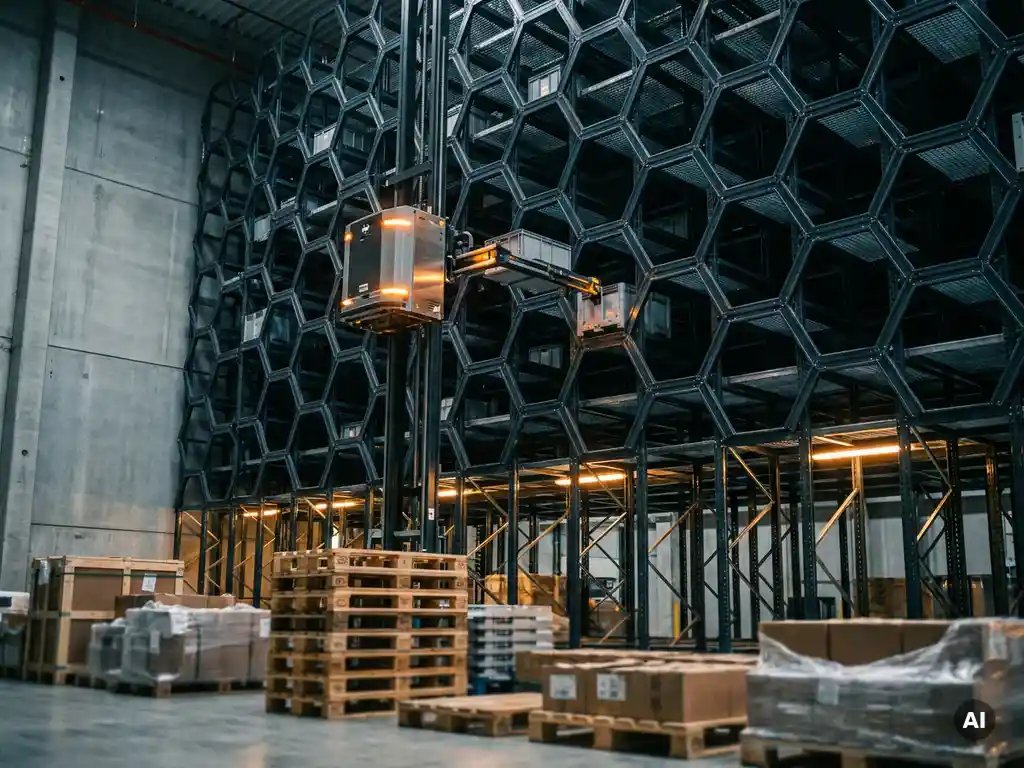
- Autonomous Hexxabots navigate horizontally beneath the hexagonal grid and climb vertically inside towers to retrieve totes in a single continuous motion, with 100% direct access to every storage location and no reshuffling.
- The system scales up to 16 meters in height, converting underutilized vertical space into productive storage without expanding the building footprint.
- Storage capacity and throughput scale independently: extending the structure adds locations; adding robots adds picks per hour, so the operation can respond to assortment growth and order-volume growth as separate challenges.
- Integration with WMS, WES, or WCS systems through standard APIs connects the AS/RS into the broader fulfillment architecture, coordinating tote retrieval with Goods-to-Person workstations and downstream packing processes.
- No in-rack electrification simplifies installation, reduces energy demand, and makes the system easier to relocate or reconfigure as operational requirements change.
If your warehouse is running out of capacity, struggling to manage a growing SKU count, or hitting throughput ceilings that more labor alone cannot solve, the Hexxabotics approach is worth exploring. Contact the team to discuss how the system fits your specific operation.
Related Articles
- What technology is used for real-time pharmaceutical inventory monitoring?
- What is a GMP-compliant warehouse and how is it certified?
- How does track-and-trace technology work in pharmaceutical logistics?
- How does temperature-controlled storage change warehouse layout requirements?
- How do you build a TCO model for warehouse automation?