
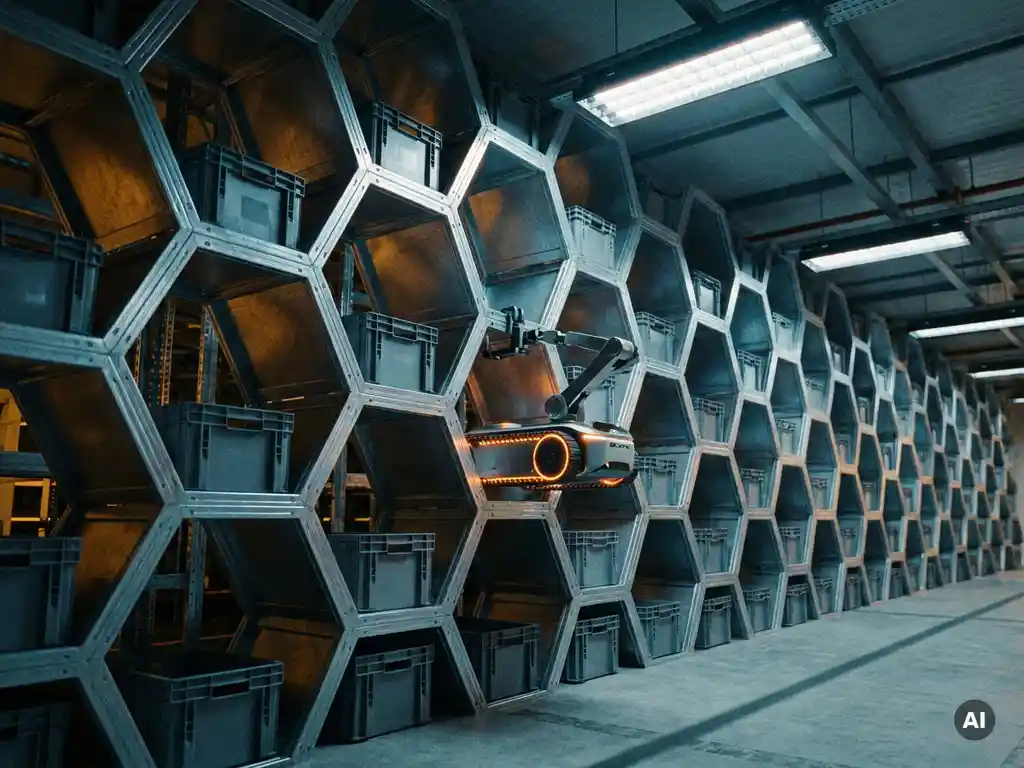
A hexagonal grid system changes warehouse logistics by enabling significantly higher storage density within the same floor footprint, while allowing storage capacity and throughput to scale independently of each other. Unlike conventional racking or cube-based systems, the hexagonal geometry draws on the same structural principles found in honeycombs, combining strength, compactness, and modularity in a way that flat or square grid layouts cannot match. The sections below unpack the specific questions engineers and logistics professionals ask most when evaluating this technology.
What makes hexagonal grid storage more space-efficient than traditional racking?
Hexagonal grid storage achieves higher space utilization than traditional racking because the hexagonal cell geometry fills a given volume more completely than cubic or rectangular structures. Where a cubic storage arrangement reaches roughly 74% space utilization, a hexagonal structure reaches approximately 94%, meaning a substantially greater share of the available building volume is occupied by actual storage rather than structural dead space.
The efficiency gain comes from geometry, not engineering complexity. Hexagonal cells, like those in a natural honeycomb, tile perfectly without gaps, distribute load evenly across the structure, and require less material to maintain the same structural integrity as a square equivalent. In practical warehouse terms, this means more totes fit within the same building envelope.
The system also exploits vertical space in a way that traditional racking rarely achieves in practice. The self-supporting hexagonal structure can reach up to 16 meters in height, using the full cubic volume of a facility rather than limiting storage to the lower portion of the building. Because every storage location is directly accessible without reshuffling other totes, that vertical depth does not come at the cost of retrieval speed or complexity.
How does a robot navigate and retrieve items inside a hexagonal grid?
Robots in a hexagonal grid system operate across two distinct movement planes. Autonomous robot units navigate horizontally beneath the grid structure to reposition themselves to the correct tower. Once in position, detachable climber units ascend vertically inside the tower to reach the target storage location. Deposit and retrieval happen in one continuous vertical cycle, with no separate lift infrastructure required.
This two-dimensional movement model eliminates the centralized cranes and fixed vertical conveyors that create bottlenecks in many conventional AS/RS designs. Because each tower has its own direct vertical access, the system has no single point of failure tied to a central lifting mechanism. Multiple robots can operate simultaneously across different towers, which means throughput scales in parallel rather than being constrained by shared equipment.
A critical operational advantage is that every tote location is directly accessible. There is no digging through layers of inventory to reach a specific item, and no reshuffling is needed before a retrieval can begin. This direct access model keeps cycle times consistent regardless of where in the tower a tote is stored, which is particularly valuable in high-SKU environments where demand patterns are unpredictable.
What is the difference between storage capacity and throughput in an AS/RS?
Storage capacity refers to how many totes or items a system can hold at any given time, while throughput refers to how many storage and retrieval cycles the system can complete per hour. In most conventional AS/RS designs, these two dimensions are tightly linked: adding more storage usually means adding more infrastructure that also affects how items are retrieved, and increasing throughput often requires structural changes that alter the storage layout.
In a hexagonal grid system, storage capacity and throughput scale independently. Capacity grows by extending the physical structure, adding more hexagonal towers to increase the total number of storage locations. Throughput grows by adding more autonomous robots to the system. Neither change requires the other, and neither requires redesigning the underlying infrastructure.
This independence has significant implications for operational planning. A warehouse that needs more storage during a seasonal expansion can add towers without touching its robot fleet. A warehouse facing a peak demand period that requires faster order fulfillment can deploy additional robots without altering its storage layout. In traditional AS/RS architectures, scaling throughput typically means upgrading or duplicating core machinery, which drives up cost and complexity. The separation of these two dimensions is one of the defining advantages of a distributed robotic approach to automated storage and retrieval.
Does a hexagonal grid system require electrical infrastructure in the rack structure?
No. A hexagonal grid system does not require any electrification within the rack structure itself. The robots carry their own power and are charged while in process, meaning the physical storage grid contains no wiring, power rails, or electrical components. This is a deliberate design choice that reduces the number of components that can fail and simplifies both maintenance and potential relocation of the system.
In conventional shuttle- or crane-based AS/RS systems, electrical infrastructure runs throughout the rack structure to power movement mechanisms, sensors, and conveyors embedded within the storage area. Each additional electrical component in the rack represents a potential failure point and a maintenance access requirement. Removing electrification from the rack entirely means fewer components overall, and the components that do exist are concentrated in the robots themselves, which are discrete units that can be serviced, replaced, or upgraded without affecting the storage structure.
The absence of in-rack electrification also reduces integration effort when deploying the system in a new facility or reconfiguring an existing one. There is no need to plan electrical routing through the rack structure or coordinate with building electrical systems beyond the charging infrastructure for the robots themselves.
What warehouse applications benefit most from hexagonal grid automation?
Warehouse operations that manage large numbers of distinct SKUs, require fast and reliable individual item retrieval, or need to scale storage and throughput at different rates benefit most from hexagonal grid automation. This includes e-commerce fulfillment, food and grocery operations, fashion and apparel distribution, FMCG logistics, pharmaceutical storage, spare parts management, and third-party logistics providers handling diverse client inventories.
The direct-access model is particularly valuable in environments where every tote location must be reachable without delay. In pharmaceutical warehousing, for example, batch traceability and regulatory compliance depend on reliable, auditable access to specific inventory locations. In fashion fulfillment, the high SKU count and unpredictable demand patterns make a system that avoids reshuffling operationally essential.
Food and grocery operations benefit from the combination of density and direct access, since fresh product requires reliable rotation and fast retrieval without the delays caused by inventory blocking. FMCG environments often face sudden promotional spikes that demand rapid throughput increases, which the ability to add robots without structural changes directly supports.
3PL providers represent another strong fit because the modular architecture scales without client-specific engineering, allowing integrators to deploy the same system architecture across multiple customer environments with predictable performance outcomes.
How Hexxabotics helps with hexagonal grid warehouse automation
Hexxabotics delivers a purpose-built robotic warehouse system designed around the principles covered in this article. Its autonomous high-density AS/RS combines a hexagonal vertical storage grid, autonomous Hexxabots, and standardized totes into one architecture that addresses the core challenges of modern warehouse logistics.
- Maximum storage density: Hexagonal geometry achieves up to 94% space utilization and supports storage heights up to 16 meters
- Direct access to every tote: No digging, no reshuffling, and no bottleneck zones created by centralized lifting equipment
- Independent scalability: Capacity and throughput scale separately, so growth in one dimension does not force changes to the other
- No in-rack electrification: Fewer components, simpler maintenance, and easier relocation compared to conventional AS/RS designs
- Broad application fit: Suitable for e-commerce, food and grocery, fashion, FMCG, pharma, spare parts, and 3PL environments
- Standard API integration: The Hexxabotics Control System connects to existing warehouse management systems without custom development
If you are evaluating automated storage and retrieval options for a new or existing facility, contact Hexxabotics to discuss how the hexagonal grid architecture fits your specific capacity, throughput, and integration requirements.
Related Articles
- What is pharmaceutical warehousing and why does it matter?
- What is the difference between cold chain and ambient pharmaceutical storage?
- What are audit trail requirements for pharmaceutical warehouses in 2026?
- What are the controlled substance storage requirements for warehouses?
- What is goods-to-person fulfillment and how does it change warehouse design?