
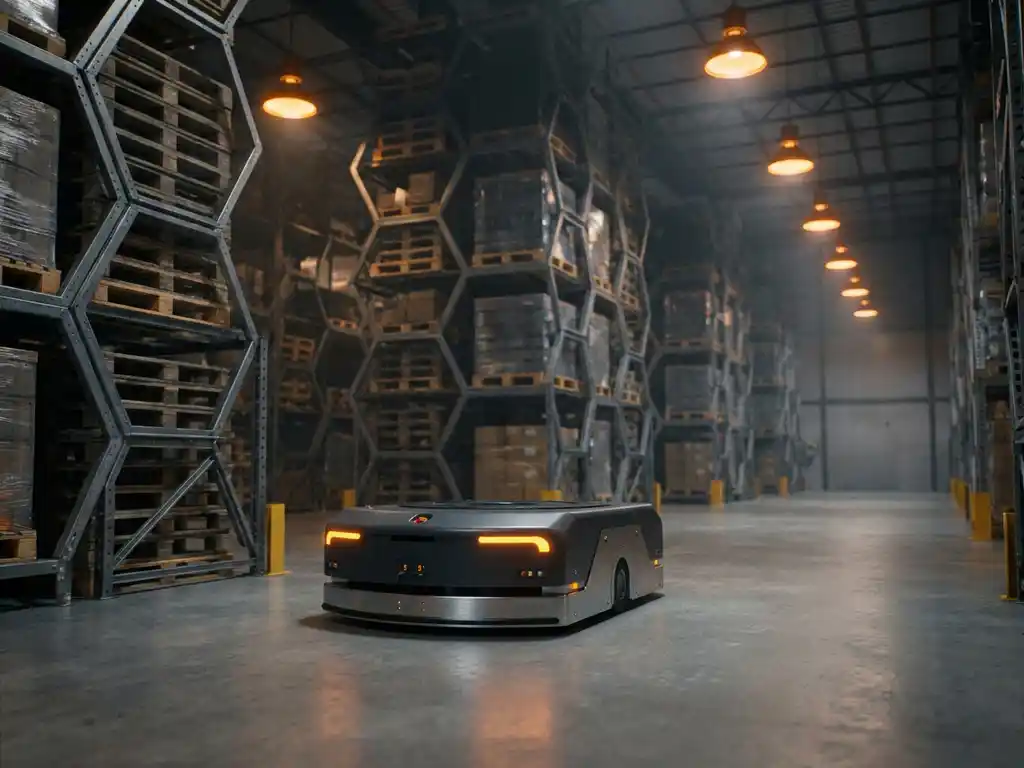
Autonomous mobile robots in warehouses are used to move inventory, transport goods between locations, and support picking, sorting, and replenishment operations without human guidance. They navigate using onboard sensors, maps, and software intelligence rather than fixed tracks or conveyors. This article unpacks the most common AMR use cases, how they compare to other robotic systems, and how to decide which approach fits your operation.
How do autonomous mobile robots actually move through a warehouse?
Autonomous mobile robots move through warehouses using a combination of onboard sensors, real-time mapping, and navigation software. Most AMRs use LiDAR, cameras, or ultrasonic sensors to detect their surroundings, build a map of the facility, and plot efficient routes between locations. Unlike older automated guided vehicles (AGVs), AMRs do not require physical tracks, magnetic tape, or fixed infrastructure on the floor.
The navigation logic behind most AMRs relies on a technique called simultaneous localization and mapping, or SLAM. The robot continuously scans its environment, compares what it detects against a stored map, and adjusts its position in real time. This allows AMRs to reroute dynamically when obstacles appear, whether that is a forklift, a pallet, or a person crossing the aisle.
Fleet management software coordinates multiple robots operating at the same time, assigning tasks, managing traffic, and preventing collisions. The warehouse layout, shelf positions, and workstation locations are all represented digitally, and each robot receives instructions through a central control system or directly from a warehouse management system via an API.
What tasks are autonomous mobile robots most commonly used for?
The most common AMR use cases in warehouses are goods transport, order picking support, inventory scanning, and replenishment. AMRs excel at repetitive, high-frequency movement tasks that previously required workers to walk long distances across a facility. By bringing goods or shelves to workers, or by guiding workers through optimized pick paths, AMRs reduce travel time and increase throughput.
The most frequently deployed mobile robot applications include:
- Goods-to-person fulfillment: Robots retrieve totes, shelves, or bins and deliver them to a stationary picking workstation, eliminating the need for pickers to walk the floor
- Person-to-goods picking support: AMRs follow or lead human pickers through the warehouse, carrying accumulating orders and reducing the physical load on workers
- Sortation and consolidation: Robots move sorted orders to packing stations or staging areas, supporting high-volume e-commerce operations
- Inventory cycle counting: Some AMRs carry scanning hardware and autonomously audit shelf locations, flagging discrepancies without halting operations
- Inbound replenishment: Robots transport received goods from the dock to storage locations, reducing manual handling in receiving areas
The right use case depends heavily on order profile, SKU count, and facility layout. Operations with high SKU diversity and frequent small orders tend to benefit most from goods-to-person configurations, while high-volume single-SKU flows often suit transport AMRs moving pallets or large totes.
What is the difference between AMRs and AS/RS systems?
Autonomous mobile robots and Automated Storage and Retrieval Systems serve different functions. AMRs are mobile units that transport goods across open warehouse floors, while AS/RS systems are fixed or semi-fixed structures designed to store goods at high density and retrieve them on demand. The two approaches differ in storage density, throughput characteristics, and infrastructure requirements.
How AMRs handle storage and movement
AMRs operating in open-floor environments keep inventory on shelves or in bins that the robots physically move. This gives flexibility in layout but limits vertical utilization. Most AMR-based storage systems use floor-level or low-bay shelving, which means a large footprint is required to hold significant inventory volume. Storage density in AMR environments is generally lower than in purpose-built AS/RS structures.
How AS/RS systems approach density and retrieval
AS/RS systems are engineered specifically to maximize cubic storage volume. They use vertical height aggressively, often reaching 10 to 16 meters, and every storage location is managed by the system rather than a human. Retrieval is automated and direct, meaning the system brings the exact tote or item to a workstation without manual intervention. Systems like hexagonal AS/RS architecture take this further by separating storage capacity from throughput, allowing warehouses to scale each independently without rebuilding infrastructure. In conventional AS/RS designs, adding throughput often means adding cranes or conveyors, which increases complexity and cost. In distributed robotic AS/RS designs, throughput scales by adding autonomous units to the same structure.
For operations prioritizing storage density, direct tote access, and vertical space utilization, AS/RS outperforms AMR-based shelving. For operations needing flexible floor routing, mixed-use environments, or transport between zones, AMRs remain a strong fit. Many modern warehouses combine both approaches.
What industries use autonomous mobile robots in their warehouses?
Autonomous mobile robots are used across a wide range of industries, including e-commerce, retail, food and grocery, pharmaceuticals, fashion and apparel, fast-moving consumer goods, spare parts distribution, and third-party logistics. Any operation with repetitive goods movement, high order volumes, or labor-intensive picking processes can benefit from warehouse robot deployment.
Industry-specific drivers include:
- E-commerce and retail: High order frequency and small order sizes make goods-to-person automation particularly effective, reducing pick times and supporting same-day fulfillment
- Food and grocery: Temperature-sensitive environments and short shelf lives demand fast, accurate retrieval with full traceability
- Pharmaceuticals: Strict batch traceability, regulatory compliance requirements, and the need for error-free picking drive adoption of robotic systems with direct-access inventory management
- Fashion and apparel: High SKU counts, seasonal variation, and returns processing create complex storage challenges that benefit from dense, directly accessible automated storage
- 3PL logistics: Multi-client environments require flexible, reconfigurable systems that can adapt to changing customer needs without infrastructure redesign
- Spare parts and industrial distribution: Large catalogs of low-velocity SKUs stored in compact, organized systems reduce retrieval time and picking errors
How do warehouse robots integrate with existing management systems?
Warehouse robots integrate with existing management systems primarily through standard APIs that connect the robot control software to a warehouse management system (WMS) or warehouse execution system (WES). This integration allows the WMS to assign tasks, track inventory locations, and receive confirmation of completed operations without requiring the warehouse to replace its existing software infrastructure.
Most modern robotic systems, including AMR fleets and AS/RS platforms, are designed with open integration in mind. The robot control layer handles physical coordination, such as routing, collision avoidance, and task sequencing, while the WMS retains authority over inventory logic, order management, and business rules. The two systems communicate in real time, so inventory status updates as soon as a tote is retrieved or a pick is confirmed.
Integration complexity depends on the maturity of the existing WMS and the openness of the robotic platform’s API. Well-documented, standards-based APIs significantly reduce implementation time. In practice, integration projects range from a few weeks for straightforward connections to several months for complex, multi-system environments. Choosing a robotic system with a proven integration track record and flexible API support reduces this risk considerably.
When should a warehouse choose robots over traditional storage methods?
A warehouse should consider robotic automation when labor costs are rising, order volumes are growing faster than floor space allows, picking accuracy is a persistent problem, or the operation needs to scale throughput without proportionally expanding its workforce. Traditional static shelving and manual picking work well at low volumes, but they create bottlenecks as complexity increases.
Key indicators that robotic systems are the right next step include:
- Order volumes that require pickers to walk excessive distances, reducing productivity and increasing fatigue
- Storage space constraints that make adding more shelving impractical without expanding the building footprint
- Picking error rates that create costly returns, re-picks, or customer dissatisfaction
- Seasonal demand spikes that are difficult to staff for reliably
- A need to utilize vertical height that conventional racking cannot efficiently serve
- Long-term labor availability concerns in the local market
The business case becomes strongest when the robotic system can scale alongside the operation rather than requiring a full infrastructure rebuild at each growth stage. Systems that allow capacity and throughput to expand independently, without stopping daily operations, offer a lower total cost of ownership over time compared to systems that lock storage and throughput into a single rigid structure.
How Hexxabotics helps with warehouse robot automation
Hexxabotics offers a next-generation AS/RS system that addresses the core limitations of both traditional AMR storage and conventional automated storage and retrieval. Built around hexagonal geometry inspired by honeycomb structures, the system converts full cubic warehouse volume into directly accessible, high-density storage without embedded motors, powered racks, or in-rack electrification.
- Maximum storage density: Hexagonal towers utilize up to 16 meters of vertical height, achieving 94% space utilization within the same footprint
- Direct access to every tote: No reshuffling, no digging, no queuing. Every storage location is independently accessible
- Independent scalability: Add storage capacity by extending the structure. Add throughput by deploying more Hexxabots. Neither change requires rebuilding the other
- No in-rack electrification: Robots charge while in process, reducing energy consumption and simplifying maintenance
- Distributed resilience: If one robot stops, the system continues. No single point of failure disrupts operations
- Standard API integration: The Hexxabotics Control System connects to existing WMS platforms without requiring infrastructure replacement
Whether you are designing a new fulfillment center or modernizing an existing warehouse, Hexxabotics delivers scalable, dense, and reliable automated storage. Contact Hexxabotics to discuss how the system fits your operation.