
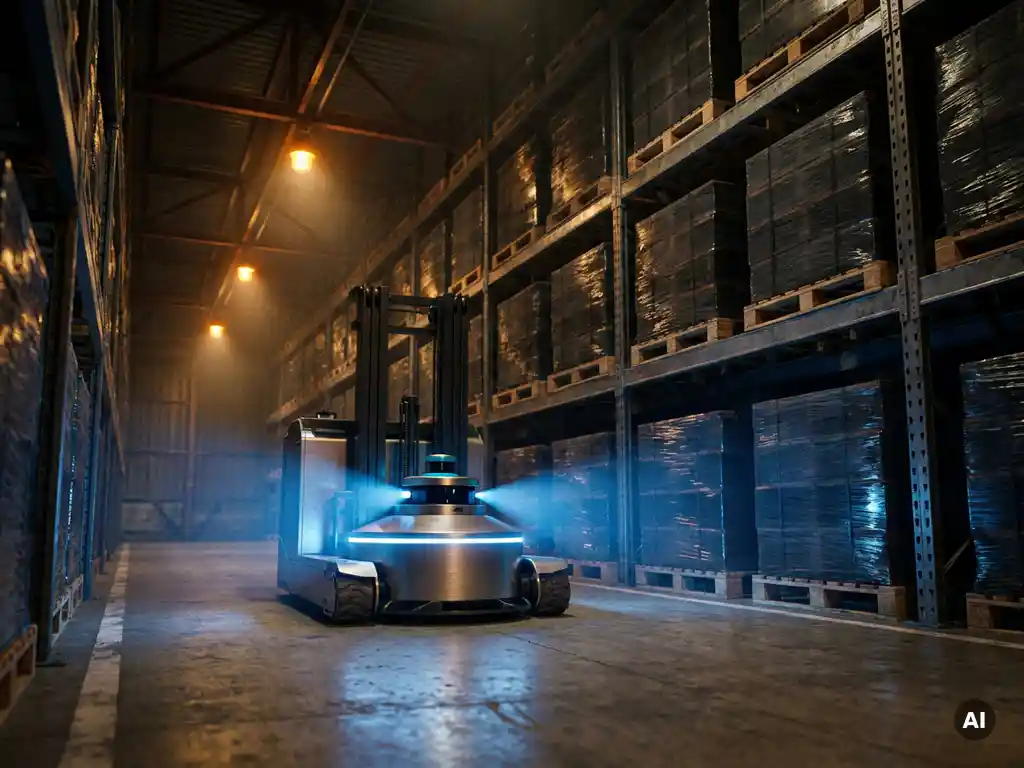
Autonomous forklift technology is genuinely reliable for structured, repetitive tasks in controlled warehouse environments, but its reliability depends heavily on the specific system type, deployment quality, and operational conditions. Modern self-driving forklifts use a combination of sensors, mapping software, and machine learning to navigate warehouses and move loads without human operators. This article walks through how the technology works, where it excels, where it falls short, and how it compares to alternative automation approaches.
How does autonomous forklift technology actually work?
Autonomous forklift technology works by combining onboard sensors, real-time mapping, and fleet management software to navigate warehouse environments, locate loads, and execute pick-and-place tasks without human input. The forklift continuously builds and updates a map of its surroundings, detects obstacles, and follows dynamically assigned routes to complete tasks.
At the hardware level, most automated forklift systems rely on a layered sensor stack. Laser scanners (LiDAR) provide 360-degree distance mapping, while cameras and depth sensors help the vehicle identify pallets, read barcodes, and detect people in the travel path. Some systems add inertial measurement units to track movement between sensor updates.
The software layer is equally important. A central fleet management system assigns tasks, tracks vehicle positions, manages traffic across multiple units, and communicates with the warehouse management system (WMS) through standard APIs. The forklift itself runs localization algorithms that compare live sensor data against a stored map to determine its exact position at any moment.
Charging is handled either through scheduled downtime at docking stations or, in some newer designs, through opportunity charging during natural pauses in operation. The result is a system that can operate continuously across shifts without a dedicated human operator for each vehicle.
What are the main types of autonomous forklift systems?
The main types of autonomous forklift systems are laser-guided vehicles (LGVs), natural-navigation autonomous mobile robots (AMRs), vision-guided forklifts, and hybrid systems that combine fixed-path and free-navigation modes. Each type suits different warehouse layouts, load types, and throughput requirements.
Laser-guided vehicles (LGVs)
LGVs follow predefined routes mapped in advance and navigate using reflective targets or magnetic tape embedded in the floor. They are highly predictable and well-suited to repetitive, high-volume movements along fixed paths, such as moving pallets from a receiving dock to a staging area. The tradeoff is inflexibility: changing the layout requires remapping and, in some cases, physical changes to floor infrastructure.
Natural-navigation AMR forklifts
Natural-navigation systems use LiDAR and simultaneous localization and mapping (SLAM) to operate without fixed floor infrastructure. The vehicle builds its own map of the environment and can adapt to layout changes more easily than LGVs. These systems are better suited to dynamic warehouses with frequently changing inventory flows, though they require a stable enough environment for reliable map matching.
Vision-guided and hybrid systems
Vision-guided forklifts use camera arrays and computer vision to locate pallets, read labels, and navigate aisles. Some systems combine vision with LiDAR for redundancy. Hybrid systems allow a vehicle to follow fixed paths in high-traffic zones while switching to free navigation in open areas, offering a practical balance between predictability and flexibility.
How reliable are autonomous forklifts in real warehouse conditions?
Autonomous forklifts are highly reliable in structured, consistent environments, with leading systems achieving uptime rates comparable to manned fleets. Reliability drops in facilities with poor lighting, irregular floor surfaces, heavy pedestrian traffic, or frequently changing layouts. The technology performs best when the operating environment is designed or adapted to support it.
In practice, the most common causes of unplanned stops are not mechanical failures but perception failures: the vehicle encounters a situation its sensors or software cannot resolve confidently and stops to wait for human intervention. This is a deliberate safety behavior, but it creates throughput gaps if the environment generates these edge cases frequently.
Fleet-level reliability is generally stronger than single-unit reliability because a well-designed system distributes tasks dynamically. If one unit is paused or charging, others absorb the workload. This distributed architecture reduces the impact of any single vehicle going offline, which is a meaningful advantage over systems that depend on a central piece of equipment to keep operations moving.
Maintenance reliability has improved significantly as the technology has matured. Modern self-driving forklift platforms are designed for predictive maintenance, with onboard diagnostics flagging wear before failures occur. That said, the sensor systems, particularly LiDAR units, require periodic calibration and cleaning to maintain accuracy in dusty or high-particulate environments.
What are the biggest limitations of autonomous forklifts in warehouse operations?
The biggest limitations of autonomous forklift technology are handling variability in pallet quality, operating in unstructured environments, managing mixed human-robot traffic safely, and scaling throughput without proportionally increasing infrastructure costs. These constraints are practical rather than theoretical and affect most real-world deployments to some degree.
- Pallet and load variability: Autonomous forklifts struggle with damaged pallets, inconsistently placed loads, or non-standard packaging. Human operators compensate intuitively; the vehicle must either stop or attempt a risky pick.
- Environmental sensitivity: Reflective floors, low-contrast lighting, steam or dust, and narrow aisles with inconsistent clearances all degrade sensor performance and increase stop frequency.
- Mixed traffic complexity: Managing safe interaction between autonomous vehicles and human workers requires zoning, speed restrictions, and sometimes physical barriers, which reduce the flexibility gains the technology is meant to provide.
- Storage density: Autonomous forklifts still require aisle space to maneuver, which limits how densely a facility can store inventory. The technology automates movement but does not fundamentally change the storage geometry of a conventional racking layout.
- Throughput scaling: Adding more vehicles to increase throughput requires more aisle space, more traffic management logic, and often infrastructure changes. Scaling is not always linear.
How do autonomous forklifts compare to robotic AS/RS systems?
Autonomous forklifts and robotic AS/RS systems solve different problems. Autonomous forklifts automate the movement of pallets or loads across open warehouse floor space, while AS/RS systems automate storage and retrieval within a dedicated, high-density storage structure. For operations where maximizing storage density and retrieval speed within a compact footprint are the priorities, AS/RS systems offer fundamentally different performance characteristics.
The core architectural difference is that forklift automation operates within existing warehouse layouts, adapting to the space as it is. AS/RS systems define the storage environment from the ground up, converting cubic volume into usable storage locations and accessing every position directly without aisle space. A next-generation AS/RS built around a hexagonal vertical grid, for example, can reach up to 16 meters in height while keeping every storage location directly accessible, with no reshuffling required to retrieve a specific tote.
From a reliability standpoint, AS/RS systems that use distributed robotic architectures eliminate the single points of failure that centralized crane-based systems introduce. When throughput is handled by multiple independent robotic units rather than one central machine, the failure of any individual unit does not halt operations. Autonomous forklifts share this distributed resilience advantage when deployed as a fleet, but they still depend on navigable floor space and are vulnerable to traffic congestion as volume increases.
Throughput scaling also differs significantly. With autonomous forklifts, adding capacity typically means adding vehicles, rethinking traffic flow, and sometimes modifying the facility layout. In a well-designed AS/RS architecture, storage capacity and throughput scale independently: capacity grows by extending the structure, and throughput grows by adding robotic units, without redesigning the underlying infrastructure.
When does autonomous forklift technology make sense for a warehouse?
Autonomous forklift technology makes the most sense when a warehouse handles high volumes of standardized palletized loads along predictable, repeatable routes, and when the facility layout and operational environment are stable enough to support consistent sensor performance. It is a strong fit for bridging large floor distances, moving goods between fixed points, and reducing labor dependency on repetitive transport tasks.
Specific conditions that favor autonomous forklift deployment include:
- High-volume, low-variability transport tasks such as dock-to-staging or staging-to-production-line movements
- Facilities with wide aisles, consistent lighting, and clean floor surfaces
- Operations running multiple shifts where labor costs and availability are persistent challenges
- Environments where existing racking infrastructure is already in place and a full AS/RS redesign is not practical
- Facilities with relatively stable layouts that do not require frequent remapping
Autonomous forklifts are a weaker fit when storage density is the primary constraint, when the SKU mix is highly variable, or when the facility handles fragile, irregularly shaped, or non-palletized goods. In those cases, the limitations around load variability and the inability to meaningfully increase storage density within the same footprint become significant operational constraints.
For operations where throughput scaling and storage density are both critical, the question is not just whether to automate movement but whether the underlying storage architecture itself should change. That is where the comparison with AS/RS technology becomes directly relevant to the investment decision.
How Hexxabotics addresses the limits of conventional forklift automation
Hexxabotics offers a robotic AS/RS that directly resolves the constraints where autonomous forklift technology reaches its ceiling. Rather than automating movement within an existing layout, the Hexxabotics system redefines the storage environment to extract maximum value from the available cubic volume.
- No aisle space required: Hexxabots navigate beneath a hexagonal grid and climb vertically inside towers, eliminating the aisle footprint that forklift-based automation requires.
- 100% direct access: Every storage location is directly accessible with no digging, reshuffling, or sequencing delays.
- Independent scalability: Storage capacity and throughput scale separately, adding structure for more locations and adding robots for more picks, without infrastructure redesign.
- No in-rack electrification: The passive steel structure contains no embedded motors or electronics, reducing failure points and simplifying maintenance.
- Distributed resilience: No centralized crane or single point of failure. If one unit stops, the system continues operating at reduced throughput rather than halting entirely.
For industrial engineers evaluating where autonomous forklift technology ends and a more capable architecture begins, Hexxabotics provides a concrete alternative worth examining. Explore the Hexxabotics system to see how hexagonal AS/RS compares to conventional forklift automation for your specific operational requirements.
Related Articles
- What are the long-term operational costs of warehouse automation?
- How does a hexagonal grid system change warehouse logistics?
- How does predictive maintenance prevent downtime in automated warehouses?
- How do 3PL providers choose between leasing and buying automation equipment?
- What is the difference between fixed automation and flexible automation?