
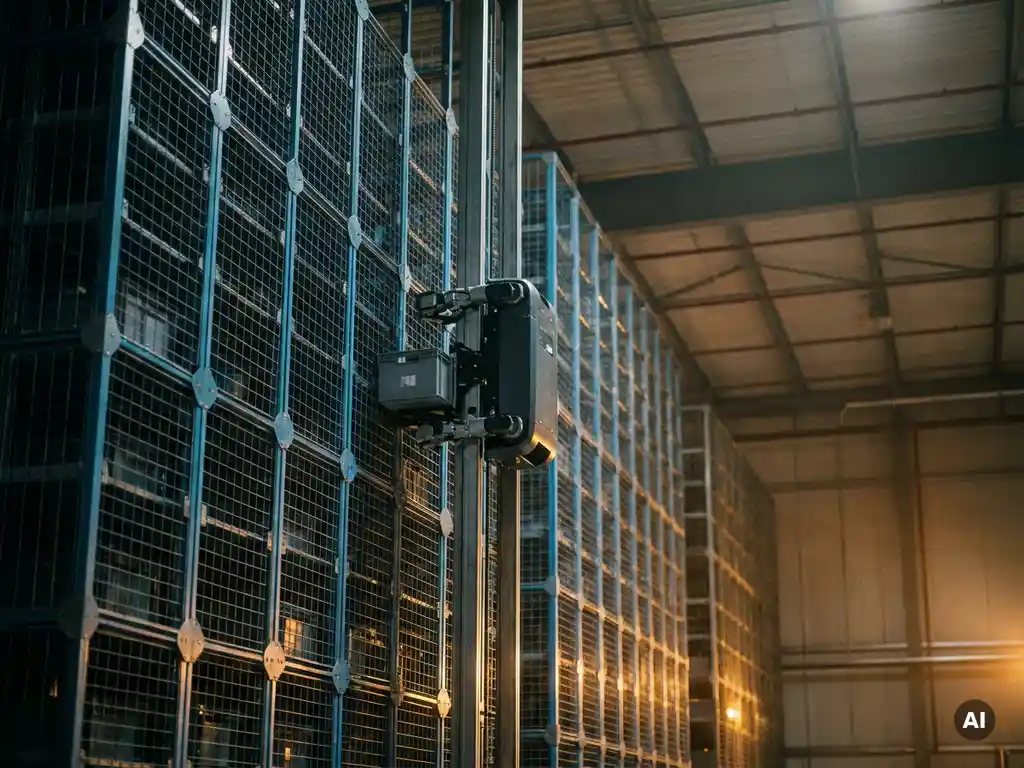
Goods-to-person automation is a warehouse fulfillment strategy where automated systems bring stored inventory directly to a stationary operator, rather than requiring workers to walk the warehouse floor to locate and retrieve items. The core mechanism relies on automated storage and retrieval systems that store totes or containers in a dense structure and deliver them on demand to ergonomic workstations. This approach is one of the most significant shifts in modern warehouse robotics, and the sections below answer the most common questions engineers and operations teams ask before evaluating or deploying a GTP system.
How does a goods-to-person system actually move inventory?
A goods-to-person system moves inventory by using autonomous robots or mechanical carriers to retrieve stored totes from a high-density storage structure and transport them to a fixed picking workstation. The operator waits at the station while the system handles all travel, retrieval, and return of the storage unit. Once the operator completes the pick, the tote is automatically returned to storage.
The exact mechanics vary by system type, but the core sequence follows the same logic: a warehouse management or control system receives an order, identifies the storage location of the required item, dispatches a retrieval unit, and routes the tote to the workstation. In advanced AS/RS designs, robots operate in parallel across the storage structure, meaning multiple orders can be processed simultaneously without one retrieval blocking another.
In systems like Hexxabotics, robots navigate horizontally beneath the storage grid to position themselves under the correct tower, then a detachable climber unit ascends vertically inside that tower to retrieve the tote. The deposit and retrieval happen in one continuous vertical cycle, eliminating empty return trips and keeping throughput high. Because every storage location is directly accessible, there is no reshuffling or digging through inventory to reach a specific tote.
What types of goods-to-person systems exist?
Goods-to-person systems fall into several distinct categories, each using a different storage and retrieval mechanism. The main types are shuttle-based AS/RS, cube storage systems, horizontal and vertical carousels, autonomous mobile robots with shelving, and vertical lift modules. Each type offers different trade-offs between storage density, throughput speed, and infrastructure complexity.
Shuttle-based AS/RS
Shuttle systems use rail-mounted robots that travel along aisles within a racking structure to retrieve totes or trays. They offer high throughput and are well suited to large SKU ranges, but the infrastructure is fixed and scaling throughput typically requires adding rails or lifts, which increases engineering complexity.
Cube and grid-based storage
Cube storage systems stack totes in a three-dimensional grid and use robots that travel across the top to retrieve containers. They achieve high density within a compact footprint but can require moving multiple totes to access one buried underneath, which introduces latency during peak demand periods.
Vertical lift modules and carousels
Vertical lift modules use a central extractor that travels between two facing columns of trays, retrieving the correct tray and presenting it at an opening at operator height. Horizontal carousels rotate a series of shelving pods to bring the correct shelf to the operator. Both are compact and effective for smaller SKU ranges but have limited throughput because a single mechanical core handles all retrieval.
AMR-based goods-to-person
Autonomous mobile robots can carry entire shelving pods to a picking station, effectively converting a conventional shelving layout into a goods-to-person workflow without fixed infrastructure. This approach offers flexibility and low deployment cost but keeps storage density relatively low compared to vertical AS/RS solutions.
What’s the difference between goods-to-person and person-to-goods picking?
The key difference is who or what does the traveling. In person-to-goods picking, a warehouse associate walks through aisles to locate and collect items, covering significant distances per shift. In goods-to-person automation, the storage system travels to the operator, who remains at a fixed workstation and focuses entirely on the pick action itself.
Person-to-goods picking is the traditional warehouse model. It requires minimal upfront investment but becomes increasingly inefficient as order volumes grow, SKU counts expand, and warehouse footprints increase. Walking time can account for a large proportion of total pick time, and error rates tend to rise under high-volume conditions.
Goods-to-person automation removes travel time from the equation entirely. Operators at GTP workstations can process significantly more picks per hour because every second is spent on value-adding activity. The trade-off is higher upfront capital expenditure and the need for system integration, but for warehouses handling sustained high order volumes, the productivity gains and error reduction typically justify the investment within a defined payback period.
What are the main benefits of goods-to-person automation?
The main benefits of goods-to-person automation are higher pick rates per operator, reduced labor costs, improved order accuracy, better use of vertical storage space, and greater resilience to labor market fluctuations. These advantages compound as order volumes increase, making GTP systems particularly valuable in high-throughput fulfillment environments.
- Increased pick productivity: Eliminating travel time means operators spend more time picking and less time walking, directly increasing units processed per hour per workstation.
- Reduced footprint: Dense vertical storage structures store far more SKUs within the same floor area than conventional shelving, freeing warehouse space for other operations.
- Improved accuracy: System-directed picking reduces the reliance on manual location scanning and human memory, lowering mispick rates.
- Scalable throughput: In distributed robotic systems, adding more autonomous units increases throughput without requiring structural changes to the storage infrastructure.
- Labor flexibility: GTP workstations are ergonomic and require less physical exertion, broadening the pool of workers who can operate effectively and reducing injury risk.
- Inventory control: Every tote movement is tracked by the control system, giving real-time visibility into stock levels and locations without manual cycle counting.
When does goods-to-person automation make sense for a warehouse?
Goods-to-person automation makes the most sense when a warehouse processes high daily order volumes, manages a large number of SKUs, faces consistent pressure on labor availability or cost, or needs to maximize storage density within a constrained footprint. The business case strengthens when any of these factors combine.
For operations with low order volumes or highly variable SKU profiles that change frequently, the upfront investment in a GTP system may not generate sufficient return quickly enough. But for e-commerce fulfillment, 3PL providers, pharmaceutical distribution, or retail replenishment operations where throughput demands are predictable and sustained, automated storage and retrieval deliver measurable efficiency gains from day one of operation.
The scalability of the chosen system also matters when evaluating timing. A GTP solution that requires structural redesign every time throughput needs to increase creates future constraints. Systems that separate storage capacity from throughput performance, allowing each to scale independently, give operations teams more control over long-term cost and flexibility. This is particularly relevant for fast-growing businesses that cannot afford operational downtime during expansion phases.
How does goods-to-person automation integrate with a warehouse management system?
Goods-to-person automation integrates with a warehouse management system through standard software interfaces, typically APIs or middleware layers, that allow the WMS to pass order data to the AS/RS control system and receive inventory updates in return. The WMS handles order logic and inventory ownership, while the automation control system manages robot coordination, location mapping, and tote routing.
In practice, the integration works as follows: the WMS receives an order, identifies which SKUs are required, and sends retrieval requests to the GTP system’s control layer. The control system dispatches robots, manages sequencing to avoid congestion, and confirms tote arrivals at the workstation. When the pick is confirmed, the control system updates inventory and returns the tote to storage, passing the transaction back to the WMS.
Most modern AS/RS platforms use open API standards, which simplifies connection to established WMS platforms without requiring custom development on either side. The depth of integration can vary, from basic tote-call requests to full bidirectional inventory synchronization with batch management, expiry date tracking, and zone-based slotting logic. For regulated industries such as pharma, the integration must also support traceability and audit trail requirements at the tote and batch level.
How Hexxabotics helps with goods-to-person automation
Hexxabotics delivers a next-generation automated storage and retrieval system built specifically for goods-to-person fulfillment environments that demand high density, direct access, and independently scalable performance. The system is designed to eliminate the trade-offs that limit conventional GTP solutions.
- 100% direct tote access: Every storage location is reachable without digging or reshuffling, so retrieval time stays consistent regardless of where a tote is stored.
- Independent capacity and throughput scaling: Extend the hexagonal tower structure to add storage locations; add Hexxabots to increase throughput. Neither change requires rebuilding the other.
- Up to 16 meters of vertical density: The self-supporting hexagonal structure converts full building height into usable storage without embedded electronics or powered racks in the structure itself.
- No in-rack electrification: Robots charge during operation and carry all active components, simplifying maintenance, reducing failure points, and lowering total cost of ownership.
- Standard API integration: The Hexxabotics Control System connects to existing WMS platforms through open interfaces, reducing integration effort for system integrators and end-user operations teams.
If you are evaluating goods-to-person automation for a new or existing warehouse, explore how the Hexxabotics AS/RS system can fit your throughput and density requirements by visiting hexxabotics.com.
Related Articles
- How does warehouse automation change the role of warehouse managers?
- What is an autonomous mobile robot used for in logistics?
- Why are fulfillment centers moving toward fully automated operations?
- How does AS/RS infrastructure work alongside AMRs?
- When should a 3PL provider invest in automated fulfillment systems?