
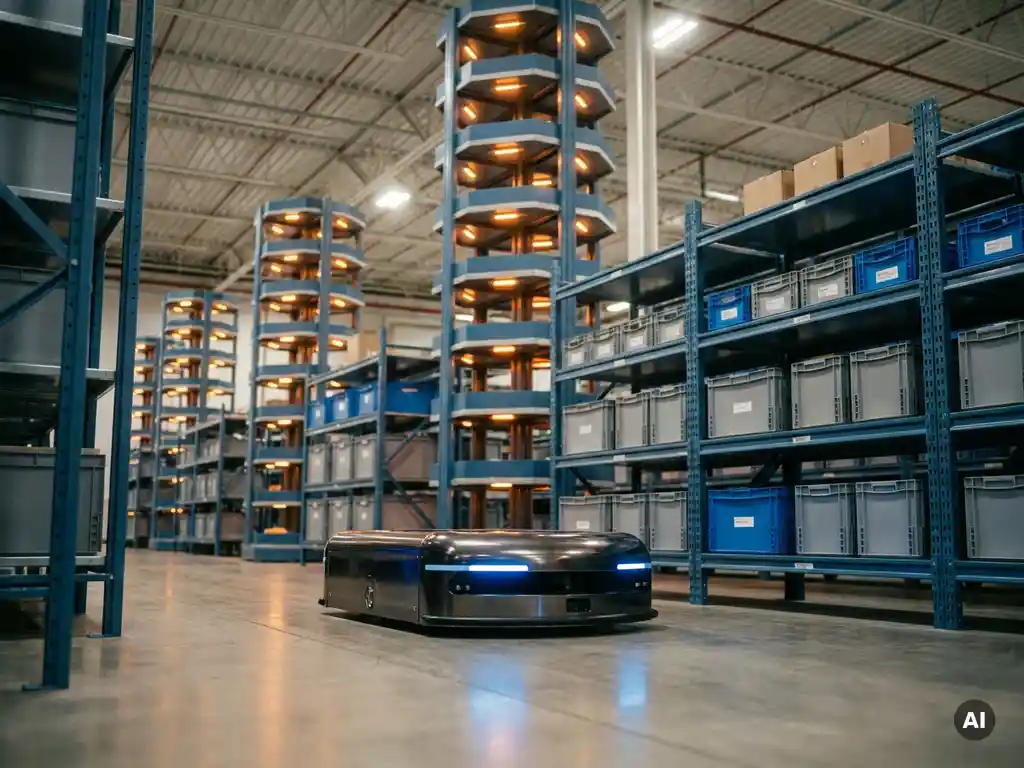
An autonomous mobile robot (AMR) in logistics is used to move goods, totes, or inventory autonomously through a warehouse without requiring fixed tracks or human guidance. AMRs use onboard sensors, cameras, and software to navigate dynamically, making them far more flexible than older conveyor- or rail-based systems. This article covers how AMRs navigate, what tasks they handle, how they compare to AGVs, and when they make sense for your operation.
How do autonomous mobile robots navigate a warehouse?
Autonomous mobile robots navigate warehouses using a combination of onboard sensors, real-time mapping, and intelligent path-planning software. Unlike fixed automation, AMRs build a live map of their environment and continuously update it, allowing them to reroute around obstacles, people, and changing floor conditions without stopping the operation.
Most AMRs rely on a technology called SLAM (Simultaneous Localization and Mapping), which allows the robot to determine its own position while building a map of its surroundings. This is typically supported by LiDAR sensors, depth cameras, and sometimes infrared or ultrasonic proximity detection. The result is a robot that understands where it is, what is around it, and how to reach its destination efficiently.
Path planning adds another layer of intelligence. The robot does not simply follow a predetermined route. It calculates the most efficient path in real time, weighing factors like distance, traffic from other robots, and task priority. When multiple AMRs operate in the same space, a fleet management layer coordinates their movements to prevent congestion and maximize throughput across the warehouse floor.
What tasks do autonomous mobile robots perform in logistics?
In logistics, autonomous mobile robots perform a wide range of material handling tasks, including inventory transport, order-picking support, goods-to-person delivery, replenishment, and sortation. Their core function is to move items between locations within a warehouse faster and more reliably than manual labor, while reducing the physical demands placed on warehouse staff.
The most common AMR use case is goods transport: moving totes, bins, shelves, or pallets from one zone to another. In an e-commerce fulfillment center, for example, AMRs might carry shelving units directly to a pick station, eliminating the need for workers to walk long distances across the floor. This goods-to-person model significantly reduces pick cycle times and improves throughput per operator hour.
Beyond transport, AMRs contribute to several other logistics workflows:
- Order-picking support: Robots follow pickers through aisles or bring goods directly to stationary pick stations
- Inventory replenishment: Robots move stock from receiving areas to storage locations automatically
- Sortation: AMRs route packages or totes to the correct outbound lanes or dispatch zones
- Returns processing: Robots transport returned items from intake areas to inspection or restocking zones
- Cycle counting: Some AMRs carry scanning hardware to audit inventory locations without halting operations
The breadth of these applications makes AMRs one of the most versatile tools in warehouse automation today, applicable across e-commerce, retail, pharma, FMCG, and 3PL environments.
What’s the difference between an AMR and an AGV?
The key difference between an AMR and an AGV (Automated Guided Vehicle) is how they navigate. AGVs follow fixed paths defined by magnetic tape, wires, or reflective markers embedded in the floor. AMRs navigate dynamically using sensors and software, with no physical infrastructure required to guide their movement.
This distinction has significant practical consequences for warehouse operators. AGVs are highly reliable along their defined routes but inflexible when the environment changes. Moving an AGV’s path requires physical modification to the floor or guidance system, which is time-consuming and disruptive. AMRs, by contrast, can be redirected through software alone, making them far easier to redeploy as operational needs evolve.
Infrastructure requirements
AGVs require dedicated floor infrastructure, which means installation is more complex and relocation is costly. AMRs need only a Wi-Fi network and a configured digital map of the space. This lower infrastructure dependency makes AMRs more suitable for warehouses that change layouts regularly or operate in leased facilities.
Obstacle handling
AGVs typically stop when they detect an obstacle in their path and wait for it to clear. AMRs actively reroute around obstacles in real time, maintaining flow even in busy, unpredictable environments. In high-traffic warehouses with human workers present, this behavioral difference is a meaningful operational advantage.
That said, AGVs retain advantages in highly structured, repetitive environments where the route never changes and maximum load capacity or precision is required. For most modern logistics operations, however, the flexibility of AMRs makes them the more adaptable choice.
How do AMRs integrate with warehouse management systems?
AMRs integrate with warehouse management systems (WMS) through standard APIs and middleware layers that allow the WMS to assign tasks, share inventory data, and receive status updates from the robot fleet in real time. This integration is what transforms individual robots into a coordinated, intelligent fulfillment operation rather than a collection of isolated machines.
In practice, the WMS acts as the source of operational truth. It holds order data, inventory locations, and fulfillment priorities. When an order is released, the WMS communicates task instructions to a fleet management system or robot control layer, which translates those instructions into specific robot movements and sequences. The robots execute the tasks and report completion back to the WMS, keeping inventory records accurate.
Most AMR vendors provide REST API interfaces or support standard integration protocols, which simplifies connection to common WMS platforms. Some operations also use an intermediate warehouse execution system (WES) to manage real-time task orchestration between the WMS and the robot fleet, particularly in high-volume environments where order priorities shift frequently throughout the day.
The quality of this integration directly determines how much value the AMR system delivers. Robots that operate in isolation from inventory data create reconciliation problems. Robots that are tightly integrated with the WMS can dynamically reprioritize tasks based on order urgency, carrier cutoff times, and real-time stock availability.
What are the limitations of autonomous mobile robots in logistics?
The main limitations of autonomous mobile robots in logistics include constrained payload capacity, sensitivity to environmental conditions, high upfront cost, and relatively low storage density compared to vertical AS/RS systems. Understanding these constraints helps warehouses deploy AMRs in roles where they genuinely outperform alternatives rather than applying them universally.
Most floor-based AMRs are optimized for horizontal movement across a flat warehouse floor. They do not utilize vertical space effectively. A warehouse relying solely on AMRs for storage and retrieval will typically need significantly more floor area than one using a high-density vertical system, because AMRs work with shelving or rack systems that cap out at reachable heights. For operations where space is the primary constraint, this is a meaningful limitation.
Other notable limitations include:
- Environmental sensitivity: AMRs can struggle with highly reflective floors, poor lighting, narrow aisles, or cluttered environments that interfere with sensor accuracy
- Payload limits: Most AMRs are designed for tote- or shelf-level loads, not heavy pallets, which limits their applicability in bulk or heavy goods operations
- Traffic management complexity: As fleet size grows, coordinating dozens of robots in a shared space requires sophisticated software and careful layout planning
- Battery management: Charging schedules must be planned carefully to avoid throughput gaps during peak periods
- Integration effort: Connecting AMRs to existing WMS and ERP systems requires technical investment that should not be underestimated
None of these limitations make AMRs unsuitable for logistics. They do, however, highlight that AMRs work best as part of a broader automation strategy rather than as a standalone solution for every warehouse challenge.
When should a warehouse consider autonomous mobile robots?
A warehouse should consider autonomous mobile robots when it needs to increase throughput or reduce labor costs without committing to fixed infrastructure, when floor layouts change frequently, or when order volumes have grown beyond what manual picking can sustainably handle. AMRs are particularly well suited to operations with high SKU counts, variable order profiles, and a need for flexible deployment.
The clearest signal that AMRs are worth evaluating is when walking distance is consuming a significant portion of picker time. In large fulfillment centers, workers can travel many kilometers per shift just moving between pick locations and pack stations. AMRs that bring goods to stationary workers eliminate this wasted movement and can dramatically increase picks per hour without adding headcount.
AMRs also make strong sense when a warehouse needs to scale quickly. Because they require no floor modifications, a fleet can be expanded by simply adding units and updating the fleet management software. This contrasts with fixed conveyor or rail systems, where expanding capacity requires structural changes that take months and significant capital.
However, warehouses with very high storage density requirements, limited floor space, or the need to utilize full building height may find that AMRs alone are insufficient. In those cases, combining AMRs with vertical storage systems or AS/RS technology delivers a more complete solution.
How Hexxabotics helps with autonomous warehouse operations
Hexxabotics addresses the storage density limitations that floor-based autonomous mobile robots cannot solve on their own. Where AMRs excel at horizontal movement, the Hexxabotics system converts full cubic warehouse volume into directly accessible storage using a hexagonal vertical grid and autonomous Hexxabots. The result is a system that delivers both the throughput flexibility of autonomous robotics and the density of a high-bay AS/RS, without the infrastructure complexity of traditional solutions.
- Up to 16 meters of vertical storage with every tote location directly accessible, no reshuffling required
- Independent scalability of capacity and throughput: add towers to increase storage, add robots to increase pick rate
- No in-rack electrification, reducing energy consumption, maintenance complexity, and installation cost
- Standard API integration with existing WMS platforms, making deployment straightforward for operations already running warehouse management software
- Distributed robot operation eliminates single points of failure, maintaining stable throughput even during peak demand
For warehouses evaluating logistics robots and looking beyond floor-level AMR solutions, Hexxabotics offers a scalable path to high-density, high-throughput automation. Explore the Hexxabotics system to see how the architecture fits your operation.
Related Articles
- What are the data integrity requirements for pharmaceutical warehouse systems?
- How do you validate a temperature-mapping study in a pharmaceutical warehouse?
- What is the impact of floor flatness on automated warehouse systems?
- What are the long-term operational costs of warehouse automation?
- Can warehouse automation lower your energy consumption?