
Validating a temperature-mapping study in a pharmaceutical warehouse requires executing a documented, risk-based protocol that places calibrated sensors at scientifically justified locations throughout the storage area, runs continuously for a defined period under representative conditions, and produces a complete data package demonstrating that every zone consistently meets the required temperature specification. The WHO, EU GDP guidelines, and national competent authorities all require this evidence before a facility can be approved for temperature-sensitive pharmaceutical storage. The sections below unpack the key questions practitioners ask when designing, executing, and maintaining a compliant temperature-mapping programme.
What regulatory standards govern pharmaceutical temperature-mapping validation?
Temperature-mapping validation in pharmaceutical warehouses is governed primarily by the EU Good Distribution Practice (GDP) guidelines (2013/C 343/01), WHO Technical Report Series guidelines on storage and distribution, and national competent authority requirements such as those issued by the MHRA in the UK or EMA-aligned bodies across Europe. In the United States, FDA 21 CFR Part 211 and USP Chapter 1079 provide the principal framework. All of these standards share a common requirement: documented evidence that storage conditions remain within specification across the entire storage area.
GDP guidelines require that temperature-controlled storage areas undergo mapping before use and after any significant change that could affect temperature distribution. The WHO guidelines add specific guidance on sensor placement, study duration, and the treatment of worst-case conditions such as summer and winter extremes. USP 1079 provides practical methodology for sensor density, qualification of monitoring equipment, and data review criteria.
Beyond these primary sources, GxP principles apply broadly. This means the study must be planned with a written protocol, executed according to that protocol, and concluded with a formal report. Any deviation from the protocol must be documented and assessed. Regulatory inspectors will expect to see the full data trail, not just a summary table, so raw sensor data, calibration certificates, and the signed protocol and report are all essential components of a compliant validation package.
How many sensors are required for a valid temperature-mapping study?
There is no single universal number mandated by regulation, but the WHO guidelines and EU GDP guidance both require that sensors be placed at sufficient locations to characterise the temperature distribution across the entire storage volume, including identified risk points. In practice, this means covering all four corners of the storage area, the geometric centre, areas near doors, heating or cooling units, and any location identified by risk assessment as potentially problematic.
The WHO guidelines suggest a minimum of one sensor per 10 to 25 cubic metres in small rooms, with sensor density reducing proportionally as volume increases, though risk assessment can justify higher density in complex environments. For large pharmaceutical distribution warehouses, this can translate to dozens or even hundreds of sensors depending on the layout.
Risk-based sensor placement
Sensor positions should be determined by a documented risk assessment rather than by applying a fixed formula mechanically. The risk assessment should consider airflow patterns, proximity to external walls and loading bays, the position of HVAC outlets and returns, areas of low air circulation, and locations where product is most likely to be stored for extended periods. Identified high-risk zones typically require additional sensors even if the volumetric calculation would not demand them.
Sensor calibration requirements
Every sensor used in the study must carry a current calibration certificate traceable to a national or international measurement standard. Calibration should be performed before the study and, for extended studies, verified afterwards. Any sensor found to be out of specification on a post-study calibration check requires a documented investigation to determine whether the data collected by that sensor remains valid or must be treated as suspect.
How long should a temperature-mapping study run?
A temperature-mapping study should run for a minimum of 24 hours under steady-state conditions according to most regulatory guidance, but studies of 72 hours or longer are common in practice and are often expected by regulatory inspectors for larger or more complex storage areas. The study must capture representative operational conditions, including door openings, loading and unloading activities, and HVAC cycling patterns.
EU GDP guidance and WHO recommendations both emphasise that mapping must be performed under worst-case seasonal conditions, which means a single study conducted in mild weather is unlikely to be sufficient on its own. Most pharmaceutical warehouses conduct at least two mapping exercises: one during the warmest period of the year and one during the coldest. Some organisations conduct quarterly studies during the initial qualification phase before transitioning to an annual or change-triggered programme.
The data logging interval also matters. Sensors should record at intervals short enough to detect transient excursions that might otherwise be missed. Intervals of five to fifteen minutes are typical, though high-risk areas or areas with rapid temperature fluctuation may justify shorter intervals. The combination of study duration and logging frequency determines the total volume of data that must be reviewed and archived.
What data must be documented to pass a temperature-mapping validation?
A complete temperature-mapping validation package must include a pre-approved written protocol, calibration certificates for all sensors, raw data files from every sensor for the full duration of the study, a signed deviation log, statistical analysis of the temperature distribution, identification of hot and cold spots, and a formal validation report concluding whether the storage area meets its defined specification.
The protocol must be approved before the study begins and must specify acceptance criteria in advance. Defining acceptance criteria after seeing the data is a serious GxP violation that will draw regulatory criticism. Acceptance criteria typically state the permitted temperature range, the maximum excursion duration that will be treated as acceptable, and the statistical approach used to evaluate compliance across all sensor locations.
The validation report must be signed by qualified personnel and must reference the protocol, the raw data, all deviations, and the conclusions drawn. It should explicitly state whether the storage area is approved for use, identify any zones that must be excluded from product storage, and specify any operational controls such as maximum door-open times or minimum air circulation requirements that are required to maintain validated conditions. This report then forms part of the facility’s quality management documentation and must be available for regulatory inspection.
What causes a temperature-mapping study to fail or be rejected?
A temperature-mapping study fails when sensor data shows that one or more locations within the storage area consistently exceed the permitted temperature range, when the study was not conducted under representative worst-case conditions, when protocol deviations were not properly documented and assessed, or when calibration records are incomplete or out of specification. Regulatory inspectors may also reject a study if the protocol was not approved before execution or if acceptance criteria appear to have been set after reviewing the results.
Common technical causes of failure include inadequate HVAC capacity or distribution, poor airflow near external walls or loading bays, temperature stratification in high-ceilinged warehouses where warm air accumulates near the roof, and thermal bridging through poorly insulated sections of the building envelope. Areas near frequently opened doors are a persistent challenge, particularly in ambient warehouses where external temperature extremes can cause rapid localised excursions.
Procedural failures are equally common. These include using sensors whose calibration had lapsed before the study, failing to document operational activities such as door openings during the study period, conducting the study during an atypically mild period that does not represent seasonal extremes, and failing to obtain protocol approval signatures before commencing data collection. Any of these procedural gaps gives a regulatory inspector grounds to question the validity of the entire dataset, even if the temperature data itself would otherwise be acceptable.
When does a validated temperature-mapping study need to be repeated?
A temperature-mapping study must be repeated after any change that could materially affect temperature distribution within the storage area. This includes changes to the HVAC system, modifications to the building fabric such as new doors or insulation, significant changes to storage layout or racking configuration, expansion of the storage area, and changes to the products stored if those products have different temperature requirements. Most regulatory frameworks also require periodic revalidation on a risk-based schedule, typically annually.
EU GDP guidelines specifically require that temperature mapping be reviewed and repeated where necessary following significant changes. The definition of significant is left to the quality system, which is why a change-control procedure that triggers a mapping review is essential. Any HVAC maintenance, equipment replacement, or building modification should automatically generate a change-control record that is assessed for its potential impact on the validated temperature profile.
Seasonal requalification is also a practical requirement even when no physical changes have occurred. A warehouse validated in winter may not meet specification during a summer heatwave, and vice versa. Continuous temperature monitoring data from the permanent monitoring system can provide early warning of drift, but it does not replace the formal mapping exercise, which uses a denser sensor array and a more rigorous data review process than routine monitoring.
How Hexxabotics supports pharmaceutical storage compliance
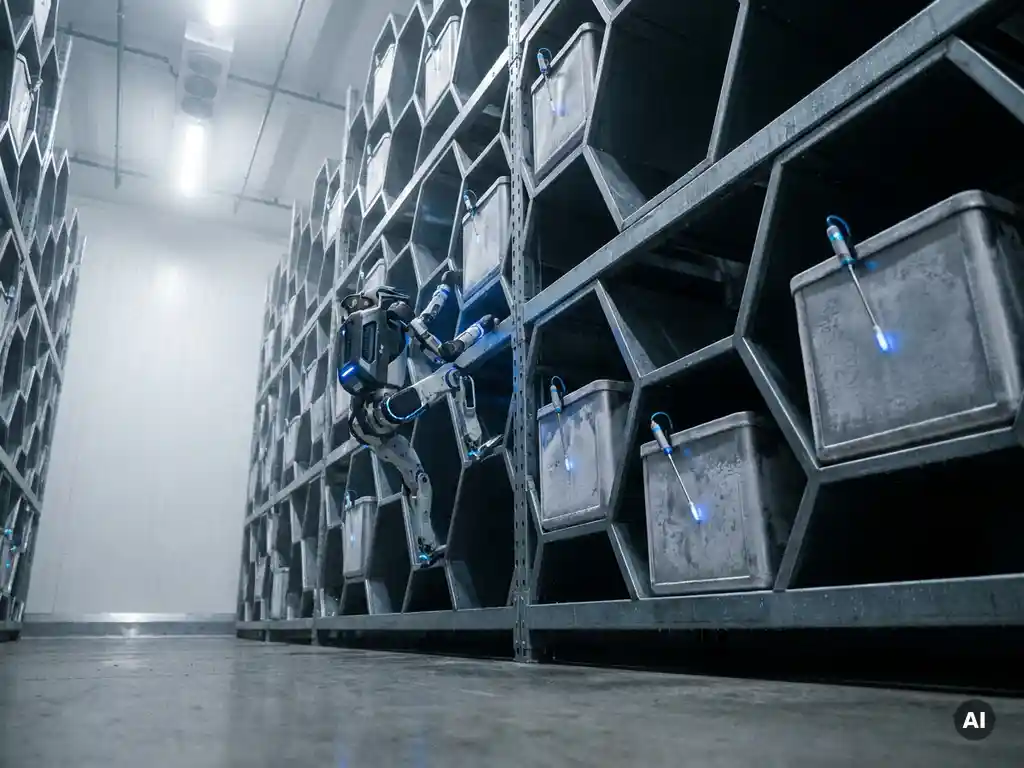
Temperature-mapping validation establishes that a storage environment meets specification. The next challenge is ensuring that every product, lot, and tote within that environment is handled with the precision and traceability that pharmaceutical regulations demand. Hexxabotics addresses this operational layer directly through its high-density AS/RS architecture, which is designed for pharmaceutical distribution and fulfilment environments where batch control, inventory accuracy, and reliable retrieval are non-negotiable.
- Direct-access retrieval: Every tote and lot is individually retrievable without digging through stacks, eliminating the inventory reshuffling that can compromise batch integrity and traceability records.
- Software-managed inventory control: The Hexxabotics Control System manages retrieval logic at the tote level, supporting the kind of digitally traceable inventory movements that pharmaceutical operations require.
- Compact, high-density footprint: By utilising full building height up to 16 metres through a hexagonal vertical grid, the system maximises storage within a validated temperature-controlled envelope rather than expanding the footprint and the mapping scope.
- Independent capacity and throughput scaling: Storage capacity and throughput can be scaled separately, allowing pharmaceutical operations to grow without triggering unnecessary infrastructure changes that would require full revalidation.
- Integration with WMS and orchestration layers: Standard APIs connect the system to existing warehouse management and execution systems, supporting the end-to-end inventory control and documentation that GDP compliance requires.
If you are evaluating automated storage solutions for a pharmaceutical distribution or fulfilment environment and want to understand how a high-density AS/RS can support your compliance and operational objectives, contact the Hexxabotics team to discuss your specific requirements.
Related Articles
- What are the data integrity requirements for pharmaceutical warehouse systems?
- What are the most common reasons pharmaceutical warehouses fail inspections?
- What is cross-docking and how does it influence warehouse design?
- Should you lease or buy warehouse automation equipment?
- What is the difference between fixed automation and flexible automation?