
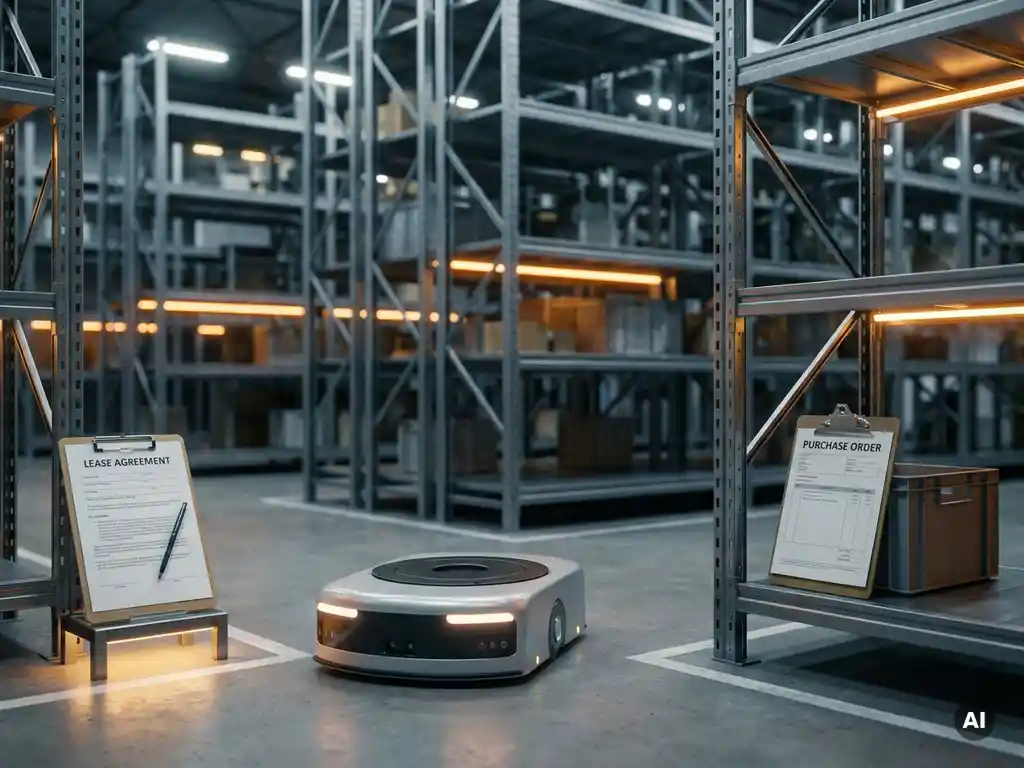
Whether to lease or buy warehouse automation equipment depends primarily on your capital position, operational timeline, and how predictable your throughput requirements are. Buying typically delivers better long-term ROI for stable, high-volume operations, while leasing preserves cash flow and reduces risk when demand is uncertain or growth is rapid. The sections below break down each dimension of this decision, from upfront costs to scalability considerations.
What are the main costs involved in warehouse automation equipment?
Warehouse automation equipment carries four primary cost categories: capital expenditure for hardware and installation, software licensing and integration fees, ongoing maintenance and support contracts, and operational costs such as energy consumption and consumables. Understanding all four is essential before comparing lease versus buy scenarios, because the total cost of ownership often looks very different from the sticker price.
Hardware is typically the largest single line item. A full automated storage and retrieval system includes the structural framework, autonomous robot units, totes or carriers, and workstation infrastructure. Installation and commissioning add further costs that are easy to underestimate, particularly when building modifications or floor reinforcement are required.
Software and integration represent a second layer that buyers frequently overlook. Warehouse management system integration, API configuration, and control system licensing can add meaningful cost to any AS/RS deployment. Ongoing software maintenance, version upgrades, and support contracts continue for the life of the system.
Maintenance costs vary significantly by system architecture. Systems with embedded motors, powered racks, or centralized lifting mechanisms carry higher long-term maintenance obligations because more mechanical components can fail. Designs that eliminate in-rack electrification and rely on distributed autonomous units rather than centralized cranes tend to reduce both failure frequency and repair complexity, which directly affects your total cost of ownership calculation.
What does leasing warehouse automation equipment actually include?
A warehouse automation lease is a financing arrangement in which a vendor or third-party lender retains ownership of the equipment while the operator pays a fixed periodic fee for the right to use it. Most leases for AS/RS and robotic systems bundle hardware, installation, and a maintenance or service level agreement into a single monthly or annual payment, though the exact scope varies considerably by vendor and contract structure.
Understanding what a lease actually covers requires reading the contract carefully. Common inclusions are:
- Hardware supply, delivery, and installation
- Commissioning and initial system configuration
- Software licensing for the control system and WMS integration layer
- Scheduled preventive maintenance visits
- Remote monitoring and technical support
- Hardware replacement or repair within defined service levels
Common exclusions include consumables such as totes or labels, operator training beyond an initial onboarding period, major infrastructure modifications to the building, and costs associated with system relocation if you move facilities. Some leases also exclude software upgrades beyond the version installed at commissioning, which can become a significant hidden cost over a multi-year term.
The lease term itself matters enormously. Short-term operating leases of two to three years offer maximum flexibility but carry higher monthly payments. Capital leases or finance leases over five to seven years reduce monthly outlay but commit you to the technology for longer, which introduces technology obsolescence risk as the automation market continues to evolve rapidly in 2026.
What are the financial advantages of buying automation equipment outright?
Buying warehouse automation equipment outright eliminates recurring lease payments and delivers full ownership of an asset that depreciates over time but continues to generate operational value. For operations with stable, long-term throughput requirements, the net present value of ownership almost always exceeds that of leasing over a horizon of seven years or more.
The primary financial advantages of purchasing include:
- No ongoing financing cost: Once capital is deployed, there are no interest charges or lease margins embedded in your payments. You pay the asset cost once.
- Depreciation tax benefits: Owned equipment can be depreciated on your balance sheet, providing tax deductions that reduce the effective cost of the investment.
- Asset equity: The system retains residual value. If operational needs change, owned equipment can be sold, relocated, or reconfigured without lease termination penalties.
- Vendor independence: Ownership removes the risk that a vendor changes lease terms, exits the market, or raises service costs at renewal.
- Lower total cost over time: When you model the full lifecycle cost, the cumulative lease payments on a seven-to-ten-year horizon typically exceed the purchase price plus maintenance by a meaningful margin.
Purchasing also gives you greater control over maintenance strategy. You can negotiate service contracts independently, bring maintenance in-house as your team builds expertise, or switch service providers if performance is unsatisfactory. Lease agreements often lock you into the vendor’s own service organization, which limits competitive pressure on service pricing.
When does leasing warehouse automation make more financial sense?
Leasing warehouse automation equipment makes more financial sense when capital preservation is a priority, when operational requirements are likely to change significantly within three to five years, or when your organization lacks the technical resources to manage a complex automation system independently. For high-growth operations, 3PL providers with variable client contracts, or companies entering automation for the first time, leasing can be the strategically correct choice even if it costs more in absolute terms.
Capital constraints and balance sheet management
Automation systems represent substantial capital expenditure. For many mid-market operators, deploying that capital in a single purchase competes directly with other investment priorities such as inventory, facility expansion, or commercial growth. A lease converts a large capital outlay into a predictable operating expense, which can improve reported return on assets and preserve credit lines for other uses. CFOs in capital-intensive industries often prefer operating lease treatment for exactly this reason.
Operational uncertainty and flexibility needs
If your warehouse footprint, product mix, or throughput volumes are likely to shift materially within the next few years, owning a large fixed automation system introduces relocation and reconfiguration risk. Leasing transfers some of that risk back to the vendor. This is particularly relevant for 3PL operators whose client contracts may not extend beyond two or three years, or for retailers navigating significant channel shifts between in-store and e-commerce fulfillment.
How does scalability affect the lease-or-buy decision?
Scalability is one of the most consequential factors in the lease-or-buy decision because it determines whether your initial investment remains fit for purpose as your business grows. Systems that require significant structural redesign to scale throughput or capacity create a financial problem regardless of whether you own or lease them. Systems that scale by adding modular units or additional robots change the economics substantially in favor of ownership.
Traditional AS/RS architectures link storage capacity and throughput performance to the same physical infrastructure. Adding capacity or throughput often means rebuilding or extending the core structure, which generates a new capital event whether you own or lease. This structural dependency makes long-term ownership planning difficult and can make leasing more attractive simply because it shifts redesign risk to the vendor.
More modern architectures separate capacity from throughput. When a system allows you to increase storage by extending the structure and increase throughput by adding autonomous robot units independently, the ownership case strengthens considerably. You can make incremental investments over time rather than facing a single large reinvestment cycle. The ability to scale during live operations without stopping daily processes further reduces the operational disruption cost that often accompanies scaling decisions.
Before committing to either acquisition model, confirm with any vendor how their system scales in practice. Ask specifically whether adding throughput requires structural changes, whether scaling can happen during live operations, and what the per-unit cost of additional capacity or robot units looks like at different scale points.
What questions should you ask a warehouse automation vendor before deciding?
Before choosing between leasing and buying warehouse automation equipment, you should ask vendors a structured set of questions covering total cost of ownership, contract flexibility, scalability mechanics, maintenance obligations, and technology roadmap. The answers will reveal whether the vendor’s commercial model aligns with your operational strategy and financial constraints.
Key questions to put to any automation vendor include:
- What is the full total cost of ownership over seven and ten years, including maintenance, software, and support? Ask for a detailed breakdown, not a headline figure.
- If I lease, what happens at the end of the term? Understand your options: renewal, purchase, return, or upgrade. Know the residual value assumptions built into the contract.
- How does the system scale, and what does scaling cost? Establish whether adding capacity or throughput requires structural redesign, and what the incremental unit economics look like.
- What is included in the maintenance contract, and what is excluded? Clarify response times, parts coverage, and what constitutes a chargeable event.
- Can the system be relocated or reconfigured if my operational needs change? This matters both for leased and owned systems.
- What is your software upgrade and technology roadmap policy? Understand whether future software versions are included in the contract or priced separately.
- What are the single points of failure in the system, and how does the architecture handle them? Distributed systems without centralized cranes or fixed vertical conveyors carry fundamentally different reliability profiles than centralized architectures.
- What financing structures do you offer, and can they be structured as operating leases for accounting purposes?
The quality of a vendor’s answers to these questions tells you as much about their commercial maturity as it does about their technology. Vendors who can answer clearly and with specific numbers are typically more reliable long-term partners than those who redirect to sales materials.
How Hexxabotics helps with warehouse automation financing decisions
Hexxabotics is built around an architecture that makes the lease-or-buy calculation more straightforward than it is with traditional AS/RS systems. Key characteristics that directly affect your acquisition decision include:
- Independent scalability: Storage capacity and throughput scale separately. You add towers to grow capacity and add Hexxabots to grow throughput, with no structural redesign required. This removes the forced reinvestment cycle that makes long-term ownership planning difficult.
- No in-rack electrification: The passive steel structure contains no embedded motors, powered racks, or fixed lifting systems. Maintenance obligations are lower and more predictable, which improves total cost of ownership modeling for both owned and leased scenarios.
- Modular, relocatable design: The system can be reconfigured and relocated without rebuilding from scratch, reducing the risk that ownership locks you into a single facility or layout.
- Distributed resilience: No single point of failure means throughput remains stable even if individual robot units require servicing, which reduces the operational downside risk of ownership.
If you are evaluating how these characteristics map to your specific capital structure and throughput requirements, the Hexxabotics team can walk through the numbers with you directly. Contact us to start a conversation about system configuration, financing options, and total cost of ownership for your operation.
Related Articles
- How do you train warehouse staff on pharmaceutical compliance requirements?
- What is direct-access storage and how does it support drug recalls?
- What is the difference between forward pick areas and reserve storage in a warehouse?
- What are the long-term operational costs of warehouse automation?
- How do robots and human workers collaborate in hybrid warehouses?