
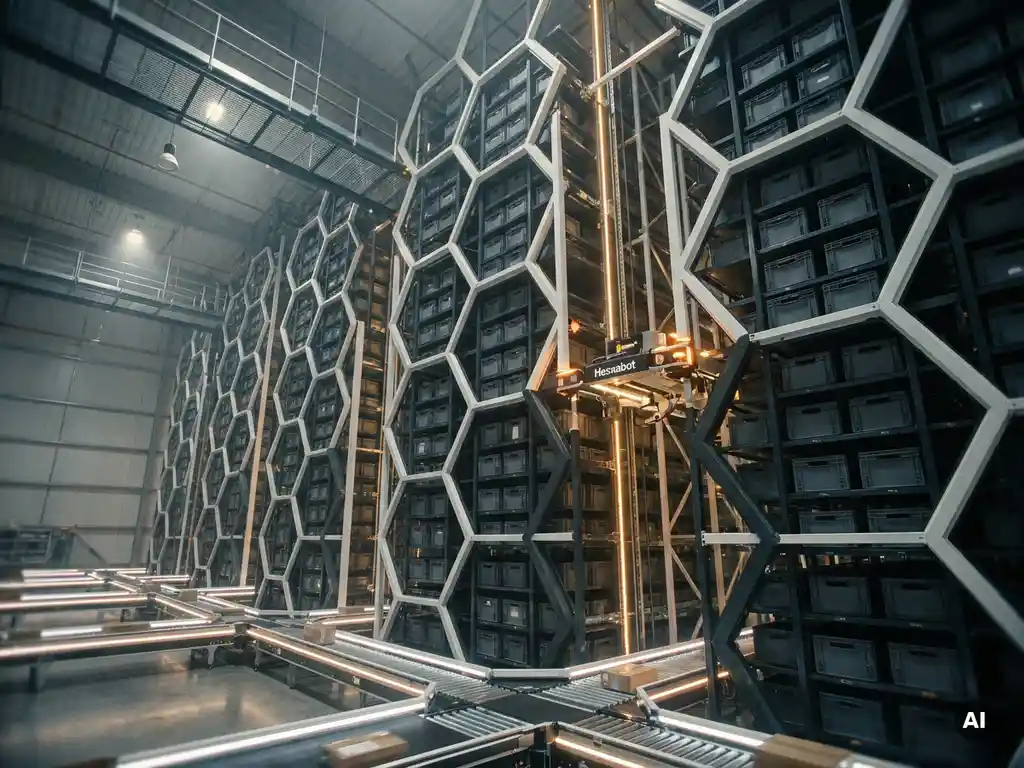
Designing a warehouse for omnichannel fulfillment in 2026 means building a single operation that can simultaneously serve retail replenishment, direct-to-consumer e-commerce, and every channel in between, each with different order profiles, service levels, and packaging requirements. The core design principle is to separate storage capacity from throughput flexibility, so the warehouse can scale each dimension independently as channel mix shifts. The sections below work through the specific questions that determine whether an omnichannel warehouse design succeeds or stalls.
What makes omnichannel fulfillment so hard to design a warehouse for?
Omnichannel fulfillment is difficult to design a warehouse for because it forces a single physical operation to serve fundamentally different order types at the same time. A retail replenishment order might call for 200 units of one SKU on a pallet. A direct-to-consumer order placed minutes later might call for three different SKUs in a single parcel, picked, packed, and shipped within hours. The same inventory, the same building, two completely different fulfillment logics running in parallel.
The underlying tension is structural. Traditional warehouse design optimizes for one primary flow, either bulk outbound or piece-pick. Omnichannel demands both. This creates pressure across every dimension of the operation:
- SKU variety: Omnichannel assortments tend to be wider, because direct-to-consumer channels carry long-tail products that retail channels would never stock on a shelf
- Order size variability: Order quantities range from single units to full pallets, making standard slotting logic difficult to apply uniformly
- Service level divergence: Same-day or next-day consumer expectations sit alongside weekly retail replenishment cycles, requiring different picking speeds from the same inventory pool
- Labor intensity: Piece-picking for e-commerce is significantly more labor-intensive per unit than case-picking for retail, and the two demands often peak at the same time
- Space inefficiency: Layouts designed for forklift access and bulk storage leave too much floor space in aisles and too little usable cubic volume for the dense, granular storage that omnichannel SKU breadth requires
The result is that warehouses designed for a single channel typically underperform on at least one dimension when omnichannel volume grows. The design challenge is not simply adding more space; it is rethinking how storage, retrieval, and order flow are organized from the ground up.
How is a 2026 omnichannel warehouse different from a 2020 one?
The most significant shift between 2020 and 2026 in omnichannel warehouse design is the move from automation islands to coordinated fulfillment architectures. In 2020, many operations added automation incrementally, a goods-to-person system here, a conveyor sorter there, without integrating those systems into a single orchestrated flow. In 2026, the expectation is that every automation zone is coordinated by a warehouse execution layer that routes orders intelligently across technologies.
Several other structural differences define the 2026 omnichannel warehouse design benchmark:
Cubic space replaces floor space as the primary metric. With urban land costs rising and building expansion increasingly constrained, operations now design vertically. Systems that can use the full building height, reaching up to 16 meters in some AS/RS configurations, deliver meaningfully more storage from the same footprint.
SKU behavior drives allocation decisions, not fixed ABC categories. Static velocity classifications were adequate when assortments were stable. In 2026, demand patterns shift faster, driven by promotions, product launches, and channel mix changes, so the most competitive operations use analytics to reassign SKUs between automation zones as behavior changes, rather than locking products into fixed locations for the life of the installation.
Capacity and throughput are designed to scale independently. Earlier systems often coupled storage volume and picking speed in the same infrastructure, meaning that adding capacity also meant redesigning throughput, and vice versa. Modern omnichannel warehouse design separates these dimensions so operators can extend storage without touching robot counts, or add throughput without restructuring the rack.
Integration standards have matured. In 2026, warehouse management systems, execution systems, and robotic platforms communicate through standardized APIs and open protocols, reducing the custom engineering burden that made earlier omnichannel integrations expensive and fragile.
What storage system works best for omnichannel SKU variety?
For omnichannel SKU variety, a direct-access three-dimensional Automated Storage and Retrieval System (AS/RS) performs best because it provides high storage density without forcing a trade-off between SKU breadth and retrieval speed. Unlike systems that require reshuffling inventory to reach a stored tote, a direct-access architecture makes every location independently reachable, which is critical when the assortment includes thousands of slow-moving or irregular SKUs alongside fast-moving staples.
The key requirement for omnichannel storage is that the system handles SKU variety without penalizing retrieval time for less frequently ordered products. In a conventional dense storage system, deep-lane or stacked configurations require moving other inventory to reach a required tote, a process that slows throughput and introduces complexity as SKU counts grow. Direct-access vertical storage eliminates that constraint by giving every storage location its own retrieval path.
Tote-based storage is particularly well suited to omnichannel because totes can hold mixed inventory, fractional quantities, and products in non-standard packaging, all common in long-tail e-commerce assortments. When an order arrives, the system retrieves the relevant tote and routes it to a goods-to-person workstation, where an operator picks the required units without walking the warehouse floor.
For the highest-velocity SKUs, products ordered so frequently that individual tote retrieval becomes a bottleneck, complementary automated dispensing technologies can handle those lines separately, feeding them directly into the order flow while the AS/RS manages the broader assortment. The result is a coordinated storage architecture in which each SKU profile is handled by the technology that serves it most efficiently, rather than forcing the entire assortment through one system.
How do you separate capacity from throughput in warehouse design?
Separating capacity from throughput in warehouse design means choosing infrastructure where storage volume and picking speed are controlled by different, independently adjustable variables. In practice, this means selecting a storage system where adding more storage locations does not require adding more robots, and adding more robots does not require restructuring the storage grid.
This independence matters operationally because omnichannel demand rarely grows in a straight line. A retailer expanding into a new channel might need significantly more storage for a broader SKU range without needing proportionally more throughput, at least initially. Conversely, a peak trading period might require substantially more picks per hour from the same inventory without adding any new storage locations. A system that forces both dimensions to scale together wastes capital and creates operational rigidity.
The architectural principle that enables independent scaling is a distributed robotic system operating within a modular grid. Storage capacity scales by extending the grid structure, adding towers or sections. Throughput scales by deploying additional autonomous robots within the same grid. Neither change requires redesigning the other dimension, and neither requires shutting down the operation to implement.
This approach also simplifies long-term planning. When an operation can model capacity and throughput as separate variables, it can right-size each dimension to actual demand rather than over-engineering both to accommodate worst-case scenarios simultaneously.
Where should automation be prioritized in an omnichannel warehouse?
Automation in an omnichannel warehouse should be prioritized where manual processes create the most significant constraints on throughput, accuracy, or labor cost, typically in storage and retrieval, piece-picking, and order consolidation. The highest-value automation investments address the steps that limit overall system performance, not simply the steps that are most visible or most familiar from previous automation projects.
A practical prioritization sequence for most omnichannel operations looks like this:
- Storage and retrieval: Automating the movement of inventory from storage to a pick station eliminates travel time, which is typically the largest single source of labor cost and throughput limitation in manual piece-pick operations
- Goods-to-person picking: Once inventory arrives at a workstation automatically, operators can pick at a consistent rate without walking aisles, dramatically increasing picks per hour per person
- High-frequency SKU dispensing: For products ordered in very high volumes, dedicated automated dispensing can handle those lines faster than any goods-to-person system, freeing the AS/RS to focus on the broader, more variable assortment
- Order consolidation and verification: Where orders draw from multiple automation zones, a coordinated consolidation step prevents errors and ensures complete orders leave the facility
- Outbound sortation: For operations with high parcel volumes across multiple carriers or delivery zones, automated sortation at the outbound stage reduces manual handling and speeds dispatch
The orchestration layer connecting these zones is as important as the individual automation technologies. A warehouse execution system that routes order lines to the appropriate technology, and coordinates the convergence of those lines into a single complete order, determines whether the automation investments work together or simply operate as disconnected islands.
What should you measure to know if your omnichannel warehouse is working?
An omnichannel warehouse is working when it consistently meets service level commitments across all channels without proportional increases in labor cost or floor space as volume grows. The metrics that confirm this are a combination of throughput efficiency, storage utilization, order accuracy, and operational flexibility indicators.
The most important performance indicators for an omnichannel warehouse design are:
- Lines picked per operator hour: The clearest measure of whether automation is genuinely augmenting labor productivity rather than simply relocating manual effort
- Order cycle time by channel: Measures whether the operation can meet different service level commitments simultaneously without one channel degrading another
- Storage density per square meter: Tracks how effectively the building’s cubic volume is being used, particularly important when floor space is constrained
- Order accuracy rate: In omnichannel operations, errors are more costly because consumer returns are more expensive to process than retail credit notes
- System utilization at peak: Whether the automation infrastructure maintains consistent performance during peak trading periods, rather than becoming a bottleneck precisely when throughput demand is highest
- Flexibility to reallocate SKUs: How quickly the operation can move a product from one automation zone to another as its velocity profile changes, a metric that reflects the long-term adaptability of the design
Measuring flexibility as an operational KPI rather than treating it as a design assumption is a meaningful shift in how mature omnichannel operations evaluate their warehouse infrastructure. A system that performs well at launch but cannot adapt to assortment changes or channel growth within 18 months is not a successful omnichannel design; it is simply a better version of the rigid infrastructure it replaced.
How Hexxabotics helps with omnichannel warehouse design
Hexxabotics delivers a three-dimensional robotic AS/RS built specifically around the operational demands that make omnichannel fulfillment difficult to design a warehouse for. The system addresses the core design challenges directly:
- Direct-access storage for wide SKU ranges: Every tote location is independently reachable: no reshuffling, no digging, no retrieval delays as SKU counts grow
- Vertical density up to 16 meters: Full cubic utilization within the existing building footprint, with no in-rack electrification to complicate installation or maintenance
- Independent capacity and throughput scaling: Extend the hexagonal grid to add storage; deploy additional Hexxabots to add throughput; neither change requires redesigning the other
- Standard API integration: Connects to existing WMS, WES, and WCS platforms without custom engineering, supporting the coordinated multi-zone fulfillment architecture that omnichannel operations require
- Modular architecture: The system can be expanded, relocated, or reconfigured as operational requirements change, without rebuilding the entire installation
If you are evaluating warehouse automation options for an omnichannel fulfillment operation, speak with the Hexxabotics team to discuss how the system fits your specific building, assortment, and throughput requirements.
Related Articles
- What is the role of serialization in preventing drug counterfeiting?
- How do you maintain temperature-controlled storage for pharmaceuticals?
- What is the difference between cold chain and ambient pharmaceutical storage?
- What is the role of natural light and ventilation in warehouse design decisions?
- What is the impact of mezzanine floors on warehouse storage and workflow?