
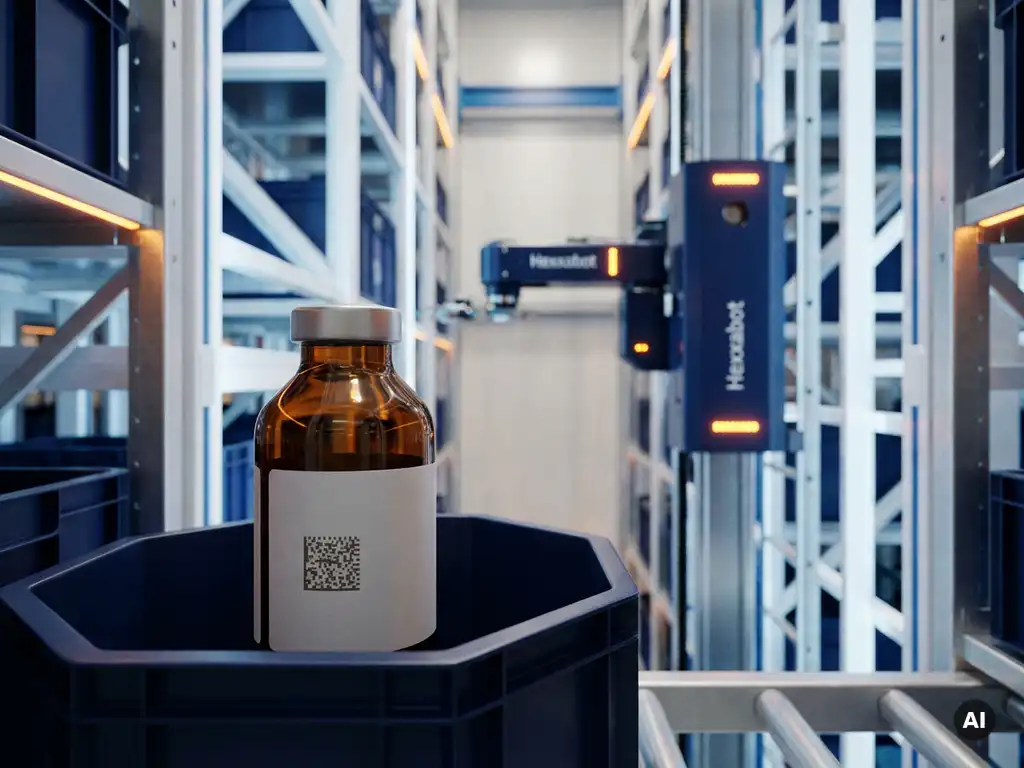
Serialization prevents counterfeit drugs from entering the supply chain by assigning a unique identifier to every individual medicine pack, making it possible to verify that a product is genuine and has followed an authorized route from manufacturer to patient. When a pack cannot be verified against a central database, it is flagged and withheld from dispensing. The sections below unpack how that mechanism works, what the data contains, and where the system faces its greatest pressure points.
How does serialization actually stop counterfeit drugs from entering the supply chain?
Serialization stops counterfeit drugs by creating a digital identity for every single medicine pack. When a pharmacist, wholesaler, or dispenser scans that pack, the system checks its unique code against a centralized or national database. If the code does not exist, has already been dispensed, or belongs to a different market, the pack fails verification and is quarantined before it reaches a patient.
The mechanism works because a genuine serial number cannot easily be replicated without access to the manufacturer’s systems. Counterfeiters may copy the physical appearance of packaging, but they cannot generate a code that passes a live database check. This is the critical distinction between serialization and older anti-counterfeiting methods such as holograms or color-shifting inks, which can be visually imitated given sufficient resources.
Serialization also creates accountability at every handoff point in the supply chain. Each time a pack changes hands, its status is updated. This means that even if a counterfeit product enters the supply chain at a weak point, such as a secondary wholesaler, the verification step at the dispensing end acts as a final safety net. The combination of upstream recording and downstream verification is what gives the system its depth.
What data does a pharmaceutical serial number contain?
A pharmaceutical serial number typically contains four core data elements: a product identifier, a unique serial number, a batch or lot number, and an expiry date. These four elements are encoded together, usually in a two-dimensional DataMatrix barcode printed on each individual pack. The product identifier links the pack to a specific medicine, dosage form, and strength registered with the relevant authority.
The serial number itself is the element that makes each pack unique. Two packs of the same medicine from the same batch will carry identical product identifiers and batch numbers, but their serial numbers will differ. This granularity is what enables individual pack verification rather than batch-level checks alone.
Beyond the four mandatory data elements, manufacturers may encode additional information depending on regulatory requirements or internal logistics needs. Some markets require country-specific reimbursement numbers or market identifiers. In regulated pharmaceutical distribution environments, this data also supports batch-controlled inventory management, expiry-aware retrieval, and First Expired First Out workflows, which are key operational requirements for compliant pharmaceutical storage and fulfillment.
What’s the difference between serialization and track-and-trace?
Serialization and track-and-trace are related but distinct concepts. Serialization is the act of assigning a unique identifier to an individual pack. Track-and-trace is the broader process of recording every movement and custody event associated with that pack throughout the supply chain. Serialization is the foundation; track-and-trace is what you build on top of it.
A serialized pack has an identity. A tracked-and-traced pack has a documented history. The difference matters practically because a system could serialize packs at the point of manufacture without ever recording subsequent movements, which would allow verification at the pharmacy but would not provide visibility into where a suspicious product traveled before it arrived.
Full track-and-trace requires that every supply chain participant, including manufacturers, wholesalers, distributors, and dispensers, records custody events and links them to the pack’s unique identifier. This creates a chain of custody that auditors, regulators, and investigators can follow. In markets where full track-and-trace is mandated, such as the United States under the Drug Supply Chain Security Act, the system can reconstruct the complete journey of any individual pack. In markets where only point-of-dispense verification is required, such as the European Union under the Falsified Medicines Directive, the chain of custody is less granular but the dispensing verification step still catches packs that cannot be authenticated.
Which regulations require drug serialization globally?
Drug serialization is now a legal requirement across most major pharmaceutical markets. The European Union’s Falsified Medicines Directive requires unique identifiers and tamper-evident features on prescription medicines and certain over-the-counter products, with verification at the point of dispensing. The United States Drug Supply Chain Security Act requires full serialization and track-and-trace across the entire supply chain, with interoperable electronic systems mandated for all trading partners. Other significant frameworks include those in China, South Korea, Saudi Arabia, Turkey, Brazil, and India, each with their own technical specifications and timelines.
The regulatory landscape is not uniform. Requirements differ on which product categories must be serialized, which supply chain participants must record custody events, what data elements must be encoded, and how verification databases are structured. Some countries operate national centralized repositories; others rely on decentralized verification systems managed by manufacturers or industry bodies.
For pharmaceutical distributors and wholesalers operating across multiple markets, this creates a compliance challenge that goes beyond simply printing a barcode. The underlying data management, software integration, and process design must accommodate different regulatory demands simultaneously. Compliance depends on the complete implementation, including software, validated procedures, and operational controls, not on any single piece of hardware or labeling alone.
Where do counterfeit drugs most commonly bypass serialization controls?
Counterfeit drugs most commonly bypass serialization controls at points where verification is weak, inconsistent, or entirely absent. The highest-risk entry points include unlicensed online pharmacies, informal secondary markets, and regions where regulatory enforcement capacity is limited. In these environments, serialization codes may be absent, duplicated from legitimate packs, or simply never checked against a verification database.
Gaps within regulated supply chains
Even within regulated markets, vulnerabilities exist. Parallel trade, where medicines are legally moved between markets to exploit price differences, creates complexity because a pack legitimately serialized for one country may carry an identifier that fails verification in another. This can generate false alerts that desensitize staff, or in some implementations, create pathways for substitution.
Verification failures also occur when database connectivity is interrupted. If a pharmacy scanner cannot reach the verification server, some systems default to allowing the transaction rather than blocking it. This is a known operational weakness, and counterfeiters with knowledge of how systems behave during outages could potentially exploit it.
The human and process dimension
Technology alone does not close every gap. Staff who bypass scanning steps, systems that are not correctly integrated, or databases that are not updated in real time all create windows of vulnerability. Counterfeit products have also been found entering supply chains through compromised legitimate distributors, where the falsified product is introduced before serialization checks are applied. This is why supply chain integrity depends on both technical controls and the operational discipline to enforce them consistently at every handoff point.
What technologies work alongside serialization to strengthen anti-counterfeiting?
Serialization works most effectively when combined with complementary technologies that address the gaps it cannot close alone. The most important supporting technologies include tamper-evident packaging, authentication features embedded in the pack itself, real-time verification databases, and controlled physical supply chain infrastructure.
Tamper-evident features, such as breakable seals or void labels, provide a physical signal that a pack has been opened before reaching the patient. These features do not verify authenticity on their own, but they add a layer of protection that complements the digital verification step. A pack that passes serialization but shows evidence of tampering should still be treated with suspicion.
Advanced authentication technologies, including covert markers, spectroscopic identifiers, and cryptographic features embedded in packaging, provide additional verification layers that are significantly harder to replicate than a printed barcode. These are particularly relevant for high-value medicines or markets where code duplication is a known risk.
At the infrastructure level, controlled and auditable storage and retrieval environments reduce the opportunity for substitution or tampering between the point of manufacture and the point of dispensing. When inventory movements are digitally recorded, every tote and batch retrieval is traceable, and access to stock is managed through software rather than manual processes, the physical supply chain becomes a harder target for infiltration. This is where the design of pharmaceutical storage operations directly supports the integrity that serialization is intended to protect.
How Hexxabotics supports pharmaceutical supply chain integrity
Hexxabotics provides a high-density Automated Storage and Retrieval System designed to support the strict inventory control requirements of pharmaceutical distribution. For operations where serialization and traceability are regulatory obligations, the physical storage environment matters as much as the software layer. Hexxabotics addresses this by delivering:
- Direct-access tote retrieval: every storage location is individually accessible without digging or reshuffling, supporting precise batch and lot control
- Software-managed inventory movements: digitally controlled retrieval creates an auditable record of every stock movement, supporting traceability requirements
- Dense storage within a compact footprint: pharmaceutical distributors managing large and long-tail assortments can store more SKUs without expanding their physical facility
- Independent scaling of capacity and throughput: storage and transaction capacity can be engineered separately, allowing operations to grow without infrastructure redesign
- Integration with warehouse management and execution systems: standard APIs connect the AS/RS to the broader orchestration layer, including batch management, expiry logic, and downstream pharmaceutical processes
Compliance depends on the complete implementation, including validated software, operating procedures, and environmental controls. Hexxabotics is designed to support batch traceability and regulated pharmaceutical workflows as part of that broader system. If you are evaluating storage infrastructure for a pharmaceutical distribution or fulfillment environment, contact Hexxabotics to discuss how the system can be configured for your operational and compliance requirements.
Related Articles
- How do you select a pharmaceutical warehousing partner for compliance-critical products?
- What are audit trail requirements for pharmaceutical warehouses in 2026?
- How do you build a TCO model for warehouse automation?
- How does a hexagonal grid system change warehouse logistics?
- What is an autonomous mobile robot used for in logistics?