
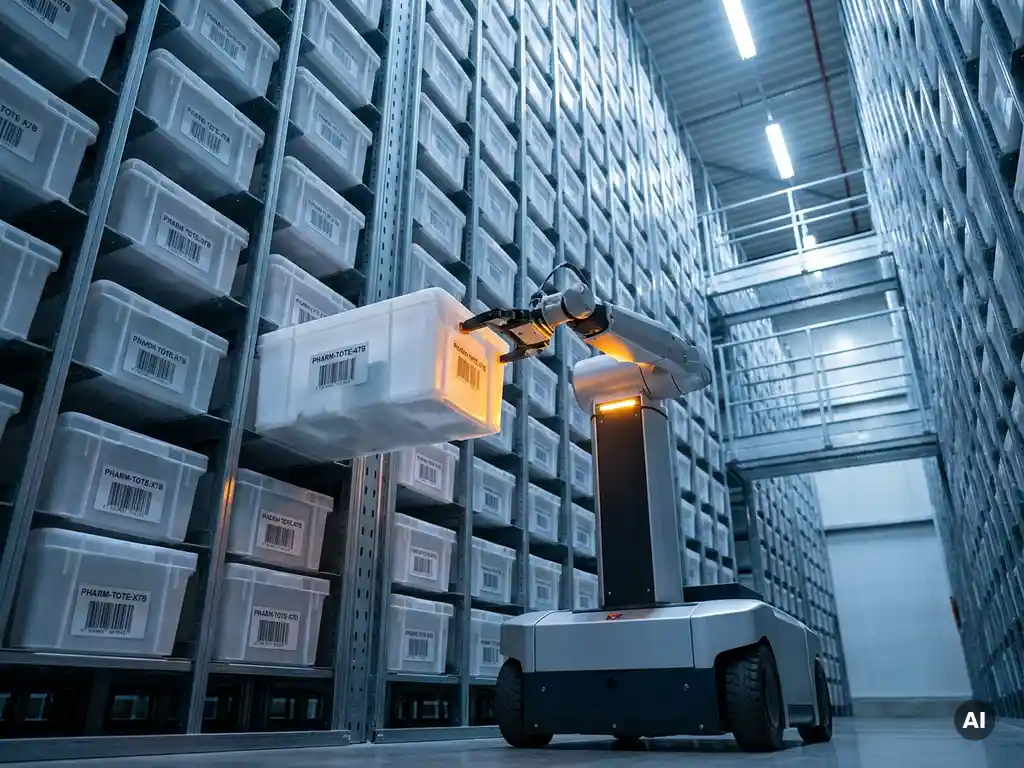
Lot segregation in a high-density pharmaceutical warehouse is achieved by combining direct-access automated storage with software-enforced inventory controls that assign every tote or container to a specific batch, status, and location, making physical commingling structurally impossible and every retrieval fully traceable. The critical enabler is a system architecture where each storage location is individually addressable, so the software can enforce batch boundaries without relying on physical distance between lots. The sections below address the most common operational questions around making this work in practice.
What makes lot segregation harder in high-density pharmaceutical storage?
High-density storage compresses inventory into a smaller footprint, which directly increases the risk that products from different lots, statuses, or handling requirements end up in adjacent or overlapping locations. In conventional shelving, physical separation is visible and manually verifiable. In dense automated systems, the segregation burden shifts entirely to the software layer, and any gap in inventory logic can result in lots that are technically co-located without any visible warning to operators.
Several factors compound this challenge. First, pharmaceutical warehouses often manage thousands of SKUs with overlapping replenishment cycles, meaning multiple lots of the same product are live simultaneously. Second, lot status changes dynamically: a lot that enters as released inventory may later move to quarantine, requiring the system to re-segregate it without a physical move being triggered by a human. Third, high-density systems often use tote-based storage, which means a single physical container may hold units from only one lot, but the system must enforce this rule consistently at every inbound transaction.
The deeper structural problem is that density and accessibility can appear to be in conflict. Traditional high-density systems that stack containers require digging through upper layers to reach lower ones, which creates both a retrieval delay and a contamination risk when handling products from different lots. This is why the retrieval architecture of any automated system used in pharmaceutical environments matters as much as its storage capacity.
How do automated storage and retrieval systems enforce lot-level separation?
An AS/RS enforces lot segregation by assigning every storage location a unique address and linking that address to a specific lot number, batch status, and expiry date in the inventory management system. No retrieval or deposit transaction can occur without the system validating that the tote, location, and lot attributes match the authorized record. Physical separation is replaced by data-enforced separation at the location level.
The mechanism works in two directions. On inbound, the system captures lot number, quantity, and status at the point of receipt and assigns the inventory to a specific tote and location. The software prevents any subsequent deposit that would place a different lot into an occupied tote or a location already reserved for a conflicting status. On outbound, the system retrieves only the tote associated with the requested lot, leaving all other lots undisturbed.
Direct-access architecture is particularly important here. Systems that require repositioning containers to reach a requested one introduce both a delay and a handling event: each handling event is a potential error point in lot control. A system where every location is independently accessible eliminates this risk: the robot retrieves the correct tote in a single motion without disturbing adjacent inventory. This is the principle behind Hexxabotics’ pharmaceutical storage approach, where each tote remains directly reachable regardless of its position in the vertical structure.
The practical result is that lot segregation becomes a function of data integrity rather than physical layout. As long as the inventory record is accurate and the system enforces one-lot-per-tote rules consistently, the automated retrieval process cannot retrieve the wrong lot: it can only retrieve what the software directs it to retrieve.
What software controls are required for GMP-compliant lot traceability?
GMP-compliant lot traceability in a high-density warehouse requires a software layer that records every inventory movement against a lot number, timestamp, operator or system identity, and location, creating an unbroken audit trail from receipt to dispatch. This typically involves a Warehouse Management System (WMS) or Warehouse Execution System (WES) with pharmaceutical-grade inventory logic, integrated with the AS/RS control system through validated interfaces.
Inventory status management
The software must maintain a status field for every lot that reflects its current regulatory standing: released, quarantined, rejected, or under review. Status changes must be logged with the reason, the authorizing user, and the timestamp. Critically, a status change must immediately restrict or permit retrieval at the system level, not just as a visual flag, but as an enforced transaction rule. A quarantined lot must become physically unretrievable for standard order fulfillment the moment its status changes, without requiring a manual physical move.
FEFO and batch selection logic
First-Expired-First-Out (FEFO) logic requires the system to rank available lots by expiry date and direct retrieval toward the earliest-expiring stock first. This is a software rule applied at the point of retrieval instruction, not a physical arrangement. The WMS must hold validated expiry dates for every lot and apply the selection rule consistently across all retrieval transactions. For pharmaceutical distribution, this capability needs to be formally specified and validated as part of the system implementation rather than assumed as a default feature. Where batch-specific selection is required (for example, to fulfill an order that must ship from a particular lot), the software must support lot-specific reservation and retrieval without allowing substitution.
Audit trail and reporting
Every transaction (deposit, retrieval, status change, location transfer, or exception) must be recorded in a tamper-evident log that can be exported for regulatory inspection. The log should capture the lot number, quantity, location, action type, system or user identity, and timestamp. For operations subject to the Falsified Medicines Directive (FMD) or similar serialization requirements, the software must also support product verification events and integrate with national medicines verification systems where applicable.
How do you handle quarantined or rejected lots in a high-density system?
Quarantined or rejected lots in a high-density automated system are controlled primarily through software status flags that immediately restrict the lot from standard retrieval workflows, combined in some implementations with physical designation of specific storage zones or totes reserved for non-conforming inventory. The software-first approach is what makes high-density systems viable for this requirement: physical isolation at the rack level would require dedicating large areas to low-probability events.
When a lot is placed under quarantine, the WMS or ERP system updates the lot status, and this change propagates to the AS/RS control system. From that point, any retrieval request that would draw from that lot is blocked at the software level. The tote containing the quarantined inventory remains in its location but becomes invisible to standard order fulfillment logic. Only users with appropriate authorization can access or release quarantined stock.
For rejected lots that must be physically removed from the facility, the system can generate a directed retrieval task that brings the relevant totes to a designated output point for destruction, return to supplier, or quarantine staging. The retrieval is logged against the lot number, and the inventory record is updated to reflect the disposition. This creates a complete chain of custody from the initial status change through to final removal.
One operational consideration is that high-density systems must be designed so that quarantine status changes can be applied in real time, without requiring a system shutdown or manual re-slotting exercise. In a well-implemented system, a quality hold placed at 11 p.m. takes effect immediately across all active retrieval tasks: no operator intervention required, no risk that an in-progress pick completes before the hold is enforced.
What are the biggest lot segregation risks when scaling pharmaceutical warehouse capacity?
The biggest lot segregation risks when scaling pharmaceutical warehouse capacity are data integrity gaps during system expansion, inconsistent lot rules across automation zones, and the failure to validate new software configurations before they go live with regulated inventory. Scaling introduces change, and change is where segregation controls are most likely to break down.
Several specific risks deserve attention during any capacity expansion:
- Lot rule inheritance: When new storage locations are added to an AS/RS, the system must automatically apply the same lot control rules to those locations. If new zones are commissioned with default settings that differ from the validated configuration, segregation gaps can appear without being immediately visible.
- Interface validation: Scaling often involves adding new integration points: additional WMS modules, new robotic units, or updated API connections. Each new interface is a potential point where lot data can be dropped, truncated, or mismatched. All interfaces carrying lot-relevant data must be validated before going live.
- Throughput pressure on exception handling: As order volumes grow, the temptation to override lot selection rules to meet dispatch deadlines increases. Scaling plans should include clear escalation procedures that maintain lot control even under peak pressure, rather than relying on operator judgment in high-stress moments.
- Mixed-lot tote risk: If inbound processes are not tightly controlled during periods of high receiving volume, there is a risk that multiple lots end up in the same tote before the tote enters the AS/RS. Once inside the system, a mixed-lot tote is very difficult to correct without a manual intervention that itself requires documentation.
- Static lot allocation becoming outdated: As assortments grow, the rules that determine which products go into which automation zones may need to be revisited. A product that was previously handled in a manual zone may be moved into the AS/RS without the corresponding lot control rules being updated to reflect its specific batch management requirements.
The underlying principle is that lot segregation controls must scale at the same rate as physical capacity. Adding storage locations or robots without a corresponding review of the software configuration and validation status creates a regulatory risk that is disproportionate to the operational benefit of the expansion.
How Hexxabotics supports lot segregation in pharmaceutical warehouses
Hexxabotics addresses the core lot segregation challenge in pharmaceutical high-density storage through a combination of direct-access architecture and software-enforced inventory control. Because every tote location in the system is independently accessible, the robots retrieve exactly the requested lot without disturbing adjacent inventory, eliminating the handling events that create commingling risk in stacked or crane-dependent systems.
- Direct access to every tote: No digging, no repositioning, no unintended handling of adjacent lots during retrieval.
- Lot-level location assignment: Each storage location is linked to a specific lot number and status, enforced at the transaction level by the control system.
- Real-time status enforcement: Quarantine and hold status changes take effect immediately across all active retrieval logic, without manual re-slotting.
- Independent scalability: Storage capacity and throughput can be expanded independently, allowing lot control configurations to be validated once and inherited by new locations without structural redesign.
- WMS and WES integration: Standard APIs connect the Hexxabotics control system to existing pharmaceutical WMS platforms, supporting FEFO logic, batch traceability, and audit trail requirements within the validated software environment.
If you are evaluating high-density storage options for a pharmaceutical distribution or fulfillment operation where lot segregation and batch traceability are non-negotiable, contact the Hexxabotics team to discuss how the system can be configured for your specific regulatory and operational requirements.
Related Articles
- How do pharmaceutical companies prepare for an FDA warehouse inspection?
- How does warehouse design impact GMP compliance for pharmaceuticals?
- How does fleet management work for warehouse robots?
- What is a warehouse execution system and how does it differ from a WMS?
- How do automated systems handle returns processing in e-commerce fulfillment?