
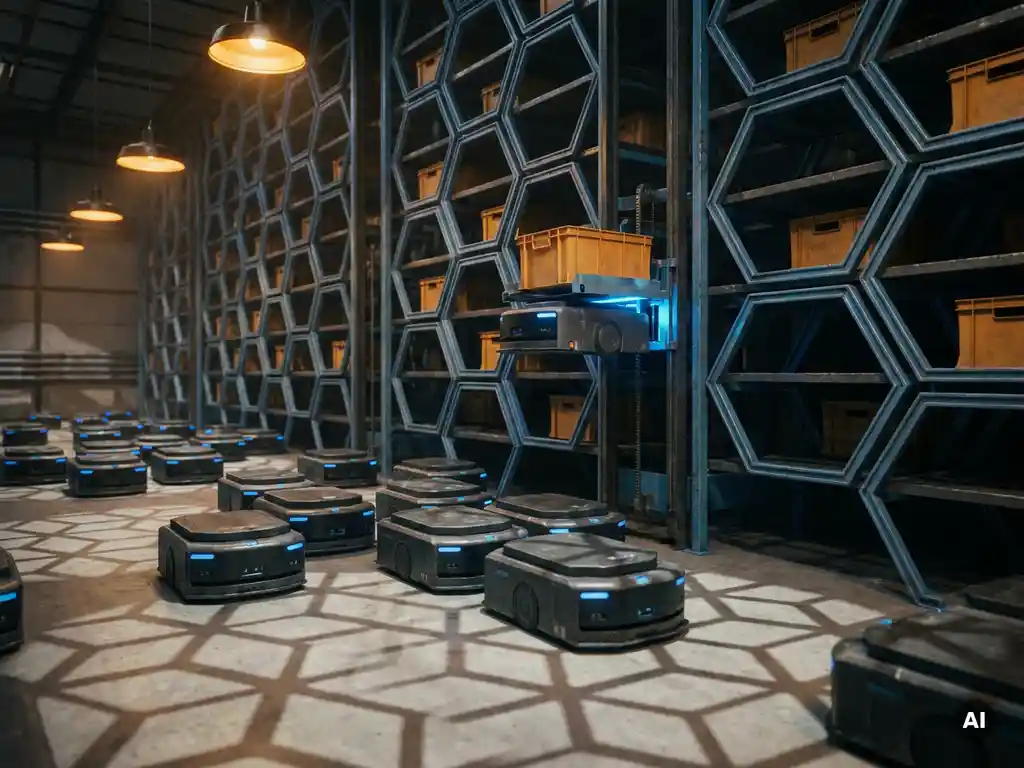
A warehouse robot fleet management system handles real-time coordination of all autonomous robots operating within a facility, including task assignment, traffic routing, collision avoidance, charging cycles, and inventory tracking. It acts as the operational brain that keeps multiple robots working in parallel without conflict. The sections below address the most common questions engineers ask when evaluating or deploying a robotic fleet.
What tasks does a fleet management system handle for warehouse robots?
A warehouse robot fleet management system is responsible for orchestrating every operational task across the robot population: assigning pick and put-away jobs, sequencing robot movements, managing battery or charging states, monitoring system health, and logging all inventory transactions. Without this layer of control, autonomous robots would operate as isolated units rather than as a coordinated fleet.
In practice, the task scope of fleet management software breaks into several functional areas:
- Job dispatching: The system receives orders from upstream software, decomposes them into robot-executable tasks, and assigns those tasks based on robot availability and location.
- Traffic orchestration: Robots are routed through shared corridors or grid zones in sequences that prevent congestion and deadlock.
- Charging management: The system monitors energy levels and schedules charging cycles so that robots return to service without interrupting throughput targets.
- Error handling and recovery: When a robot encounters an obstacle or fault, the fleet manager reroutes other units and flags the issue for resolution.
- Inventory coordination: Every tote or bin location is tracked in real time so that storage and retrieval commands are always directed to the correct physical position.
The depth of these functions varies by architecture. Systems built around distributed robots, where each unit operates autonomously within a shared grid, tend to handle more intelligence at the robot level, reducing the coordination burden on a central server. This is a meaningful design distinction when evaluating long-term reliability and scalability.
How does robot traffic management prevent collisions in a shared warehouse?
Robot traffic management prevents collisions by dividing the operational space into zones or grid cells, assigning exclusive access rights to each robot as it moves, and using real-time position data to resolve conflicts before they occur. The goal is to eliminate physical contention entirely through software logic rather than relying on reactive sensors alone.
Most warehouse robot coordination systems use one of two approaches, or a combination of both:
- Reservation-based routing: A robot requests a path segment before entering it. The fleet manager grants or denies access based on whether another robot holds a reservation for that segment. This prevents head-on conflicts and crossing collisions.
- Priority rules: When two robots converge on the same zone simultaneously, the system applies predefined priority logic, such as giving precedence to the robot carrying a loaded tote or the one closer to a deadline.
In three-dimensional systems where robots operate both horizontally beneath a grid and vertically inside storage towers, traffic management extends across two movement planes. Horizontal navigation and vertical climbing must be coordinated so that a robot ascending a tower does not conflict with units repositioning on the floor below. Distributed architectures handle this naturally because each robot carries its own movement logic, and the central system only needs to arbitrate at intersection points rather than micromanage every movement step.
How does fleet management software integrate with a warehouse management system?
Fleet management software integrates with a warehouse management system (WMS) through standard APIs, typically REST or message-queue protocols, that allow the WMS to pass order data down to the robot layer and receive inventory confirmations back. This bidirectional connection ensures that the WMS always reflects the true physical state of the warehouse without requiring manual reconciliation.
The integration typically works in the following sequence:
- The WMS generates a pick or replenishment order and sends it to the fleet management layer via API call.
- The fleet manager translates the order into one or more robot tasks, assigns them to available units, and begins execution.
- As robots complete tasks, the fleet system sends confirmation events back to the WMS, updating inventory positions and order statuses in real time.
- Exception events, such as a missing tote or a robot fault, are also communicated upstream so the WMS can replan affected orders.
Well-designed warehouse automation control systems are built with WMS-agnostic integration layers from the start, meaning the fleet software does not require a specific WMS vendor. This reduces deployment risk significantly for facilities that already run established warehouse management platforms and want to add robotic automation without replacing existing software infrastructure.
What’s the difference between centralized and decentralized robot fleet control?
The key distinction is where decision-making authority lives. In a centralized fleet control model, a single server or controller calculates every robot’s path and issues movement commands continuously. In a decentralized model, each robot carries enough intelligence to make local decisions, and the central system sets objectives rather than dictating every step.
Centralized fleet control
Centralized control gives operators a single point of visibility and makes global optimization straightforward because the controller has a complete picture of the fleet at all times. However, it introduces a single point of failure: if the central controller goes offline or becomes overloaded during peak demand, the entire fleet can stall. Scaling a centralized system also becomes computationally expensive as robot count grows, because the volume of real-time calculations grows with every unit added.
Decentralized fleet control
Decentralized control distributes intelligence across the robot population. Each unit can navigate, avoid conflicts, and complete tasks using onboard logic, with the central system providing task assignments and high-level coordination. This architecture is more resilient: if one robot stops, the others continue operating without interruption. It also scales more predictably, because adding a robot adds throughput capacity without proportionally increasing the coordination burden on a central server. The trade-off is that global optimization, such as balancing workloads across the entire fleet in real time, requires more sophisticated onboard algorithms and careful design of the coordination protocol.
For autonomous mobile robot coordination in high-density AS/RS environments, decentralized approaches are increasingly favored precisely because they eliminate the single-point-of-failure risk that centralized crane-based systems historically introduced.
How does fleet management scale when robot count increases?
Fleet management scales when robot count increases by relying on software architectures that add coordination capacity proportionally, rather than requiring infrastructure changes. In well-designed systems, adding a robot to the fleet should increase throughput linearly without requiring new servers, new rack structures, or reconfiguration of existing robots.
Several design factors determine whether a fleet management system scales cleanly:
- Stateless task assignment: If the fleet manager assigns tasks without maintaining complex shared state per robot, adding more robots does not create coordination overhead that grows faster than the fleet itself.
- Distributed traffic logic: When robots handle local collision avoidance themselves, the central system is not required to recalculate global paths for every new unit.
- Modular physical infrastructure: Robot fleet software scales most effectively when the physical environment it manages is also modular. A storage structure that can be extended without mechanical redesign allows robot count and storage capacity to grow independently and at different rates.
This independence between capacity and throughput is a defining characteristic of modern AS/RS robot management. Operators can add storage locations to serve growing SKU counts while keeping the robot fleet constant, or they can add robots to handle seasonal throughput peaks without expanding the physical footprint. Both actions are managed through the same fleet control layer, and neither requires stopping operations to reconfigure the system.
What data does a robot fleet management system collect and why does it matter?
A robot fleet management system continuously collects operational data across four main categories: robot performance metrics, inventory movement records, system health indicators, and task execution logs. This data matters because it is the primary input for optimizing throughput, diagnosing inefficiencies, and planning future capacity decisions.
Each data category serves a distinct operational purpose:
- Robot performance metrics: Cycle times, travel distances, charge levels, and idle periods reveal whether individual units are being utilized efficiently or whether task distribution is uneven across the fleet.
- Inventory movement records: Every tote retrieval and deposit is timestamped and location-stamped, creating a complete audit trail that supports order accuracy verification, batch traceability in regulated industries, and demand pattern analysis.
- System health indicators: Sensor readings, error codes, and maintenance flags allow predictive maintenance scheduling, reducing unplanned downtime by addressing component wear before it causes a failure.
- Task execution logs: Order completion times and exception rates feed back into WMS reporting, giving operations managers visibility into whether the robotic layer is meeting service-level commitments.
Aggregated over time, this data also informs infrastructure decisions. If fleet logs consistently show that a particular zone of the storage grid has higher dwell times or congestion events, that insight can drive a targeted expansion of that zone or a rebalancing of robot assignments. In systems where storage capacity and robot count scale independently, data from the fleet management layer becomes the evidence base for deciding which dimension to expand next.
How Hexxabotics helps with warehouse robot fleet management
Hexxabotics provides an integrated approach to autonomous robot coordination through its three-dimensional AS/RS platform, where fleet management is built into the architecture rather than bolted on afterward. Key aspects of how the system addresses the challenges covered in this article include:
- Distributed robot operation: Hexxabots navigate the grid independently, eliminating single points of failure and enabling linear throughput scaling by simply adding more units.
- No in-rack electrification: The passive tower structure removes embedded motors and fixed conveyors from the coordination equation, reducing the number of components the fleet system needs to monitor and maintain.
- Direct access to every storage location: Because every tote is directly reachable without reshuffling, the fleet manager never needs to sequence complex dig cycles, keeping task logic simple and execution fast.
- Standard API integration: The Hexxabotics Control System connects to existing warehouse management systems through standard interfaces, reducing integration effort and protecting existing software investments.
- Independent capacity and throughput scaling: Storage positions and robot count grow separately, so fleet management decisions about adding robots do not require infrastructure changes and vice versa.
If you are evaluating robotic fleet management solutions for a high-density storage environment, learn more about Hexxabotics and how its architecture is designed to scale without the constraints of traditional AS/RS systems.
Related Articles
- What are the long-term operational costs of warehouse automation?
- How does predictive maintenance prevent downtime in automated warehouses?
- How do 3PL providers choose between leasing and buying automation equipment?
- Should you choose an AMR system or a fixed-rail AS/RS in 2026?
- What is the difference between fixed automation and flexible automation?