
Autonomous inventory counting is accurate, fast, and increasingly reliable enough to replace traditional manual stocktakes in most warehouse environments. Modern systems achieve inventory accuracy rates that consistently outperform manual counting, primarily because they eliminate human errors, fatigue, and sampling gaps that make manual audits unreliable. The sections below unpack how these systems work, where they excel, and what infrastructure they require.
How does autonomous inventory counting actually work?
Autonomous inventory counting works by using robots, sensors, and software to continuously track the location and quantity of every stored item without interrupting warehouse operations. Instead of stopping work to count stock, the system logs every movement automatically, maintaining a real-time record that reflects what is actually in storage at any given moment.
In practice, this happens through two complementary mechanisms. The first is transaction-based tracking, where every deposit and retrieval is recorded by the warehouse control system the instant it occurs. Each tote or item is assigned a unique identifier, and its location is updated in real time as robots move it through the system. The second mechanism is automated cycle counting, where the system periodically verifies stored positions against the inventory record without pulling items from active circulation.
In robotic AS/RS environments, this process is especially precise because every storage location is fixed, addressable, and accessed by a machine rather than a person. The robot either confirms an item is present or it does not; there is no ambiguity from misreads, miscounts, or skipped locations. The warehouse management system receives a continuous stream of verified position data, making the inventory record a live reflection of physical reality rather than a snapshot taken during a periodic audit.
How accurate is autonomous inventory counting compared to manual methods?
Autonomous inventory counting is significantly more accurate than manual methods. Manual counts are prone to transposition errors, fatigue-related miscounts, and sampling gaps when full counts are impractical. Automated systems, by contrast, log every transaction at the point of movement, removing the conditions that cause most inventory discrepancies in the first place.
Manual inventory accuracy in a typical warehouse environment often falls in the range of 95 to 98 percent under good conditions, but that figure drops during peak periods when counting is rushed or delegated to temporary staff. Autonomous systems operating within closed robotic environments routinely achieve accuracy levels above 99.9 percent because the record is updated by the same machine that physically moves the item. There is no gap between what happened and what was recorded.
The accuracy advantage compounds over time. Manual counts degrade between audits as informal movements, misplacements, and unrecorded adjustments accumulate. Automated counting maintains accuracy continuously, meaning the inventory record does not drift between formal stocktakes. For operations managing thousands of SKUs across dense storage, this sustained accuracy translates directly into fewer mis-picks, fewer write-offs, and more reliable order fulfillment.
What types of errors does autonomous counting eliminate?
Autonomous inventory counting eliminates the three main categories of manual counting errors: human recording errors, location misidentification, and coverage gaps. Each of these is a structural weakness of manual processes that automation removes by design rather than by improving human performance.
- Recording errors: Manual counts rely on staff entering numbers by hand or scanning items in sequence. Transposition errors, double-scans, and missed items are common, especially during high-volume counts. Automated systems record movements through the control system at the moment of transaction, with no manual data entry involved.
- Location misidentification: In dense storage environments, a human counter can mistake one bin for an adjacent one, particularly in high-bay or deep-rack configurations. Robotic systems navigate to precise, machine-verified coordinates, so location errors of this kind are structurally impossible.
- Coverage gaps: Full manual stocktakes are time-consuming, so many operations rely on partial counts or statistical sampling. Items in hard-to-reach locations are often skipped or counted less frequently. In a direct-access robotic system, every storage position is equally reachable, and automated cycle counting can cover the entire inventory systematically without skipping locations.
- Timing gaps: Manual counts capture a snapshot at one point in time. Between counts, unrecorded movements create drift. Continuous automated tracking eliminates the concept of a stale count entirely.
Can autonomous inventory counting replace full physical stocktakes?
Yes, autonomous inventory counting can replace full physical stocktakes in most warehouse environments, provided the system maintains continuous transaction records and the control software performs regular automated verification cycles. Regulatory requirements in some industries may still mandate periodic formal audits, but the operational need for a full shutdown count disappears when the inventory record is continuously maintained.
Traditional physical stocktakes exist because inventory records drift over time and need periodic correction. If the system never allows drift, because every movement is logged and every location is verified automatically, there is no accumulated error to correct. Automated cycle counting distributes the verification work across the year, checking different sections of inventory on a rolling basis rather than counting everything at once.
For industries with strict regulatory requirements, such as pharmaceuticals or food, autonomous counting does not eliminate compliance audits, but it substantially simplifies them. A system that maintains a verified, timestamped record of every item movement provides auditors with a far more detailed and defensible evidence trail than a manual stocktake ever could. The audit becomes a review of system records rather than a physical recount.
What warehouse systems support autonomous inventory counting?
Autonomous inventory counting is supported by any warehouse system that combines automated storage and retrieval with a real-time inventory management layer. This includes robotic AS/RS platforms, goods-to-person systems, and automated shuttle systems, all of which track item movements through a central control system rather than relying on manual scans or periodic audits.
The key requirement is closed-loop control: the system must know where every item is at all times and must update that record automatically whenever an item moves. Open-storage environments where humans pick directly from shelves can support autonomous counting through drone-based scanning or RFID, but the accuracy ceiling is lower because human interaction introduces untracked movements.
Robotic AS/RS systems are the strongest foundation for autonomous inventory counting because they combine two features that manual and semi-automated environments lack. First, every item is stored in a standardized tote with a unique identifier. Second, every movement is performed by a machine that reports back to the control system. There is no parallel informal process running alongside the automated one. In systems where robots handle 100 percent of storage and retrieval, the inventory record is a direct output of machine activity, not a reconstruction of it.
How does autonomous counting integrate with warehouse management systems?
Autonomous inventory counting integrates with warehouse management systems (WMS) through standard APIs that synchronize the robotic control system’s real-time inventory data with the broader warehouse operation. The control system manages robot coordination and position tracking, while the WMS handles order logic, replenishment, and reporting. The two systems exchange data continuously so that inventory status is consistent across both layers.
In practice, integration works in both directions. The WMS sends retrieval and storage tasks to the robotic control system, which executes them and returns confirmation with precise location and timestamp data. This creates a closed feedback loop where every transaction is confirmed at the execution level before being posted to the inventory record. Discrepancies between what was requested and what was executed are flagged immediately rather than discovered during a periodic audit.
Standard API integration also means that autonomous counting data flows into the broader supply chain systems a business uses, including ERP platforms, procurement tools, and demand forecasting software. Inventory accuracy at the warehouse level becomes a reliable data input for decisions made upstream, rather than an estimate qualified by the age of the last stocktake. For operations managing high SKU counts or running omnichannel fulfillment, this real-time data quality is a meaningful operational advantage.
How Hexxabotics supports autonomous inventory counting
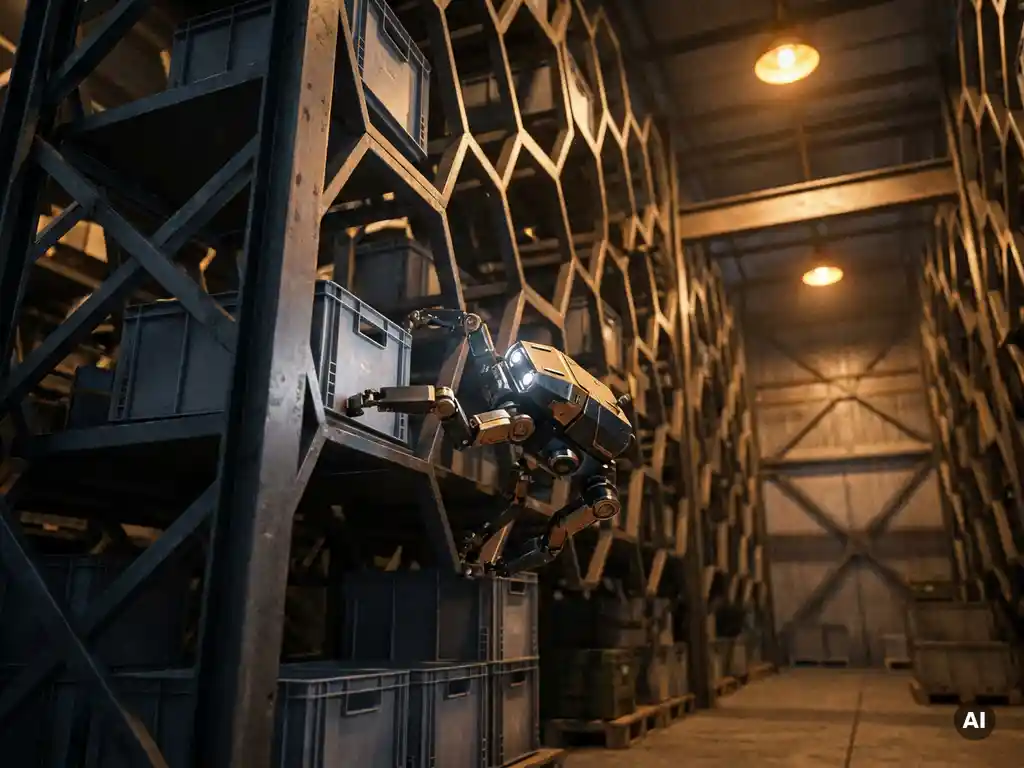
Hexxabotics is built around the architecture that makes autonomous inventory counting most effective: a closed robotic system where every item movement is executed and recorded by machine, with no manual handling in the storage zone. Key features that directly support inventory accuracy include:
- 100% direct access: Every tote location is directly reachable by a Hexxabot without digging or reshuffling, so cycle counting does not require reorganizing inventory to reach items at the back of a stack.
- Transaction-level tracking: The Hexxabotics Control System logs every deposit and retrieval in real time, maintaining a continuously verified inventory record without relying on periodic manual audits.
- No in-rack electrification: The passive rack structure reduces the number of components that can fail and introduce tracking errors, contributing to system reliability and data integrity.
- Standard API integration: The control system connects to external WMS platforms through standard APIs, ensuring that inventory data flows consistently into the broader warehouse operation.
- Distributed robot operation: Parallel Hexxabot operation means cycle counting tasks can run alongside normal fulfillment without reducing throughput or requiring operational pauses.
If you are evaluating robotic AS/RS solutions that support continuous, accurate inventory management, explore Hexxabotics to see how the system architecture directly addresses the accuracy and integration requirements that matter most.
Related Articles
- Can warehouse automation lower your energy consumption?
- How does a hexagonal grid system change warehouse logistics?
- How do warehouse AMRs communicate and coordinate in real time?
- How do 3PL providers choose between leasing and buying automation equipment?
- What is the difference between an AMR and an AGV in warehousing?