
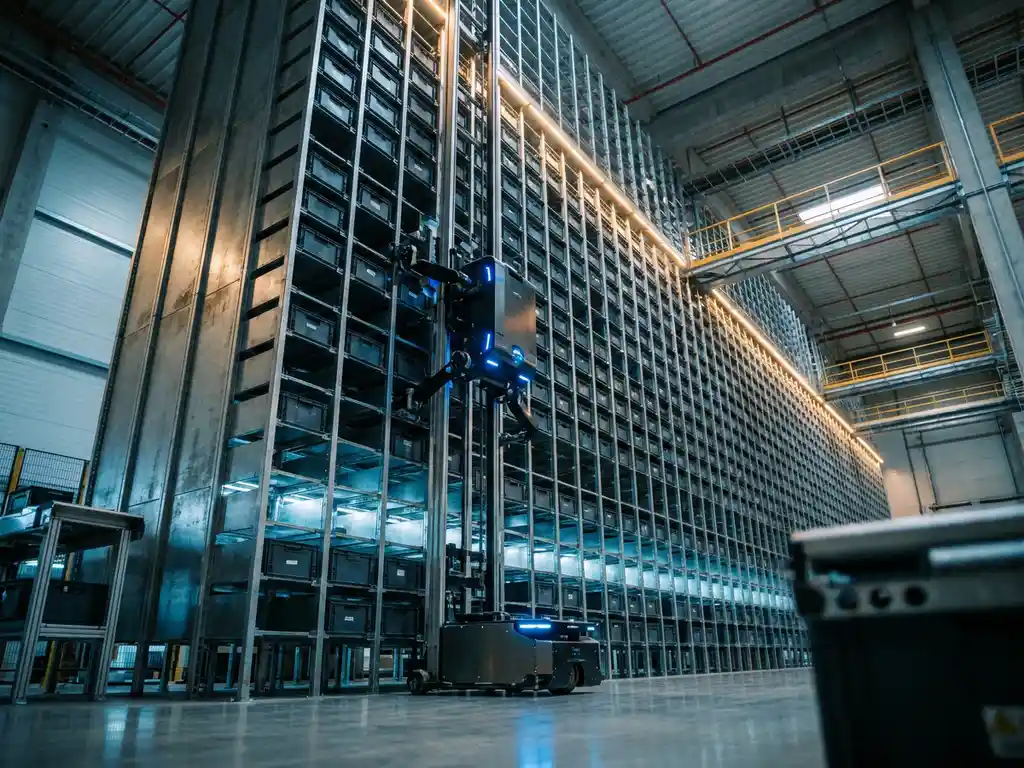
An AS/RS system (Automated Storage and Retrieval System) is a computer-controlled warehouse technology that automatically stores and retrieves goods from defined locations without requiring manual labor for each transaction. These systems use a combination of mechanical hardware, autonomous robots or cranes, and intelligent software to manage inventory movement within a structured storage grid. The sections below unpack how they work, what types exist, how they compare to traditional racking, and when it makes sense to invest in one.
How does an AS/RS system actually work?
An AS/RS system works by using automated machines guided by a warehouse control system to move goods into and out of predefined storage locations. When an order is placed or inventory needs to be stored, the system identifies the optimal location, dispatches the appropriate hardware to retrieve or deposit the item, and delivers it to a workstation or outbound area without human intervention.
The core operational loop involves three layers working together. First, a warehouse management or control system receives the storage or retrieval request and determines the best available location based on inventory logic, demand frequency, and system load. Second, the mechanical hardware executes the physical movement, whether that is a crane, shuttle, robot, or climbing unit. Third, the goods themselves are standardized into totes, trays, or cartons to ensure consistent handling across the entire system.
In more advanced AS/RS configurations, robots operate in parallel, meaning multiple storage and retrieval cycles run simultaneously. This parallel operation is what separates modern automated storage and retrieval from older single-crane systems where one machine handled all movement and a single failure brought the entire system to a halt. In distributed robotic systems, if one unit stops, the remaining units continue operating and throughput stays stable.
The goods-to-person principle is central to how most modern AS/RS warehouses function. Rather than sending workers to walk aisles and pick items, the system brings the item directly to a fixed workstation. This eliminates travel time, reduces picking errors, and dramatically increases the number of order lines a single operator can process per shift.
What are the different types of AS/RS systems?
The main types of AS/RS systems are unit-load crane systems, mini-load crane systems, shuttle systems, cube storage systems, vertical lift modules (VLMs), and robotic grid or tower systems. Each type is optimized for different combinations of storage density, throughput speed, item size, and scalability requirements.
- Unit-load crane AS/RS: Large stacker cranes handle full pallets in high-bay warehouses. Well suited for bulk storage but limited in throughput because a single crane typically serves one aisle.
- Mini-load crane AS/RS: Smaller cranes handle totes and trays in medium-height racks. Good for parts and e-commerce, but throughput is constrained by the number of cranes and the system becomes rigid as it scales.
- Shuttle systems: Robotic shuttles travel horizontally along rack levels while lifts move them between levels. Higher throughput than crane systems but infrastructure complexity increases significantly as the system grows taller or wider.
- Cube storage systems: Robots operate on top of a three-dimensional grid and dig down through stacked bins to retrieve items. Very high density, but retrieval speed depends on how deeply buried an item is, which can create delays for slower-moving SKUs.
- Vertical lift modules (VLMs): Enclosed vertical carousels that store trays and bring them to an operator window. Compact footprint, but throughput is inherently limited because one tray is presented at a time.
- Robotic tower systems: Autonomous robots navigate horizontally beneath a vertical storage grid and climb directly into towers to store or retrieve totes. Every location is directly accessible, throughput scales by adding robots, and storage capacity scales by extending the structure, without redesigning infrastructure.
The right type depends on factors including building height, SKU count, order profile, and whether the business expects its storage or throughput requirements to change significantly over time. Businesses with unpredictable growth trajectories increasingly favor systems where capacity and throughput can be scaled independently.
What’s the difference between AS/RS and a traditional warehouse racking system?
The fundamental difference is that a traditional racking system is passive storage that requires human workers to navigate aisles and locate items manually, while an AS/RS system is active, computer-controlled storage where machines handle all movement. This distinction drives major differences in labor requirements, storage density, picking accuracy, and operational cost over time.
Traditional racking systems, such as selective pallet racking or shelving, are low in upfront cost and simple to install. However, they consume significant floor space because aisles must remain wide enough for forklifts or workers, and vertical height is often underutilized because humans cannot safely or efficiently access locations above a certain height without specialized equipment.
AS/RS warehouse systems remove the aisle constraint almost entirely. Robots or cranes access locations that would be unreachable for a person on foot, and because machines do not need walking space between every rack row, storage density per square meter increases substantially. Building height becomes a productive asset rather than an unused overhead.
From an operational standpoint, traditional racking introduces variability: picking speed depends on individual worker performance, familiarity with the layout, and fatigue. An automated storage and retrieval system delivers consistent cycle times regardless of shift, season, or staffing levels. This consistency is particularly valuable during peak periods when manual operations typically require temporary labor that introduces training delays and error rates.
The trade-off is capital investment and system complexity. AS/RS systems carry a higher upfront cost and require integration with warehouse management software. For operations with stable, low-volume storage needs, traditional racking may remain the more practical choice. For operations handling high SKU counts, tight order turnaround windows, or limited floor space, the productivity and density advantages of an AS/RS system typically outweigh the initial investment over a multi-year horizon.
What industries use AS/RS systems the most?
AS/RS systems are most widely used in e-commerce fulfillment, retail distribution, pharmaceuticals, food and grocery, fashion and apparel, spare parts logistics, and third-party logistics (3PL). These industries share common characteristics: high SKU counts, tight order turnaround requirements, and strong pressure to maximize storage density within constrained facilities.
E-commerce and retail were early adopters because the economics of online order fulfillment demand fast, accurate picking at scale. When thousands of unique SKUs need to be picked, packed, and shipped within hours, manual picking becomes a bottleneck that AS/RS directly resolves.
Pharmaceuticals benefit from the traceability and controlled access that AS/RS systems provide. Every tote movement is logged, which supports batch tracking, expiry date management, and regulatory compliance without additional manual record-keeping.
Food and grocery operations use AS/RS to handle high-velocity, time-sensitive products with precise inventory rotation. The ability to enforce first-in-first-out (FIFO) logic automatically reduces waste and supports freshness standards.
Spare parts and industrial components represent another strong use case. These operations often manage tens of thousands of low-velocity SKUs that sit in storage for extended periods but must be retrieved quickly and accurately when needed. AS/RS systems make every location directly accessible without requiring workers to search through rows of shelving.
3PL providers increasingly use AS/RS to serve multiple clients within a single facility, using software partitioning to separate inventory while sharing the physical infrastructure. The ability to reconfigure and scale without rebuilding is particularly valuable for logistics providers whose client mix and volume requirements change regularly.
How much does an AS/RS system cost to implement?
AS/RS system costs vary widely depending on system type, scale, building requirements, and integration complexity. Smaller vertical lift modules or robotic tower systems for compact operations can start in the low hundreds of thousands, while large-scale unit-load or shuttle systems for distribution centers can reach into the tens of millions. Total cost of ownership, not just upfront capital, is the more meaningful metric for evaluating the investment.
The main cost components to account for include:
- Hardware: The physical structure, robots or cranes, conveyors, and workstations. This is typically the largest single cost component.
- Software and integration: The warehouse control system, inventory management logic, and API integration with existing WMS or ERP platforms.
- Installation and commissioning: Civil works, structural preparation, electrical infrastructure, and the time required to bring the system live and validate performance.
- Ongoing maintenance: Preventive maintenance contracts, spare parts, and software updates over the operational life of the system.
One factor that significantly affects long-term cost is how the system handles scaling. Traditional AS/RS architectures often require structural modifications when storage capacity or throughput needs to grow, which means additional capital expenditure at each expansion milestone. Systems designed with independent scalability, where storage and throughput can be expanded separately without rebuilding the core infrastructure, tend to deliver a lower total cost of ownership over a five to ten-year horizon.
Energy consumption is another cost dimension that is often underestimated. Systems with in-rack electrification, embedded motors, or centralized lifting infrastructure carry higher ongoing energy costs and more complex maintenance requirements than passive structural designs where all powered movement is handled by the robots themselves.
When should a warehouse consider switching to AS/RS?
A warehouse should consider switching to an AS/RS system when manual operations can no longer keep pace with order volumes, when floor space is reaching its limit, when picking accuracy is a persistent problem, or when labor availability and cost are becoming structural constraints on growth. These pressures rarely appear in isolation and often compound each other.
Specific operational signals that indicate readiness for AS/RS include:
- Order volumes are growing faster than the ability to add floor space or headcount
- Peak demand periods require disproportionate temporary staffing that introduces errors and training costs
- SKU count has grown to a point where manual location management leads to frequent picking errors or lost inventory
- Building height is underutilized while floor space is exhausted
- Labor turnover in the warehouse is high, making consistent throughput difficult to maintain
- Same-day or next-day delivery commitments are creating pressure on pick-and-pack cycle times
From a financial standpoint, the decision typically hinges on whether the labor savings, space efficiency gains, and accuracy improvements justify the capital outlay within an acceptable payback period. Operations processing high daily order volumes across a large SKU range tend to see the strongest return because the system’s productivity advantage compounds across every order cycle.
Timing also matters in relation to facility decisions. Implementing an AS/RS during a warehouse build or fit-out is significantly more cost-effective than retrofitting an existing space, because the structural and electrical requirements can be designed in from the start rather than worked around existing constraints.
For operations that anticipate significant changes in volume or product mix over the next three to five years, choosing a system architecture that supports incremental scaling without infrastructure redesign reduces the risk of the technology becoming a bottleneck rather than an enabler as the business evolves.
How Hexxabotics helps with AS/RS warehouse automation
Hexxabotics offers a next-generation AS/RS system built around hexagonal vertical storage towers, autonomous Hexxabots, and standardized totes. The system is designed specifically to address the limitations that make traditional AS/RS difficult to scale and expensive to maintain over time.
- Maximum storage density: The hexagonal geometry converts full cubic building volume into usable storage, utilizing up to 16 meters of vertical height with no embedded motors or in-rack electrification.
- Direct access to every tote: Hexxabots climb directly into towers and complete a deposit or retrieval in one continuous motion. There is no digging, no reshuffling, and no delay caused by inventory position.
- Independent scalability: Storage capacity grows by extending the structure. Throughput grows by adding robots. Neither change requires redesigning the other, which keeps expansion costs predictable and operations uninterrupted.
- Distributed resilience: With no centralized crane or single point of failure, the system maintains stable throughput even if individual units require service.
- Simple integration: The Hexxabotics control system connects to existing warehouse management platforms through standard APIs, reducing integration complexity for both new builds and retrofit projects.
If you are evaluating AS/RS options for a new facility or looking to replace an underperforming system, contact Hexxabotics to discuss your specific storage and throughput requirements.
Related Articles
- How do you ensure lot segregation in a high-density pharmaceutical warehouse?
- What is the difference between an AMR and a traditional shuttle system?
- How do you integrate autonomous mobile robots into an existing warehouse?
- What is the difference between CAPEX and OPEX in warehouse automation?
- What is swarm robotics and how is it used in logistics?