
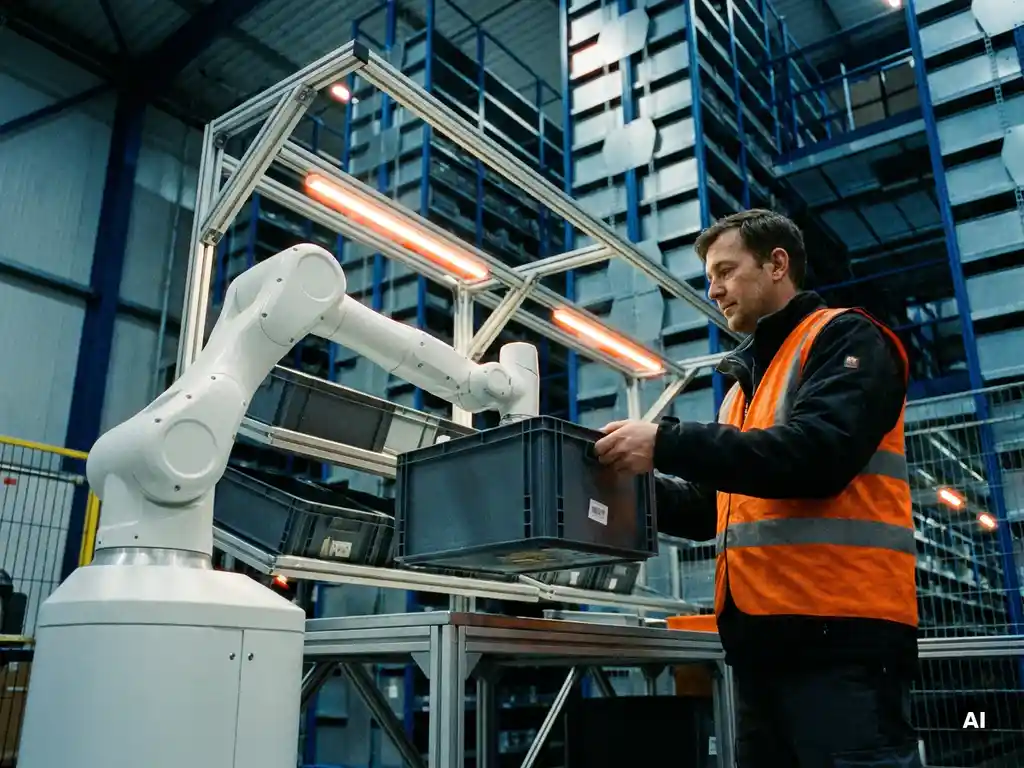
In a hybrid warehouse, robots and human workers collaborate by dividing tasks according to their respective strengths: robots handle repetitive, high-volume storage and retrieval operations while humans manage tasks requiring judgment, dexterity, and contextual reasoning. This division is not about replacing workers but about deploying each resource where it performs best. The result is a warehouse that runs faster, more accurately, and at greater scale than either humans or robots could achieve alone. The sections below answer the most common questions about how this collaboration actually works in practice.
What tasks do robots handle versus human workers in a hybrid warehouse?
In a hybrid warehouse, robots typically handle storage, retrieval, transport, and inventory tracking, while human workers focus on receiving, quality inspection, exception handling, packing, and customer-facing decisions. The clearest boundary is between tasks that are repetitive and location-based versus tasks that require physical adaptability or judgment.
Automated Storage and Retrieval Systems, for example, excel at moving standardized totes from dense storage grids to picking stations without human involvement. Robots navigate horizontally beneath storage structures and climb vertically inside towers to deposit or retrieve items in a single continuous motion. Every storage location is directly accessible, so there is no reshuffling or digging through inventory to reach a specific product. This is exactly the type of work that would otherwise consume significant human labor without adding cognitive value.
Human workers, by contrast, remain essential at Goods-to-Person workstations, where they receive items presented by the system and make decisions about packing, bundling, or substitution. They also handle inbound receiving, where product conditions, labeling errors, and damaged goods require on-the-spot judgment. Exception management, returns processing, and any task involving irregular item shapes or nonstandard packaging remain firmly in the human domain in most hybrid warehouse environments today.
How does a warehouse robot know where humans are working?
Warehouse robots detect human presence through a combination of sensors, zone-based safety logic, and centralized control software. Most modern automated systems use a warehouse control system or robot coordination platform that maps the physical environment in real time and enforces spatial rules about where robots can and cannot operate when humans are present.
In AS/RS environments, the most common approach is physical separation rather than dynamic coexistence. The robot operating zone, typically the storage grid and transport aisles beneath it, is enclosed or access-controlled. Humans interact with the system only at designated workstations at the perimeter, where items are delivered to them. This architecture removes the need for robots to detect humans in real time within the storage area because the two populations simply do not share the same physical space during normal operations.
Where robots and humans do share space, such as in AMR-based picking environments, robots use LiDAR, cameras, ultrasonic sensors, and safety-rated proximity detection to slow down or stop when a person enters their path. Safety-rated monitored stops and speed and separation monitoring are the two primary technical mechanisms used in these closer-proximity scenarios.
What are the safety standards for human-robot collaboration in warehouses?
The primary safety standards governing human-robot collaboration in warehouses are ISO 10218 (covering industrial robot safety requirements), ISO/TS 15066 (specifically addressing collaborative robot applications), and EN ISO 13849 (covering safety-related control systems). In practice, most warehouse deployments also follow regional regulations such as the EU Machinery Directive and OSHA guidelines in the United States.
ISO/TS 15066 is particularly relevant because it defines four collaborative operation modes: safety-rated monitored stop, hand guiding, speed and separation monitoring, and power and force limiting. Each mode determines how close a robot can come to a human and under what conditions it must slow or stop. For warehouse AS/RS systems where humans and robots are spatially separated, the relevant standards shift toward machine guarding, access control, and emergency stop requirements rather than collaborative operation modes.
In 2026, regulatory attention on warehouse robotics is increasing, particularly around autonomous mobile robots operating in shared aisles. Warehouses deploying hybrid systems are expected to conduct formal risk assessments, document safety validation, and train workers on interaction protocols. Compliance is not just a legal requirement but a practical prerequisite for maintaining system uptime, since an unplanned safety stop triggered by a procedural violation can disrupt throughput across an entire shift.
How does adding more robots affect warehouse worker headcount?
Adding more robots to a warehouse typically reduces the number of workers needed for physical storage, retrieval, and transport tasks, while increasing demand for workers in roles involving oversight, maintenance, exception handling, and system management. The net effect on total headcount depends on the scale of automation, the nature of the operation, and how the business chooses to redeploy labor.
In high-density AS/RS deployments, the storage and retrieval function that previously required teams of forklift operators or manual pickers is handled entirely by autonomous robots. A system capable of thousands of picks per hour operates continuously without breaks, shift changes, or fatigue-related errors. This directly reduces the labor requirement for that specific function.
However, the same deployment creates demand for workers who can monitor system performance dashboards, manage inbound receiving, handle returns and exceptions at workstations, and maintain the robotic hardware. Warehouses that grow their throughput significantly through automation often find that while the labor mix changes, total headcount does not always fall proportionally because the business itself scales to handle greater order volumes. The more accurate framing is that automation changes what warehouse workers do rather than simply eliminating jobs wholesale.
What skills do warehouse workers need to operate alongside robots?
Warehouse workers in hybrid environments need a combination of basic digital literacy, system awareness, and procedural discipline. Workers do not need to be robotics engineers, but they do need to understand how the automated system operates, how to interact with its interface, and how to respond correctly when exceptions or system alerts occur.
The most consistently valuable skills include:
- Workstation operation: Understanding how Goods-to-Person stations present items, how to confirm picks accurately, and how to flag discrepancies in the system
- Exception handling: Recognizing when an item does not match its tote record, when a product is damaged, or when an order requires manual intervention
- Safety protocol adherence: Following access control rules, understanding emergency stop procedures, and never bypassing physical safety barriers
- Basic system monitoring: Reading status dashboards, understanding throughput indicators, and escalating alerts to technical staff appropriately
- Inbound receiving: Correctly labeling and loading totes so the system can track inventory accurately from the moment goods enter the warehouse
Employers increasingly invest in structured onboarding for workers entering hybrid warehouse environments. Workers who understand the logic of the automated system, not just the physical motions of their role, adapt faster, make fewer errors at workstations, and contribute meaningfully to continuous improvement efforts.
Which warehouse workflows are hardest to automate in a hybrid setup?
The warehouse workflows hardest to automate in a hybrid setup are those involving physical variability, contextual judgment, or irregular item handling. Specifically, inbound receiving of mixed-SKU pallets, returns processing, kitting and assembly of custom orders, and any task requiring manipulation of nonstandard packaging remain the most resistant to full automation in 2026.
Inbound receiving is difficult to automate because supplier shipments arrive in inconsistent conditions. Cartons may be unlabeled, damaged, or mixed with other SKUs on the same pallet. A human worker can assess, sort, and resolve these issues in seconds. A robot attempting the same task requires structured input, consistent packaging, and reliable labeling to function accurately.
Returns processing presents similar challenges. Returned items may be in any condition, may be missing original packaging, or may need to be assessed for resale eligibility. These decisions require judgment that current robotic systems cannot replicate reliably at scale.
Kitting and custom order assembly, where workers build sets of products that are not stored together, also remain largely human-driven. While robots can retrieve individual components from storage, the physical assembly of a kit, especially one requiring wrapping, bundling, or insertion into nonstandard containers, still depends on human dexterity. These workflows are active areas of development in warehouse robotics, but for most operations today, they represent the natural boundary where human labor remains indispensable in a hybrid warehouse.
How Hexxabotics supports human-robot collaboration in warehouse automation
Hexxabotics addresses the core challenge of hybrid warehouse design: enabling robots to handle dense storage and retrieval at scale while keeping human workers focused on high-value tasks at the perimeter of the system. The Hexxabotics AS/RS is built around a clear separation of robot and human operating zones, which simplifies safety management and lets each resource operate at its natural best.
- Goods-to-Person delivery: Hexxabots retrieve totes and deliver them directly to human workstations, eliminating the need for workers to enter the storage zone
- 100% direct tote access: Every storage location is reachable without digging or reshuffling, so robots retrieve the right item on the first attempt without delays that would slow human pickers downstream
- Independent throughput scaling: Adding robots increases picking output without structural changes, allowing operations to scale labor-efficiently during peak demand
- No in-rack electrification: The passive rack structure reduces maintenance complexity, keeping technical demands on warehouse staff manageable
- Standard API integration: The Hexxabotics Control System connects with existing warehouse management systems, so workers interact with familiar interfaces rather than learning entirely new platforms
If you are evaluating warehouse automation solutions for a hybrid operation, Hexxabotics provides the architecture to scale robotic storage and retrieval without disrupting the human workflows that still require skilled workers. Contact the Hexxabotics team to explore how the system fits your specific operational requirements.
Related Articles
- How do you design a warehouse for omnichannel fulfillment in 2026?
- What are the controlled substance storage requirements for warehouses?
- How do you design a warehouse for robotic picking systems?
- Can warehouse automation lower your energy consumption?
- How do automated systems handle returns processing in e-commerce fulfillment?