
Controlled substance storage requirements for warehouses are primarily governed by the Drug Enforcement Administration (DEA) under the Controlled Substances Act, which mandates physical security measures, strict recordkeeping, and regular inventory audits tailored to each substance’s schedule classification. The specific requirements a warehouse must meet depend on which DEA schedule the substances fall under, with Schedule I and II drugs carrying the most rigorous security obligations. This article addresses the most common compliance questions warehouses face, from DEA registration and vault specifications to inspection consequences and the role of modern storage technology.
Who regulates controlled substance storage in warehouses?
The primary federal regulator for controlled substance storage in warehouses is the Drug Enforcement Administration (DEA), which operates under the authority of the Controlled Substances Act (CSA) of 1970. Any warehouse that stores, distributes, or handles controlled substances must register with the DEA and comply with its security, recordkeeping, and reporting requirements. State pharmacy boards and health agencies may impose additional obligations on top of federal rules.
The DEA issues registrations by business activity type. A warehouse functioning as a distributor, reverse distributor, or manufacturer of controlled substances must hold the appropriate DEA registration for that activity. Operating without a valid registration, or storing substances beyond the scope of a registration, is a federal violation regardless of state licensing status.
Beyond the DEA, the Food and Drug Administration (FDA) regulates the broader pharmaceutical supply chain, including storage conditions such as temperature and humidity for drug integrity. The Drug Supply Chain Security Act (DSCSA) adds traceability and serialization requirements for prescription drug distributors. Warehouses handling controlled substances therefore operate within a layered regulatory environment where DEA security requirements and FDA product-integrity standards apply simultaneously.
What are the DEA’s physical security requirements for controlled substance storage?
The DEA’s physical security requirements for controlled substance storage are defined in 21 CFR Part 1301 and vary by substance schedule. Schedule I and II controlled substances must be stored in a securely locked, substantially constructed cabinet or safe, or in a vault meeting specific construction and alarm standards. Schedule III through V substances require a securely locked cabinet, though the construction standards are less stringent than for Schedule I and II.
Vault and safe specifications
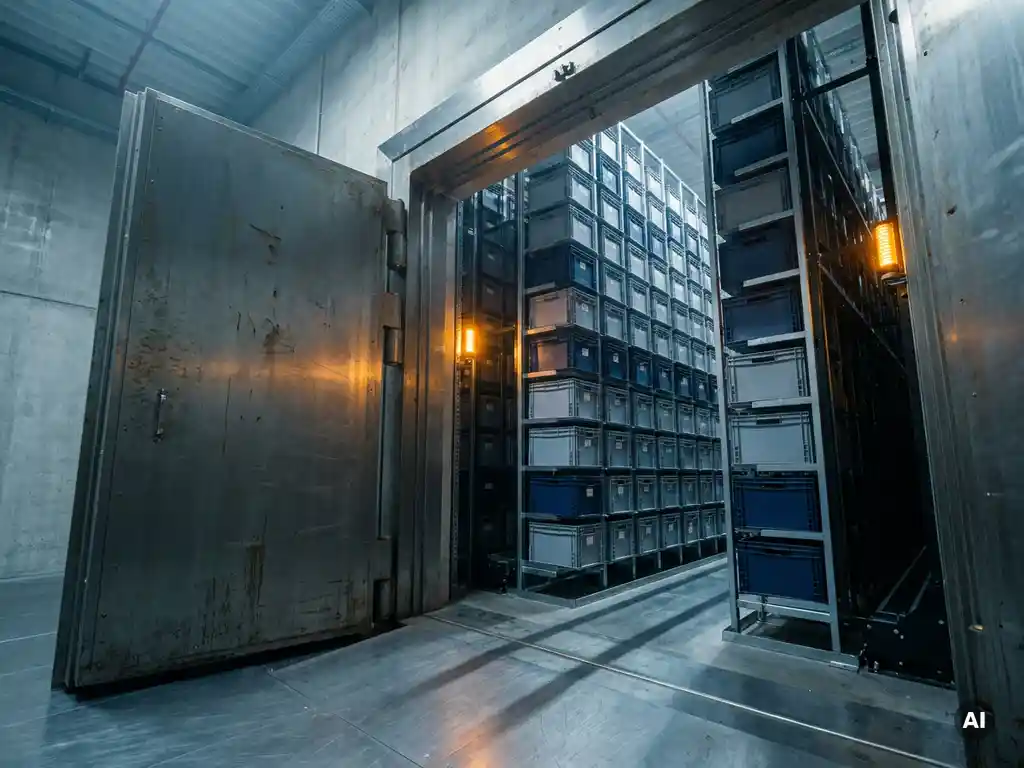
For large-volume distributors and warehouses, the DEA distinguishes between approved safes and full vaults. A DEA-compliant vault must have reinforced concrete walls of a minimum specified thickness, a steel-lined door with a combination or key lock, an alarm system connected to a central monitoring station, and motion detection inside the vault. Approved safes must meet weight and construction standards designed to prevent removal or forced entry within a defined time threshold. The DEA publishes detailed construction specifications in its regulations, and any warehouse uncertain about whether existing infrastructure qualifies should seek a pre-inspection consultation.
Alarm and monitoring requirements
An approved alarm system is mandatory for facilities storing Schedule I and II substances. The system must detect unauthorized entry, be connected to a monitoring station capable of notifying local law enforcement, and be capable of detecting intrusion within the storage area itself rather than only at perimeter entry points. Access controls, surveillance cameras, and visitor logs are additional security layers that DEA investigators routinely expect to see during inspections, even when not explicitly codified for every registration type.
How are controlled substances classified and why does it affect storage?
Controlled substances are classified into five schedules under the Controlled Substances Act based on their accepted medical use, abuse potential, and risk of dependence. Schedule I substances have no accepted medical use and the highest abuse potential; Schedule V substances have the lowest abuse potential and accepted medical applications. The schedule classification directly determines what physical security infrastructure, recordkeeping frequency, and ordering procedures a warehouse must maintain.
Schedule II substances, which include many opioids, stimulants, and certain depressants, carry the strictest warehouse storage requirements. Procurement requires a DEA Form 222 or its electronic equivalent (CSOS), and these substances must be stored separately from other inventory in a vault or approved safe. A warehouse storing Schedule II opioids faces a materially different compliance burden than one storing only Schedule IV or V products.
Schedules III through V permit somewhat more operational flexibility, but they are not unregulated. Warehouses must still maintain secure storage, complete accurate dispensing records, and report theft or significant losses. Many warehouses that handle a broad pharmaceutical assortment will store substances across multiple schedules simultaneously, requiring segregated storage areas and separate inventory records for each schedule category.
What recordkeeping and inventory requirements apply to warehouse storage?
Warehouses storing controlled substances must maintain complete, accurate records of every transaction involving those substances, including receipts, distributions, returns, and destructions. Records must be kept for a minimum of two years and be readily retrievable for DEA inspection. Schedule I and II records must be stored separately from all other records; Schedule III through V records may be stored with other business records if they are clearly identified and retrievable.
A biennial inventory is required under federal law. Every two years, the warehouse must conduct a physical count of all controlled substances on hand and document the results. For Schedule I and II substances, an exact count is required. For Schedule III through V substances, an estimated count is permissible if the substance is in a container holding more than 1,000 units, though an exact count is always acceptable. The inventory must be dated, signed, and retained as part of the facility’s official records.
Acquisition records are equally critical. Schedule II substances can only be ordered using DEA Form 222 or through the Controlled Substances Ordering System (CSOS). These documents create a paper trail linking every unit of a Schedule II substance from manufacturer to distributor to end recipient. Warehouses must reconcile their inventory records against these acquisition documents and investigate any discrepancy that cannot be explained. Unexplained losses must be reported to the DEA using Form 106.
What happens if a warehouse fails a DEA inspection?
If a warehouse fails a DEA inspection, the consequences range from a formal warning and required corrective action plan to suspension or revocation of the DEA registration, civil monetary penalties, and in cases of deliberate violations, criminal prosecution. The severity of the outcome depends on the nature of the deficiency, whether it reflects a systemic failure or an isolated gap, and whether the registrant has a prior history of violations.
Minor deficiencies, such as incomplete recordkeeping for a small number of transactions or a procedural gap in inventory documentation, typically result in a written warning and a requirement to remediate within a specified timeframe. The DEA may schedule a follow-up inspection to confirm that corrective measures have been implemented.
Serious deficiencies, particularly those involving inadequate physical security, unexplained inventory losses, or evidence of diversion, carry significantly higher risk. The DEA has authority to issue an Order to Show Cause, which initiates proceedings to suspend or revoke the warehouse’s registration. A suspended or revoked registration means the facility can no longer legally possess, store, or distribute controlled substances until the matter is resolved, which can effectively halt pharmaceutical distribution operations. Warehouses that discover compliance gaps before an inspection should document corrective actions proactively, as self-reported remediation is generally viewed more favorably than deficiencies discovered by investigators.
How can automated storage systems support controlled substance compliance?
Automated storage systems can support controlled substance compliance by enforcing access controls at the individual tote or location level, generating auditable transaction records automatically, and enabling lot and batch segregation without relying on manual processes. When integrated with a warehouse management system, automated storage can provide a real-time inventory record that supports both DEA biennial inventory requirements and the ongoing reconciliation that controlled substance regulations demand.
The most compliance-relevant capability of modern automated storage is direct, traceable access to specific inventory units. Traditional dense storage configurations, where products are stacked and a required item may be buried behind others, create retrieval challenges that can compromise batch integrity and make FEFO (First Expired, First Out) compliance difficult to enforce consistently. A system with direct access to every storage location removes this constraint, allowing the software layer to select the correct lot, batch, or expiry date without manual intervention or reshuffling.
Automated systems also reduce the human touchpoints that represent diversion risk. Every retrieval event can be logged with a timestamp, operator credential, tote identifier, and quantity, creating the kind of transaction-level audit trail that DEA inspectors expect to find. This is particularly valuable for Schedule II substances, where the reconciliation between acquisition records and inventory on hand must be precise and defensible.
It is important to note that automation does not replace the physical security requirements the DEA mandates. Vaults, alarm systems, and access controls must still meet regulatory construction and monitoring standards regardless of what storage technology operates inside them. Automated systems complement compliance infrastructure; they do not substitute for it.
How Hexxabotics supports pharmaceutical warehouse compliance
Hexxabotics offers a high-density AS/RS system designed for pharmaceutical distribution environments where regulatory compliance, batch traceability, and inventory accuracy are non-negotiable. For warehouses managing controlled substances alongside broader pharmaceutical assortments, the system provides several compliance-relevant capabilities:
- Direct-access retrieval: Every tote is individually accessible without moving surrounding inventory, supporting accurate lot and batch selection and reducing the risk of picking errors that can create reconciliation discrepancies.
- Automated transaction logging: Each storage and retrieval event is recorded by the Hexxabotics Control System, providing a timestamped audit trail that supports DEA recordkeeping requirements.
- Integration with WMS and orchestration layers: Standard API connectivity allows the system to operate within an existing warehouse management environment, so controlled substance inventory records remain synchronized across systems.
- Scalable capacity without infrastructure redesign: Storage capacity and throughput can be scaled independently, allowing pharmaceutical distributors to accommodate growing SKU counts or order volumes without disrupting compliant storage configurations.
- No in-rack electrification: The passive tower structure simplifies the integration of fire suppression and security monitoring systems required within controlled substance storage areas.
If your warehouse is evaluating how automated storage can support controlled substance compliance while improving operational efficiency, contact the Hexxabotics team to discuss your specific requirements and facility constraints.
Related Articles
- What are the biggest compliance risks in pharmaceutical cold storage?
- How do you train warehouse staff on pharmaceutical compliance requirements?
- How do you implement track-and-trace in an existing warehouse system?
- What is the role of natural light and ventilation in warehouse design decisions?
- What is the difference between forward pick areas and reserve storage in a warehouse?