
A forward pick area holds a small, active quantity of fast-moving inventory at the pick face for immediate order fulfillment, while reserve storage holds the bulk supply of that same inventory in a separate, higher-density location until the pick face needs replenishing. The two zones exist because no single storage format serves both goals equally well: dense bulk storage slows down picking, and ergonomic pick faces cannot hold enough stock to avoid constant restocking trips. This article unpacks how each zone works, what triggers movement between them, and when the traditional boundary between them creates more problems than it solves.
How are warehouse storage zones typically organized?
Most warehouses divide their floor plan into functional zones based on how frequently inventory is touched and how quickly it needs to be accessed. The most common split is between the forward pick area, positioned close to packing and dispatch, and reserve storage, located further back or at height where space is cheaper and density is prioritized.
Beyond this primary division, warehouse storage zones are often organized by a combination of the following factors:
- Product velocity: Fast-moving SKUs are placed in ergonomic, easy-reach locations; slow movers are stored at height or in bulk racking.
- Product size and weight: Heavy items are stored at floor level to reduce handling risk; smaller items may be binned or stored in shelving units.
- Temperature or regulatory requirements: Controlled-environment zones are physically separated from ambient storage.
- Order type: Single-line orders, multi-line orders, and bulk dispatch may each have dedicated pick zones configured for their specific workflow.
The underlying logic is that a picker’s time is the most expensive variable in manual fulfillment. Organizing zones to minimize travel distance, reduce bending and reaching, and keep the highest-frequency products within arm’s reach directly improves pick rates and reduces labor cost per order.
What is a forward pick area in a warehouse?
A forward pick area, also called a pick face or active pick zone, is a dedicated section of the warehouse where pickers fulfill orders directly from a small, replenished quantity of inventory. It holds only enough stock to sustain picking for a defined period, typically a shift or a day, rather than the full stock holding of a product.
The forward pick area is designed for speed and ergonomics. Locations are set at a consistent working height, labeled clearly, and positioned to minimize travel between picks. In a conventional warehouse layout, this zone sits closest to packing, sorting, and dispatch so that completed picks travel the shortest possible distance before leaving the building.
The trade-off is capacity. A pick face optimized for speed cannot also hold deep inventory. A forward pick location might hold two to four days of demand for a product, meaning it must be refilled regularly from a separate reserve location. This is what creates the operational dependency between the pick face and reserve storage.
What is reserve storage and how does it differ from active inventory?
Reserve storage is the bulk holding area where full case quantities, pallets, or large tote volumes of inventory are kept until the forward pick area needs replenishing. It differs from active inventory in that it is not picked from directly during order fulfillment; it is a supply buffer that feeds the pick face rather than serving orders itself.
Active inventory, by contrast, is the stock currently available at the pick face and ready to be selected for an order without any intermediate handling step. Reserve stock must go through a replenishment process before it becomes active inventory.
Reserve storage is typically located in high-bay racking, floor-level bulk positions, or automated storage systems where density is the priority rather than pick ergonomics. Because pickers do not work directly in reserve storage during order fulfillment, the layout can prioritize cubic space utilization over aisle width and working-height accessibility. This is why reserve areas often use narrower aisles, taller racking, and less forgiving storage formats than the forward pick zone.
What triggers replenishment from reserve storage to the pick face?
Replenishment is triggered when the quantity at the pick face drops to a predefined minimum level, known as a replenishment trigger point or reorder level. When stock at the pick face falls to or below this level, a replenishment task is generated to move product from reserve storage to the active pick location before it runs out entirely.
The most common replenishment methods follow one of two patterns:
- Reactive replenishment: A pick face location reaches its minimum quantity and a task is automatically created. A replenishment operative retrieves the required quantity from reserve storage and refills the pick face. This is the most widely used approach and works well when demand is predictable.
- Proactive or wave-based replenishment: Replenishment tasks are generated in advance of a pick wave, based on the planned pick volume. Reserve stock is moved to the pick face before picking begins, reducing the risk of a picker arriving at an empty location mid-wave.
The trigger point itself is calculated from expected demand during the replenishment lead time. If it takes 20 minutes to complete a replenishment task and the pick face serves 30 units per hour, the trigger point should be set no lower than 10 units to avoid a stockout at the pick face. Getting this calculation wrong in either direction creates problems: too high and replenishment operatives are constantly moving stock unnecessarily; too low and pickers encounter empty locations and lose productive time waiting.
When does separating pick areas from reserve storage create operational problems?
Separating pick areas from reserve storage creates operational problems when the replenishment process cannot keep pace with picking demand, when SKU counts grow faster than pick face capacity, or when the physical distance between the two zones adds significant labor cost and time to the fulfillment process.
The most common failure modes include:
- Pick face stockouts: Replenishment tasks are not completed before pickers arrive at empty locations, causing delays, workarounds, and reduced pick rates.
- Replenishment labor bottlenecks: As SKU counts increase, the volume of replenishment tasks grows proportionally. At high SKU counts, replenishment can consume as much labor as picking itself.
- Slotting complexity: Deciding which products belong at the pick face and which remain in reserve requires ongoing analysis. When demand patterns shift, a product that was correctly slotted in the forward pick area may no longer justify its prime location, but re-slotting takes time and resources.
- Space inefficiency: Maintaining a dedicated forward pick area means allocating floor space to ergonomic but low-density storage. As operations scale, this zone can consume a disproportionate share of available warehouse space.
These problems compound in operations with high SKU diversity, seasonal demand peaks, or frequent product range changes. The more dynamic the assortment, the harder it becomes to maintain a well-calibrated boundary between active and reserve inventory.
How does automated storage eliminate the boundary between pick and reserve?
Automated storage systems, particularly Goods-to-Person AS/RS solutions, eliminate the functional boundary between pick and reserve by making every stored tote directly accessible at a workstation without a separate replenishment step. The system retrieves any stored item on demand, so there is no need to pre-position a subset of inventory at an ergonomic pick face while holding the rest in a separate bulk location.
In a conventional layout, the pick face exists because a human picker must walk to inventory and retrieve it quickly. The forward pick area brings a small quantity of fast-moving stock close to the picker. When the goods come to the picker instead, the rationale for a separate pick face largely disappears. The entire stored inventory becomes, in effect, active inventory: any tote can be retrieved and presented to an operator within seconds.
This architectural shift has several practical consequences. Storage density improves because the system exploits the full building height rather than dedicating floor space to ergonomic but shallow pick face locations. Replenishment labor is reduced or eliminated because the system manages retrieval directly. And the operational distinction between fast-mover and slow-mover locations becomes less critical, since the retrieval time for any location is determined by the system rather than by a picker’s travel distance.
The result is a more unified inventory model where warehouse automation handles both the storage density function and the pick presentation function within a single architecture, rather than requiring separate zones optimized for separate purposes.
How Hexxabotics helps with forward pick and reserve storage management
Hexxabotics removes the operational tension between pick face efficiency and reserve storage density by consolidating both functions into one automated system. Key capabilities that directly address the challenges covered in this article include:
- 100% direct access: Every tote in the system is retrievable without moving other totes first, eliminating the need for a separate forward pick zone to pre-position fast-moving stock.
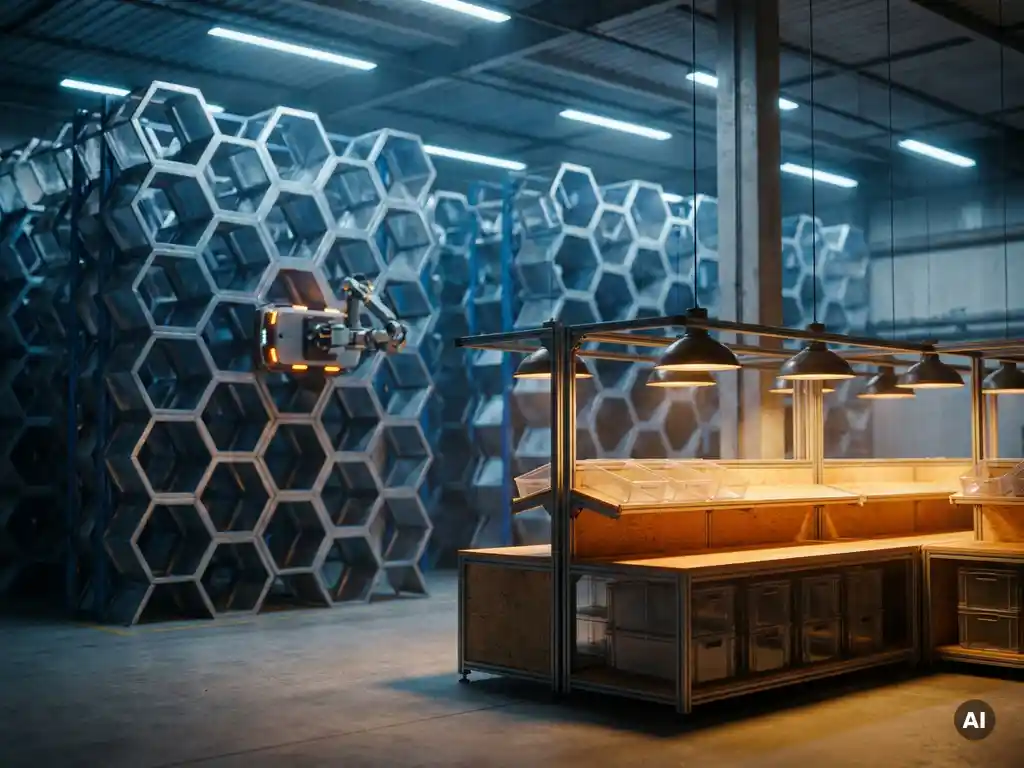
- Cubic space utilization up to 16 meters: The hexagonal vertical grid uses the full building height, replacing both low-density pick face shelving and high-bay reserve racking with a single dense structure.
- Independent scaling of capacity and throughput: Storage capacity grows by extending the structure; throughput grows by adding Hexxabot units. Neither change requires a redesign of the other, and both can happen without stopping daily operations.
- No in-rack electrification: Robots charge autonomously during operation, reducing infrastructure complexity and maintenance overhead compared to conventional AS/RS designs.
- WMS integration via standard APIs: The Hexxabotics Control System connects to existing warehouse management systems, preserving inventory logic and order orchestration without replacing established processes.
If your operation is outgrowing the traditional pick-face-and-reserve model, learn more about Hexxabotics and speak with the team about how the system can be configured for your facility and SKU profile.
Related Articles
- What is the role of serialization in preventing drug counterfeiting?
- How does batch traceability work in pharmaceutical warehousing?
- What is direct-access storage and how does it support drug recalls?
- What documentation is required for controlled substance warehousing?
- What are audit trail requirements for pharmaceutical warehouses in 2026?