
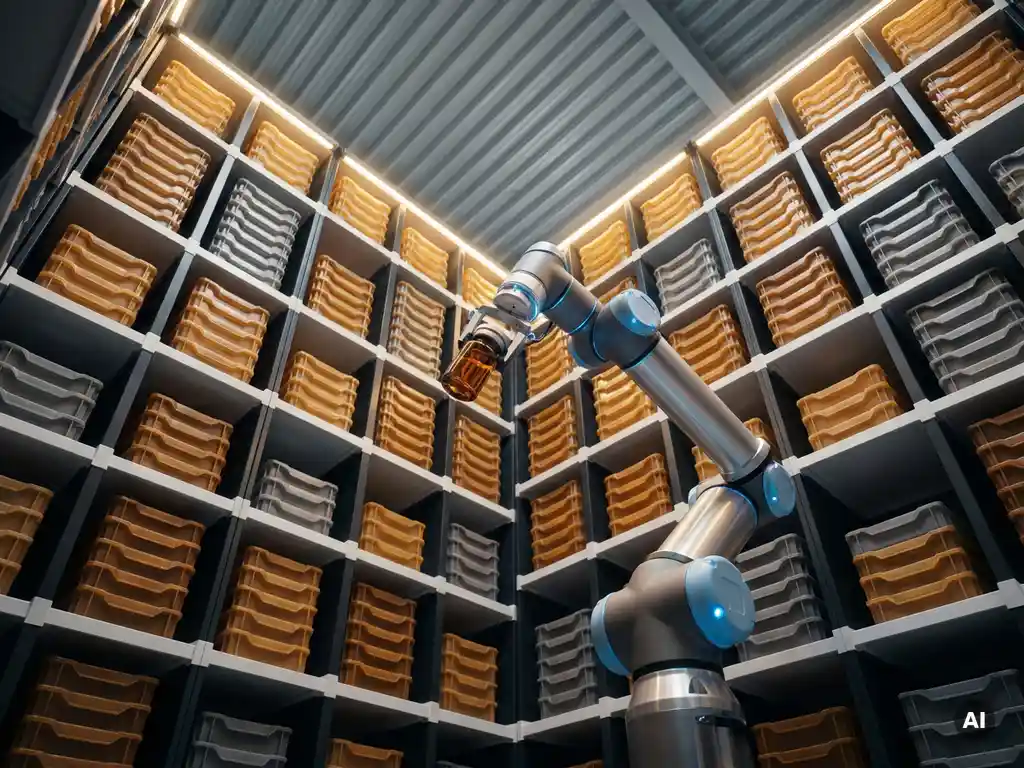
Direct-access storage supports drug recalls by making every stored tote or lot immediately retrievable without moving surrounding inventory first. Because no digging or reshuffling is required, warehouse teams can isolate and quarantine a recalled batch in minutes rather than hours. This matters most in pharmaceutical environments where regulatory timelines are strict and delays carry serious compliance and patient-safety consequences. The questions below unpack how this works in practice and what it means for your recall readiness.
How does direct-access storage enable faster drug recall execution?
Direct-access storage enables faster drug recall execution because every storage location is individually reachable without disturbing adjacent inventory. When a recall notice arrives, the system can immediately retrieve all totes associated with a specific lot number, batch, or SKU and route them to a quarantine point, compressing what can otherwise be a multi-hour manual process into a controlled, rapid automated sequence.
In conventional dense storage, retrieving a specific container often means moving everything stacked above or in front of it first. That reshuffling takes time, introduces handling errors, and risks mixing recalled product with compliant inventory. A direct-access architecture eliminates this entirely. Each tote is individually addressed, and the retrieval logic can be driven by batch identifiers, expiry dates, or operational priority flags rather than physical position alone.
The practical result is that recall scope can be executed systematically and completely. Rather than relying on operators to manually locate and pull affected units across a large warehouse floor, the system works through the recall list autonomously, reducing both the time to completion and the risk of missed units.
What role does lot-level traceability play in recall compliance?
Lot-level traceability is the foundation of recall compliance. Without knowing exactly which lot numbers are stored in which locations, a warehouse cannot execute a targeted recall. It must instead quarantine entire product lines as a precaution, which is operationally disruptive and commercially costly. Granular lot tracking allows teams to isolate only the affected batch while leaving unaffected inventory in service.
In regulated pharmaceutical distribution, traceability extends beyond knowing where a product is stored today. It includes a full inventory history: when a lot arrived, where it was positioned, whether it was moved, and when it was picked or dispatched. This audit trail is what regulators and pharmaceutical manufacturers expect to see when a recall is initiated or reviewed.
When an automated storage system maintains lot-level records integrated with a warehouse management system, that traceability becomes searchable and reportable in real time. A recall query against a specific batch number returns an immediate list of affected totes and their locations, rather than requiring a manual stock count across multiple warehouse zones. This is the difference between a recall that takes hours and one that takes days.
How do automated storage systems reduce human error during recalls?
Automated storage systems reduce human error during recalls by removing reliance on manual identification, physical search, and operator judgment under time pressure. The system retrieves inventory based on verified digital records rather than label reading or memory, which eliminates the misidentification errors that are most likely to occur during a high-urgency, high-stress recall event.
Manual recall processes are vulnerable at several points. Operators may misread lot numbers, overlook units stored in secondary locations, or inadvertently handle recalled product alongside compliant stock. In a large warehouse with thousands of SKUs, the probability of at least one error increases with every manual step added to the process.
Automation addresses this by executing retrieval instructions derived directly from the inventory database. Every tote retrieved is matched against the recall criteria before it leaves its storage location. The system logs each action, creating a timestamped record that confirms which units were retrieved, when, and in what sequence. This documentation is directly useful for regulatory reporting and internal audit purposes following a recall event.
What’s the difference between direct-access and FIFO storage for recall scenarios?
Direct-access storage and FIFO storage serve different primary purposes, and they behave very differently during a recall. FIFO (First In, First Out) is a sequencing rule that determines the order in which inventory is retrieved based on arrival date. Direct access is an architectural property that determines whether any specific unit can be retrieved without moving others. A system can implement FIFO without offering direct access, and this distinction becomes critical during recalls.
FIFO in a recall scenario
FIFO ensures that older stock is dispatched before newer stock, which supports expiry management under normal operating conditions. However, a recall rarely aligns neatly with arrival order. A recalled batch may have arrived at any point in the inventory cycle, and FIFO logic alone does not help retrieve it efficiently if physical access to that batch requires moving other inventory first. In a traditional FIFO buffer or deep-lane racking system, reaching a mid-stack lot can require significant reshuffling.
Direct access in a recall scenario
Direct-access storage allows the system to retrieve any specific tote, regardless of its position in the storage structure, without disturbing surrounding inventory. During a recall, this means the affected lot can be targeted and extracted immediately, even if it arrived weeks ago and has been surrounded by newer stock ever since. The two approaches are not mutually exclusive: a direct-access system can also apply FEFO (First Expired, First Out) or FIFO logic during normal operations, while retaining the ability to override that sequence for recall or quarantine purposes.
Which warehouse automation systems support pharmaceutical recall requirements?
Warehouse automation systems that support pharmaceutical recall requirements share three characteristics: direct or individually addressed storage locations, integrated lot and batch tracking, and software that can execute priority retrieval based on regulatory identifiers. Automated Storage and Retrieval Systems (AS/RS) with goods-to-person architectures are the most commonly deployed technology class in pharmaceutical distribution environments where these requirements apply.
Within the AS/RS category, the specific architecture matters. Systems that rely on a single crane or centralized lifting mechanism can create throughput bottlenecks during a recall, when rapid retrieval of many affected units is required simultaneously. Distributed robotic architectures, where multiple autonomous units operate in parallel, maintain retrieval throughput even when a large recall batch must be processed urgently.
Software integration is equally important. The automation hardware must connect to a Warehouse Management System (WMS) or Warehouse Execution System (WES) that holds lot-level inventory records and can generate retrieval instructions based on batch identifiers, expiry data, or regulatory flags. Without this software layer, even a technically capable AS/RS cannot execute a targeted recall efficiently. Pharmaceutical warehouse automation that combines direct-access hardware with lot-aware software orchestration is specifically designed to meet these requirements.
How does storage density affect recall speed in high-volume warehouses?
Storage density affects recall speed because higher density means more units are stored in a smaller physical space, which increases the number of totes that must be accessed and managed during a recall event. In a dense warehouse, the ability to retrieve individual units without disturbing surrounding inventory becomes more important, not less, because the margin for reshuffling is smaller and the consequences of errors are amplified across a larger inventory volume.
Conventional high-density approaches, such as deep-lane pallet racking or buffer systems, trade accessibility for compactness. They work well for high-volume, uniform inventory flows but become a liability when a recall requires targeted retrieval from within a densely packed storage block. The denser the storage, the more disruptive the digging process becomes.
Vertical density managed through a direct-access architecture resolves this trade-off. By utilizing building height rather than expanding floor area, and by making every vertical position individually accessible, a warehouse can achieve high storage density without sacrificing the retrieval precision that recall compliance demands. The result is a facility that holds more inventory within a compact footprint while retaining the ability to extract any specific lot on demand, at speed, without operational disruption to the surrounding stock.
How Hexxabotics supports pharmaceutical recall readiness
Hexxabotics delivers a direct-access AS/RS architecture specifically suited to the recall compliance requirements of pharmaceutical distribution. The system is designed to combine high storage density with individual tote addressability, so every lot is retrievable without reshuffling surrounding inventory. Key capabilities relevant to recall scenarios include:
- 100% direct access to all storage locations, eliminating digging and the errors that come with it
- Lot and batch-aware retrieval when integrated with a WMS or WES, enabling targeted quarantine based on regulatory identifiers
- Distributed robotic operation with no single point of failure, maintaining throughput during high-urgency recall events
- Vertical density up to 16 meters, maximizing storage capacity within a compact footprint without sacrificing accessibility
- Independent scaling of storage capacity and throughput, so operations can grow without redesigning the infrastructure that supports recall readiness
If your pharmaceutical distribution operation needs storage that supports batch traceability and regulatory workflows without compromising retrieval speed, contact the Hexxabotics team to discuss how the system can be configured for your environment.
Related Articles
- How does warehouse design impact GMP compliance for pharmaceuticals?
- How does batch traceability work in pharmaceutical warehousing?
- What is the difference between forward pick areas and reserve storage in a warehouse?
- Can warehouse automation lower your energy consumption?
- How do warehouse AMRs communicate and coordinate in real time?