
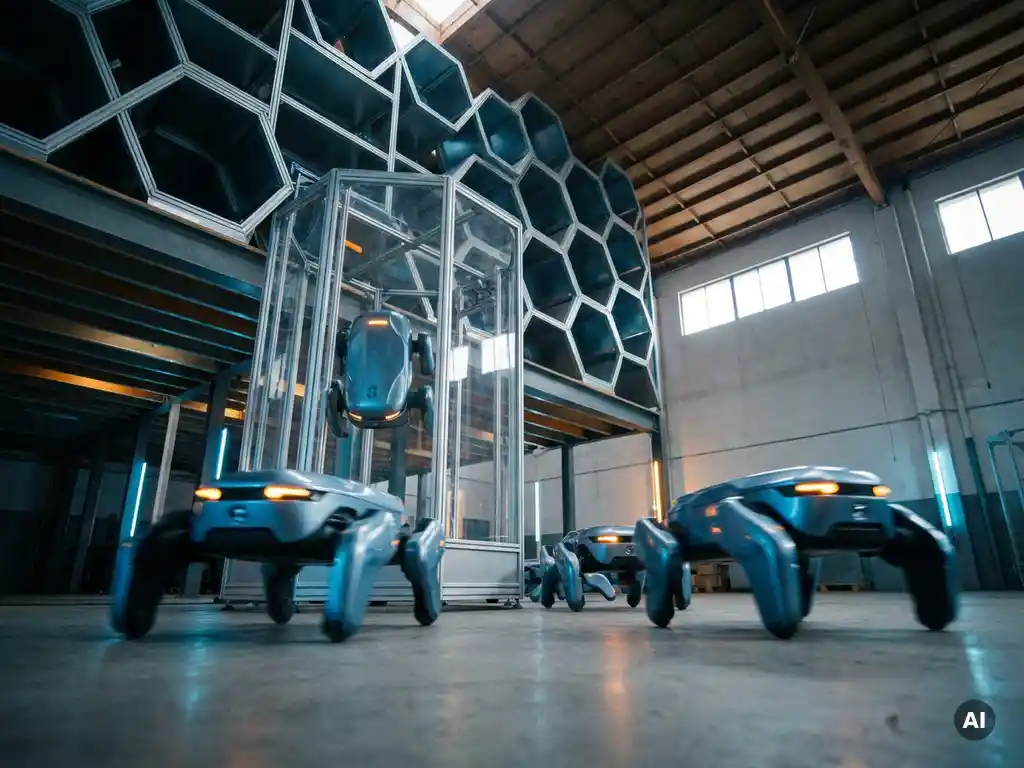
Warehouse AMRs communicate and coordinate in real time using a combination of wireless network protocols, onboard sensors, and centralized or distributed fleet management software. Each robot continuously exchanges position data, task status, and environmental information with a control system that orchestrates movement, assigns jobs, and prevents conflicts across the entire fleet.
The specific protocols and coordination logic vary by system architecture, but the underlying principle is consistent: robots must share a common operational picture to move efficiently without interfering with one another. The sections below break down the key mechanisms, from communication protocols to WMS integration and fault handling.
What protocols do warehouse AMRs use to communicate?
Warehouse AMRs primarily communicate over Wi-Fi (IEEE 802.11) networks, using standard TCP/IP or UDP protocols to exchange data with fleet management software and other system components. Some deployments supplement Wi-Fi with ultra-wideband (UWB) for precise indoor positioning, or use MQTT as a lightweight messaging protocol optimized for frequent, low-latency updates.
The choice of protocol depends on the demands of the application. Wi-Fi is the dominant transport layer because it covers large areas with existing infrastructure, but its reliability in dense warehouse environments depends heavily on network design. Dead zones, channel congestion, and interference from metal racking can all degrade signal quality, which is why robust deployments invest in dedicated wireless infrastructure rather than relying on general-purpose corporate networks.
At the application layer, MQTT has become widely adopted for AMR telemetry because it uses a publish-subscribe model that reduces bandwidth consumption. Robots publish status updates to a broker, and the fleet management system subscribes to those streams, processing position, battery level, task state, and error codes in near real time. Some enterprise systems also use OPC UA or REST APIs to expose robot data to higher-level warehouse management platforms.
How does a fleet management system coordinate multiple AMRs?
A fleet management system (FMS) coordinates multiple AMRs by acting as a central dispatcher: it receives task requests from the warehouse management system, assigns jobs to available robots based on proximity and workload, calculates optimal paths, and continuously monitors each unit’s position and status to dynamically reassign tasks when conditions change.
The coordination logic typically runs on a dedicated server or cloud instance and maintains a real-time map of the warehouse floor. Each robot reports its position at regular intervals, and the FMS uses this data to build a shared spatial model. When a new pick or transport task arrives, the system evaluates which robot can complete it most efficiently, factoring in current location, battery state, and queued workload.
Static task assignment versus dynamic reallocation
Simpler fleet systems assign tasks at the start of a shift and do not adjust mid-execution. More sophisticated platforms use dynamic reallocation, where the FMS continuously re-evaluates assignments as conditions change. If a robot encounters an obstacle, loses battery faster than expected, or a higher-priority order arrives, the system can reroute or reassign tasks in real time without human intervention.
Distributed versus centralized coordination
Traditional fleet management is centralized: one system makes all routing decisions. Distributed architectures push some decision-making to the robots themselves, allowing peer-to-peer negotiation for path priority. Distributed systems tend to be more resilient because they eliminate the single point of failure that a centralized controller represents. In practice, most commercial warehouse AMR systems use a hybrid approach, with a central FMS handling task assignment and robots managing local collision avoidance autonomously.
How do AMRs avoid collisions in a shared warehouse space?
AMRs avoid collisions through a layered approach combining onboard sensors for local obstacle detection, fleet-level path planning to prevent route conflicts, and traffic management rules that assign right-of-way in shared zones. No single mechanism is sufficient on its own; reliable collision avoidance requires all three layers working together.
At the robot level, LiDAR, depth cameras, and ultrasonic sensors create a real-time picture of the immediate environment. When a robot detects an obstacle within its safety zone, it decelerates or stops automatically. This local reaction is fast but reactive. The more efficient approach is proactive: the fleet management system plans paths that avoid simultaneous occupation of the same aisle or intersection, so robots rarely need to stop for one another.
Traffic management rules handle the remaining edge cases. These include defined priority corridors, speed limits in high-density zones, and reservation systems where a robot claims a segment of path before entering it. If two robots request the same segment simultaneously, the FMS grants access to one and holds the other until the segment clears. This logic is analogous to traffic light control, applied dynamically across hundreds of possible conflict points on the warehouse floor.
What’s the difference between AMRs and AS/RS robots in terms of coordination?
AMRs navigate freely through open warehouse space and require dynamic, real-time coordination because their paths are not fixed. AS/RS robots, by contrast, operate within a defined physical structure and follow constrained movement patterns, which makes their coordination more deterministic and less dependent on continuous real-time negotiation.
A conventional AMR fleet must solve complex multi-agent pathfinding problems continuously because any robot can theoretically be anywhere on the floor at any time. The coordination system must account for an enormous number of possible conflict scenarios. AS/RS robots work within a grid or rack structure where movement is constrained to specific axes, which dramatically reduces the coordination problem. The system knows exactly where each robot can and cannot go at any given moment.
Some next-generation AS/RS architectures, such as Hexxabotics, take a distributed approach that combines the structural predictability of AS/RS with the scalability benefits of parallel robot operation. Autonomous units navigate beneath the storage grid for horizontal transport while detachable climber units handle vertical access within each tower independently. Because there are no centralized cranes or lift shafts, coordination does not depend on sequencing access to shared lifting infrastructure. Each robot operates within a defined spatial domain, and throughput scales linearly by adding more units rather than by increasing the capacity of shared equipment.
How do warehouse robots integrate with a WMS in real time?
Warehouse robots integrate with a WMS in real time through standard APIs, most commonly REST or SOAP interfaces, that allow the WMS to send task requests and receive status updates. The robot fleet management system acts as the middleware layer, translating high-level warehouse instructions into specific robot commands and reporting completions back to the WMS as they occur.
The integration flow typically works as follows: the WMS identifies a pick or replenishment task and sends a request to the fleet management system via API. The FMS assigns the task to an available robot, which executes the movement and reports completion. The FMS then sends a confirmation back to the WMS, which updates inventory records and triggers the next step in the fulfillment process.
The quality of this integration has a direct impact on warehouse throughput. Latency in the communication loop means robots wait for instructions that could have been pre-staged. Well-designed integrations use event-driven architectures where the FMS proactively pushes status updates rather than waiting for the WMS to poll, reducing response time and keeping robots in continuous motion. Standard protocols like MQTT or webhooks support this pattern effectively.
What happens when an AMR loses connectivity mid-task?
When an AMR loses wireless connectivity mid-task, it typically stops in place, completes a safe deceleration sequence, and waits for the connection to be restored before resuming. The robot does not abandon its payload or attempt to navigate autonomously to a destination it can no longer confirm with the fleet management system, because doing so could create conflicts with other robots whose positions it can no longer track.
The fleet management system handles the disconnection by marking the robot as unavailable and, depending on the system design, either reassigning its task to another unit immediately or holding the task in a pending state until connectivity resumes. In well-designed systems, the FMS maintains a last-known position for the disconnected robot and treats the area around it as a reserved zone to prevent other robots from routing through that space.
Recovery behavior varies by system. Some AMRs store enough local map data and task context to resume autonomously once the connection is restored, without requiring manual intervention. Others require a brief resynchronization with the fleet management system before they can proceed. The key design principle is that a single robot losing connectivity should not cascade into a broader system failure. Distributed architectures are particularly resilient here: because no single robot is responsible for a critical shared resource, the rest of the fleet continues operating at reduced but stable throughput while the affected unit recovers.
How Hexxabotics helps with warehouse AMR coordination
Hexxabotics addresses the core coordination challenges described in this article through a system architecture that reduces coordination complexity by design rather than solving it entirely through software overhead.
- No centralized bottlenecks: Autonomous Hexxabots navigate beneath the storage grid independently, eliminating the single points of failure that complicate coordination in crane-dependent systems.
- Distributed vertical access: Detachable climber units provide direct vertical access within each tower without competing for shared lift infrastructure, making vertical coordination deterministic and parallel.
- Linear throughput scaling: Adding robots increases throughput without redesigning coordination logic or infrastructure, so the system grows without adding coordination complexity.
- Standard API integration: The Hexxabotics Control System connects to external warehouse management systems through standard APIs, enabling real-time task assignment and status reporting with minimal integration effort.
- No in-rack electrification: Robots charge while in process and operate autonomously, reducing the failure points that typically trigger mid-task connectivity or power loss events.
If you are evaluating AS/RS and AMR coordination architectures for a new or existing facility, explore the Hexxabotics system to see how distributed robotic design can simplify fleet coordination while delivering independently scalable storage and throughput performance.
Related Articles
- What are the long-term operational costs of warehouse automation?
- Can warehouse automation lower your energy consumption?
- How does predictive maintenance prevent downtime in automated warehouses?
- How do 3PL providers choose between leasing and buying automation equipment?
- What is the difference between an AMR and an AGV in warehousing?