
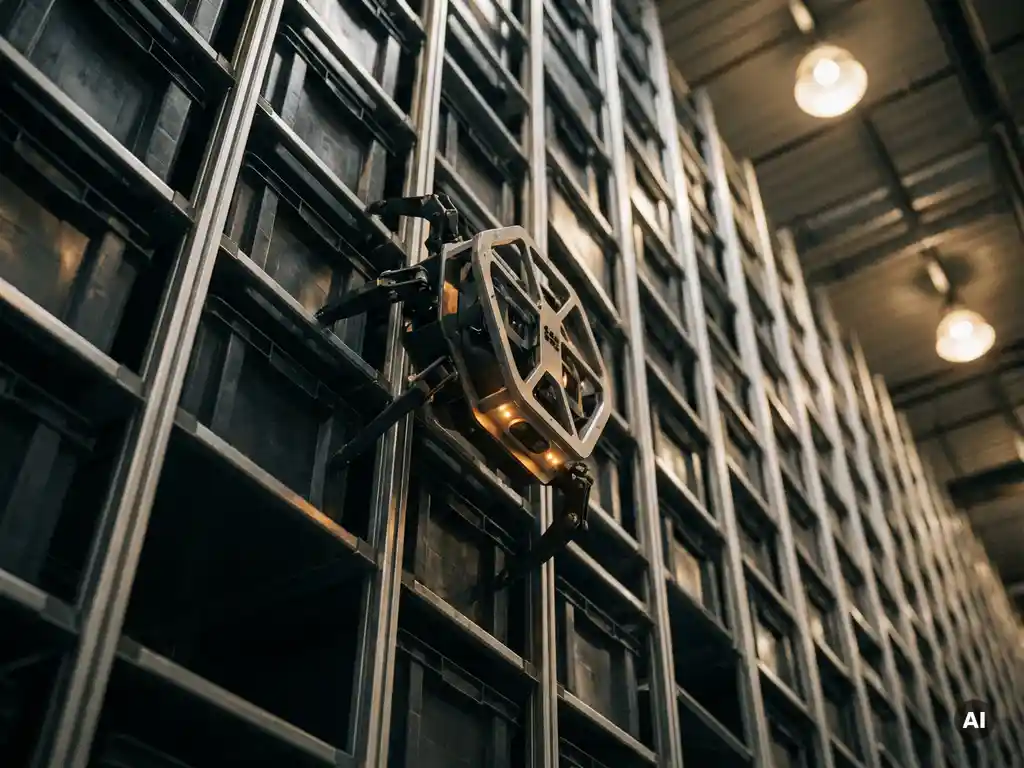
Predictive maintenance prevents downtime in automated warehouses by continuously monitoring robot and system performance data to identify early signs of mechanical or electronic degradation before a failure actually occurs. Instead of waiting for something to break or following a fixed service schedule, the system flags anomalies in real time and triggers maintenance actions at the right moment. The sections below unpack exactly how this works across sensors, control systems, failure types, and integration with warehouse management software.
What data does predictive maintenance actually monitor in automated warehouses?
Predictive maintenance in automated warehouses monitors motor load, vibration patterns, temperature readings, battery state, cycle counts, and error-rate logs from robotic units and mechanical components. This data is collected continuously during normal operations and compared against baseline performance profiles to detect deviations that indicate wear, misalignment, or impending failure.
In practice, the most operationally useful data streams include:
- Motor current and torque: Elevated draw on drive motors often signals bearing wear or mechanical friction before any visible symptom appears
- Vibration frequency: Unusual vibration signatures in moving components point to imbalance, loosened fasteners, or surface degradation
- Thermal data: Consistent temperature increases in drive electronics or charging contacts indicate electrical stress
- Battery charge and discharge curves: Deviations from expected capacity curves reveal battery degradation ahead of performance loss
- Cycle count and error frequency: A rising rate of retry events or soft faults in a specific robot or location often precedes a hard failure
In systems where robots operate autonomously without in-rack electrification, such as architectures where the rack structure contains no embedded motors or powered components, the monitoring focus shifts almost entirely to the mobile units themselves. This simplifies the data model considerably because there are fewer fixed components to track, and the robots carry their own diagnostic intelligence.
How does predictive maintenance differ from preventive maintenance in warehouse automation?
Predictive maintenance uses real-time performance data to trigger service actions only when evidence of deterioration exists, while preventive maintenance follows a fixed schedule regardless of actual component condition. The key difference is that preventive maintenance is time-based and predictive maintenance is condition-based, which means predictive approaches avoid both premature servicing and unexpected failures more effectively.
Preventive maintenance works on the assumption that components degrade at a predictable rate. A conveyor belt gets inspected every 500 hours, a robot drive unit gets replaced every quarter, and so on. This approach is simple to plan but inefficient in practice: some components are replaced long before they need to be, while others fail between scheduled intervals because their actual wear rate differs from the assumed one.
Predictive maintenance removes that assumption. A robot unit that shows no deviation from its baseline performance profile after 600 hours does not need servicing yet. A different unit that shows rising motor current and increased vibration after only 300 hours gets flagged immediately. The result is maintenance effort concentrated where it is actually needed, which reduces both unnecessary labor and unplanned downtime.
For warehouse automation specifically, the operational stakes are high. A single failed robot in a conventional system with centralized lifting infrastructure can halt an entire aisle or zone. In distributed robotic architectures where multiple autonomous units share the workload, a degraded unit can be taken offline for service while the remaining units continue operating, but only if the degradation is caught early enough to act proactively rather than reactively.
How do warehouse control systems detect early signs of robot failure?
Warehouse control systems detect early signs of robot failure by running continuous statistical comparisons between live telemetry from each unit and established performance baselines, then escalating alerts when readings fall outside acceptable thresholds. Modern control systems combine rule-based threshold alerts with pattern recognition to catch both sudden anomalies and gradual drift that might not trigger a simple threshold alarm.
The detection process typically works in layers:
- Raw telemetry collection: Each robot transmits operational data to the control system continuously, including position accuracy, task completion time, motor load, and battery status
- Baseline comparison: The control system compares incoming data against the unit’s own historical profile and against the fleet average for the same task type
- Anomaly flagging: Deviations beyond defined tolerances generate alerts, categorized by severity and urgency
- Pattern correlation: The system checks whether anomalies are isolated to one unit or appearing across multiple units in the same zone, which can indicate an environmental or infrastructure issue rather than a unit-specific fault
- Maintenance queue generation: Flagged units are automatically added to a maintenance queue with diagnostic context, so technicians arrive with relevant data rather than starting from scratch
The quality of early detection depends heavily on how much operational history the control system has accumulated. A system that has logged thousands of cycles per unit develops precise baselines, making subtle deviations easier to distinguish from normal variation. This is one reason why warehouse automation systems with centralized control logic and rich telemetry pipelines tend to deliver more reliable predictive alerts over time.
What types of failures does predictive maintenance prevent most effectively?
Predictive maintenance is most effective at preventing gradual mechanical wear failures, battery degradation, and drive system faults because these failure modes produce measurable performance signals well before complete failure. It is less effective at preventing sudden, random failures caused by external impacts or manufacturing defects, which offer little or no advance warning.
The failure categories where predictive monitoring delivers the clearest value in automated warehouse environments include:
- Bearing and wheel wear: Progressive friction increases show up in motor current and vibration data long before a bearing seizes
- Battery capacity loss: Charge and discharge curves degrade gradually and are highly predictable, making battery replacement timing highly accurate
- Drive motor degradation: Rising current draw and heat generation in drive motors signal winding or brush wear before failure
- Sensor drift: Navigation and positioning sensors that begin returning inconsistent readings can be recalibrated or replaced before they cause routing errors or collisions
- Charging contact wear: In systems where robots charge during operation, contact resistance increases as connectors wear, which shows up in charging efficiency data
Architectures that eliminate fixed in-rack electrification reduce the total number of failure points that need monitoring. When the rack structure itself contains no embedded electronics, motors, or lifting systems, the predictive maintenance scope is concentrated on the mobile units rather than spread across a complex network of powered rack components. Fewer components in the failure model means fewer monitoring channels and a cleaner signal-to-noise ratio in the alert system.
When should a warehouse operator act on a predictive maintenance alert?
A warehouse operator should act on a predictive maintenance alert based on the alert’s severity classification and the operational context at the time. Critical alerts indicating imminent failure risk require immediate response, while advisory alerts flagging gradual degradation can be scheduled into the next available maintenance window without disrupting throughput.
Effective alert response follows a tiered logic:
- Immediate action: Alerts indicating a high probability of failure within the current shift, such as a battery approaching critical depletion or a motor showing sharp current spikes, warrant pulling the unit from active duty immediately and routing it to a service station
- Scheduled action: Alerts indicating consistent but slow-moving degradation, such as a gradual increase in cycle completion time or a mild vibration signature change, can be scheduled for the next planned maintenance period without operational risk
- Monitored watchlist: Early-stage anomalies that fall within acceptable ranges but show a directional trend get placed on a watchlist with increased monitoring frequency rather than triggering immediate service
The operational advantage of distributed robotic architectures is particularly relevant here. When throughput is generated by multiple autonomous units operating in parallel rather than a single centralized crane or lift mechanism, removing one unit for maintenance does not halt operations. The remaining units absorb the workload, throughput decreases proportionally rather than collapsing, and the operator has a genuine window to act on advisory alerts without forcing an emergency response. This flexibility is what makes predictive maintenance strategies practical rather than theoretical in high-volume warehouse environments.
How does predictive maintenance integrate with warehouse management systems?
Predictive maintenance integrates with warehouse management systems through standard APIs that allow the warehouse control system to share robot health data, maintenance alerts, and service status with the broader WMS platform. This integration enables the WMS to factor robot availability into task assignment, order prioritization, and shift planning rather than treating maintenance as an isolated operational event.
The integration typically covers three functional areas:
Real-time availability reporting
The warehouse control system continuously reports the operational status of each robot unit to the WMS, including any units currently flagged for monitoring or removed for service. The WMS uses this data to adjust task routing dynamically, assigning workloads to available units and avoiding over-scheduling units that are operating under a watchlist flag.
Maintenance event coordination
When a predictive alert escalates to a scheduled maintenance action, the control system communicates the planned downtime window to the WMS. This allows order management logic to prioritize urgent picks before the maintenance window opens and to defer lower-priority tasks until full robot capacity is restored. The result is that planned maintenance has a measurable but manageable impact on throughput rather than causing unpredictable disruption.
Systems built on open API architecture make this coordination straightforward. When the warehouse control system uses standard integration protocols, connecting predictive maintenance data flows to existing WMS platforms does not require custom development for each deployment. This reduces integration effort and ensures that maintenance intelligence is accessible across the full operational stack rather than siloed inside the automation layer.
How Hexxabotics helps prevent downtime in automated warehouses
Hexxabotics is designed from the ground up to reduce the conditions that cause downtime in the first place, making predictive maintenance strategies more effective and easier to execute. Key features that directly support uptime reliability include:
- No in-rack electrification: The hexagonal tower structure contains no embedded motors, electronics, or lifting systems, eliminating an entire category of fixed infrastructure failures from the maintenance scope
- Distributed robot operation: Multiple autonomous Hexxabots share the workload in parallel, so removing one unit for maintenance or service does not halt operations, and throughput scales down proportionally rather than stopping
- No single point of failure: The absence of centralized cranes or lift shafts means there is no core component whose failure brings the system down
- Standard API integration: The Hexxabotics Control System connects with external warehouse management systems through standard APIs, enabling maintenance data to flow directly into operational planning
- Autonomous charging during operation: Hexxabots charge while in process, reducing idle time and allowing battery health to be monitored continuously across the active fleet
If you are evaluating how to build a more resilient and maintainable automated warehouse, explore the Hexxabotics platform to see how distributed architecture and intelligent control combine to keep operations running.
Related Articles
- What is pharmaceutical warehousing and why does it matter?
- How do you train warehouse staff on pharmaceutical compliance requirements?
- What is the difference between cold chain and ambient pharmaceutical storage?
- What are the controlled substance storage requirements for warehouses?
- How do you build a TCO model for warehouse automation?