
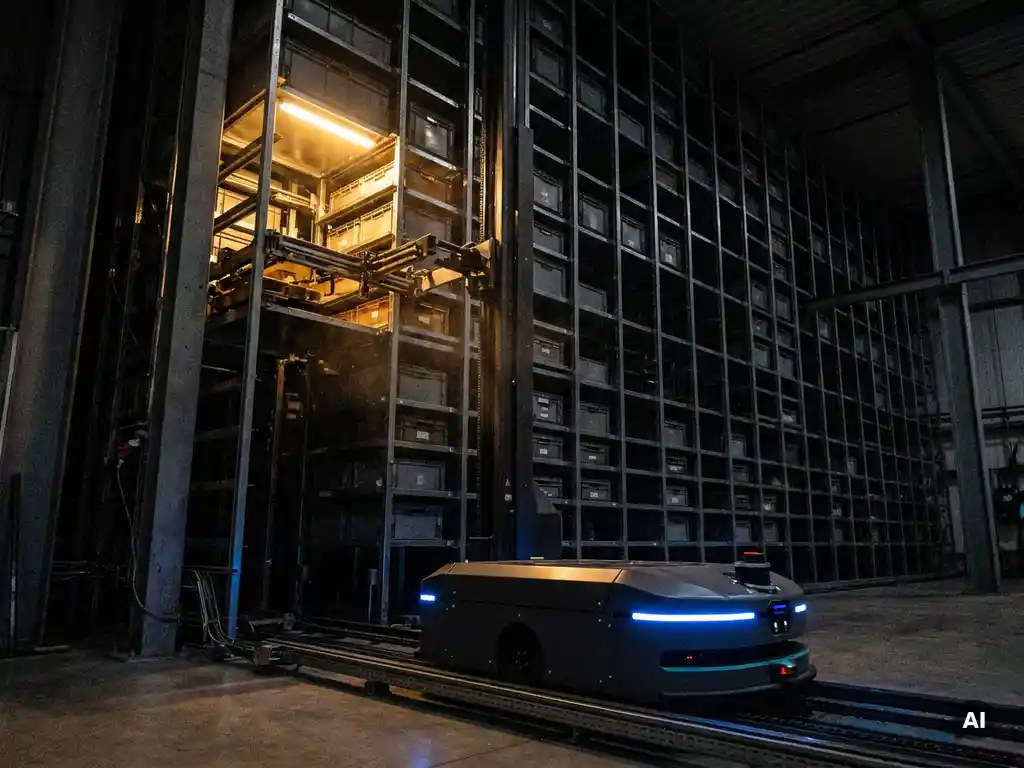
A dark warehouse and a smart warehouse are not the same thing. A dark warehouse operates entirely without human workers on the floor, relying on full automation to run lights-out around the clock. A smart warehouse, by contrast, uses intelligent technology to optimize operations but still involves people working alongside automated systems. Understanding the distinction matters because the two models represent different levels of automation maturity, different capital commitments, and different operational outcomes. The sections below unpack how each model works, where they differ, and how one can evolve into the other.
How does a dark warehouse actually operate?
A dark warehouse operates without any human presence on the warehouse floor during normal operations. Robots, automated conveyors, and warehouse management systems handle every task from receiving and storage to picking and dispatch, entirely without human intervention. The name comes from the fact that, with no workers present, the lights can literally be switched off, cutting energy costs alongside labor costs.
The operational logic of a lights-out warehouse depends on three interconnected layers working in unison. First, physical automation hardware handles movement: autonomous mobile robots, automated storage and retrieval systems, conveyor networks, and robotic picking arms perform every physical task. Second, a warehouse management system or warehouse control system coordinates all activity, directing robots, managing inventory locations, sequencing orders, and flagging exceptions. Third, sensors, cameras, and safety systems monitor the environment continuously, since there are no human eyes on the floor to catch problems in real time.
In practice, human involvement in a dark warehouse is confined to supervisory roles performed remotely or in control rooms, and to maintenance windows where technicians enter the facility to service equipment. Order management, inventory replenishment logic, and throughput optimization all run through software rather than workforce decisions. The result is a facility that can operate continuously, including nights, weekends, and public holidays, without scheduling constraints tied to human labor.
What makes a warehouse ‘smart’ rather than just automated?
A smart warehouse is one where technology actively learns from operational data and adapts decisions in real time, rather than simply executing pre-programmed instructions. Automation executes fixed tasks. Intelligence adapts to changing conditions. A warehouse with conveyor belts and barcode scanners is automated. A warehouse where the system reroutes robots around congestion, predicts demand spikes, and dynamically reassigns storage locations based on order patterns is smart.
The defining characteristic of a smart warehouse is data-driven decision-making at the system level. A warehouse management system in a smart facility does not just track inventory; it analyzes velocity, anticipates replenishment needs, and adjusts picking sequences to minimize travel time. Robots in a smart warehouse respond to real-time conditions rather than following static routes. When one robot goes offline, the system redistributes the workload automatically across the remaining units without human intervention.
Integration is the other pillar. A smart warehouse connects its internal systems, including AS/RS platforms, goods-to-person stations, and inventory software, with external systems such as enterprise resource planning platforms, e-commerce order management tools, and supplier networks through standard APIs. This connectivity allows the warehouse to respond to upstream demand signals and downstream delivery requirements in real time, making the entire supply chain more responsive rather than just making the warehouse itself faster.
What are the key differences between dark and smart warehouses?
The key difference between a dark warehouse and a smart warehouse is human presence and the degree of autonomy. A smart warehouse uses intelligent technology to support and enhance human workers. A dark warehouse eliminates human workers from the operational floor entirely. Every smart warehouse uses automation, but not every smart warehouse operates lights-out. Dark warehouses represent the furthest point on the automation spectrum.
Operational autonomy
In a smart warehouse, humans make judgment calls, handle exceptions, and perform tasks that require dexterity or contextual reasoning that robots cannot yet replicate reliably. In a dark warehouse, the system handles exceptions autonomously, either resolving them through software logic or flagging them for remote human review. The threshold for human involvement is much higher, and most operational decisions never leave the automated system.
Technology requirements
Smart warehouses can be built incrementally, adding automation layers to existing infrastructure without requiring a complete redesign. Dark warehouses typically require purpose-built facilities or major retrofits, since every physical and software system must function reliably without human backup on the floor. The redundancy requirements are also higher: a smart warehouse can compensate for a failed robot with a human worker; a dark warehouse must compensate through system design alone, which means distributed architectures with no single point of failure are essential. Systems like autonomous AS/RS platforms address this through distributed robot operation, where individual unit failures do not halt overall throughput.
Cost and complexity profile
Smart warehouses offer a more accessible entry point, with automation investments that scale alongside operational growth. Dark warehouses carry higher upfront capital costs but can deliver stronger long-term returns in high-volume, repetitive environments where labor costs are significant and operational hours extend beyond what human shifts can cover cost-effectively.
Which industries benefit most from dark warehouse technology?
Industries that benefit most from dark warehouse technology are those with high order volumes, highly repetitive picking tasks, 24-hour operational demands, and significant labor cost pressure. E-commerce fulfillment, pharmaceutical distribution, food and grocery logistics, and fast-moving consumer goods are the sectors where lights-out automation delivers the clearest return on investment.
E-commerce fulfillment is the most prominent use case because order profiles are predictable in structure even when unpredictable in volume. Every order follows the same basic logic: locate, retrieve, pack, dispatch. Automation handles this sequence at scale without fatigue, and dark warehouse systems can sustain throughput through peak demand periods that would require expensive temporary labor in conventional facilities.
Pharmaceutical and cold-chain logistics benefit from a different angle. In these environments, the value of the goods is high, regulatory traceability requirements are strict, and environmental conditions such as cold storage or controlled atmospheres make human working conditions challenging. Removing humans from the operational floor reduces contamination risk, simplifies compliance documentation, and allows the facility to maintain precise environmental controls without designing for human comfort.
Spare parts distribution and 3PL logistics are also strong candidates, particularly where SKU counts are high and storage density is critical. When a facility must manage tens of thousands of distinct items in a compact footprint, automated storage and retrieval systems that provide direct access to every location without reshuffling inventory offer a structural advantage that manual or semi-automated operations cannot match.
Can a smart warehouse evolve into a dark warehouse?
Yes, a smart warehouse can evolve into a dark warehouse, but the transition requires deliberate planning rather than simply adding more robots. The path from smart to lights-out depends on achieving sufficient automation coverage across every operational function, eliminating the tasks that still require human judgment, and building the system redundancy needed to operate safely without people on the floor.
Most warehouses follow an incremental path. They begin by automating high-volume, repetitive tasks such as storage and retrieval, then extend automation to picking, packing, and exception handling as technology matures and confidence in system reliability grows. Each stage reduces the human footprint on the floor. A facility that has automated its AS/RS, integrated goods-to-person workstations, and deployed a capable warehouse management system is already most of the way toward lights-out capability.
The practical barriers are not always technological. Safety certification for unmanned operation, insurance requirements, and regulatory frameworks vary by country and facility type, and these considerations can slow the transition even when the hardware and software are ready. Maintenance access also needs to be designed into the operational model: dark warehouses are not permanently human-free; they are human-free during normal operations, with structured access protocols for technicians.
The most future-proof approach is to build smart warehouse infrastructure on an architecture that was designed for scalability from the start. Systems where storage capacity and throughput scale independently, where no single machine creates a bottleneck, and where the control layer integrates with external platforms through open APIs are far easier to evolve toward lights-out operation than rigid, centralized systems that require structural changes every time performance demands increase.
How Hexxabotics helps with dark and smart warehouse automation
Hexxabotics delivers a next-generation AS/RS designed to support both smart and dark warehouse environments, with an architecture built for the operational demands of each. Key capabilities include:
- Direct access to every storage location with no digging or reshuffling, enabling fully autonomous retrieval without human intervention
- Independent scaling of capacity and throughput by adding towers or robots separately, without structural redesign
- No in-rack electrification, reducing failure points and simplifying maintenance in lights-out environments
- Distributed robot operation that eliminates single points of failure and maintains stable throughput during peak demand
- Standard API integration with external warehouse management systems, supporting the connected intelligence that defines a smart warehouse
- Vertical storage up to 16 meters, converting full cubic volume into usable, revenue-generating capacity
Whether you are building a smart warehouse today or planning a path toward fully lights-out operation, Hexxabotics provides the scalable foundation to support both. Explore the Hexxabotics system to see how the architecture performs across industries and operational scales.
Related Articles
- What is the role of edge computing in real-time warehouse operations?
- Why is robot navigation accuracy critical in automated storage systems?
- What is a warehouse execution system and how does it differ from a WMS?
- How does free-roaming robot technology reduce warehouse downtime?
- When should a 3PL provider invest in automated fulfillment systems?