
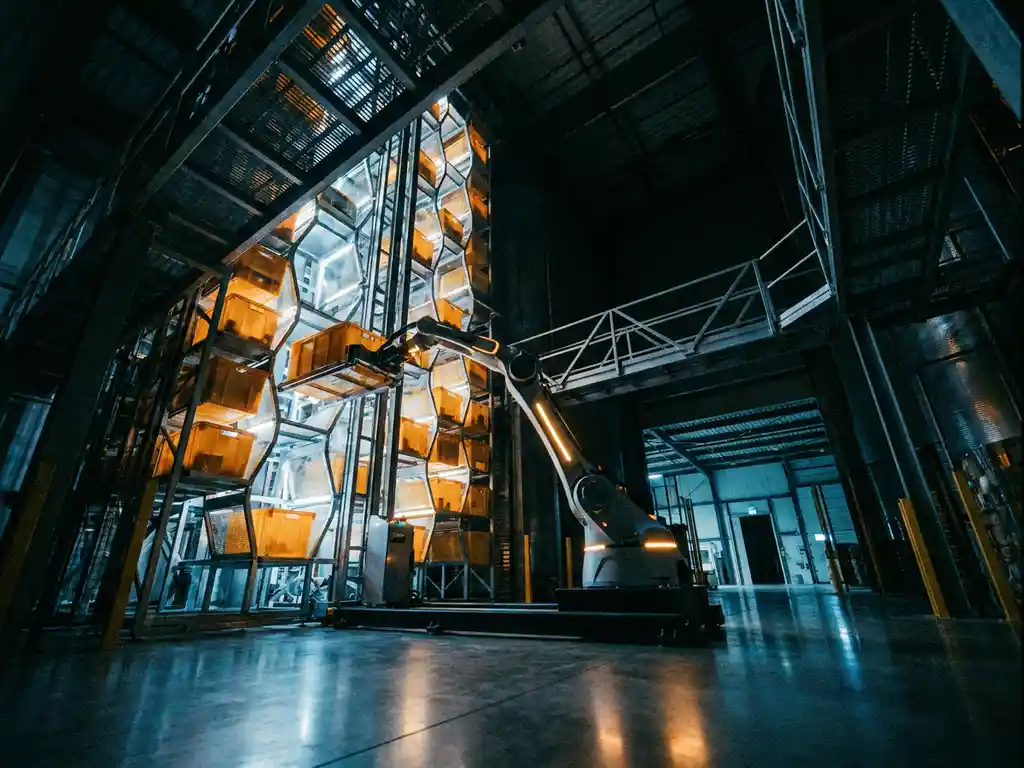
The future of warehouse automation beyond 2026 is defined by three converging forces: artificial intelligence that makes robotic systems genuinely adaptive, three-dimensional storage architectures that extract far more value from existing building footprints, and modular designs that allow companies to scale capacity and throughput independently without rebuilding infrastructure. These shifts are not speculative — they are already visible in the systems being deployed today. The sections below unpack the most pressing questions shaping how warehouses will operate through 2030 and beyond.
How will AI and machine learning reshape warehouse robotics?
AI and machine learning will transform warehouse robotics from rule-based systems that follow fixed instructions into adaptive systems that learn from operational data, predict demand patterns, optimize robot routing in real time, and reduce downtime through predictive maintenance. The result is a warehouse that improves its own performance continuously without requiring manual reprogramming.
Today, most automated warehouses operate on deterministic logic: if a tote is requested, a robot follows a predefined path to retrieve it. Machine learning breaks this constraint. Systems trained on order history can pre-position inventory closer to picking stations before peak demand arrives. Reinforcement learning algorithms allow robot fleets to discover more efficient routing strategies over time, reducing cycle times without any human intervention.
Predictive maintenance is another area where AI delivers measurable value. Rather than scheduling maintenance on fixed intervals, AI-driven systems monitor motor performance, movement patterns, and energy consumption to flag components approaching failure before they cause downtime. For high-throughput environments, avoiding even a single unplanned outage can justify the investment in intelligent monitoring alone.
The broader implication is that the intelligence layer of a robotic warehouse system becomes a compounding asset. The longer it operates, the more data it accumulates, and the more accurately it can optimize. Companies that deploy AI-capable warehouse robotics in 2026 will have a meaningful operational advantage over those that wait.
What is the role of autonomous mobile robots in next-generation warehouses?
Autonomous mobile robots (AMRs) in next-generation warehouses serve as the dynamic transport layer of automated storage and retrieval, replacing fixed conveyors and centralized cranes with distributed robotic units that navigate independently, handle parallel workloads, and scale linearly with throughput demand. Their key advantage is that adding more robots increases performance without requiring structural changes to the facility.
Traditional warehouse automation relies heavily on centralized equipment: a single crane or conveyor serves an entire zone, and when that equipment reaches capacity or fails, the whole system slows. AMRs eliminate this single point of failure. Because each robot operates independently, the system continues functioning even when individual units are taken offline for charging or maintenance.
Horizontal and vertical mobility
In flat-floor applications, AMRs navigate aisles and zones to transport goods between storage areas and workstations. In three-dimensional AS/RS architectures, the concept extends vertically: robotic units navigate beneath a storage grid for horizontal transport and then climb vertically inside storage towers to deposit or retrieve totes. This two-axis mobility is what allows modern systems to exploit full building height rather than limiting storage to floor-level aisles.
Linear throughput scaling
One of the most operationally significant properties of AMR-based warehouse systems is that throughput scales linearly. Each additional robot contributes a predictable increment of picking capacity. This means a warehouse can respond to growth by adding units rather than commissioning an entirely new infrastructure build, which dramatically shortens the lead time between deciding to scale and actually achieving higher output.
How does three-dimensional storage change warehouse space utilization?
Three-dimensional storage fundamentally changes warehouse space utilization by converting vertical building height into active, directly accessible storage rather than leaving it unused above traditional racking. Instead of spreading inventory across a large floor footprint, 3D storage systems stack totes in dense vertical towers, dramatically increasing the number of storage positions available within the same square meters.
Conventional warehouses use perhaps a third of their available cubic volume. Wide aisles, low rack heights, and the need for forklifts to maneuver all consume space that contributes nothing to storage capacity. Three-dimensional AS/RS systems eliminate these constraints by removing the need for aisle access at the rack level entirely. Robots access every storage location directly, which means the structure can be far denser than any human-accessible racking system.
The geometry matters too. Hexagonal storage architectures, for instance, achieve significantly higher space utilization than rectangular grid systems because the hexagonal shape minimizes wasted volume between storage positions while maintaining structural strength. Systems built on this geometry can reach up to 16 meters in height, converting vertical space into revenue-generating storage that would otherwise be empty air. You can explore how this works in practice on the Hexxabotics technology page.
For industrial engineers evaluating site constraints, the practical implication is significant: a three-dimensional AS/RS system can often match or exceed the storage capacity of a much larger conventional facility within a fraction of the footprint. This reduces real estate costs, shortens pick paths, and makes high-density fulfillment viable in urban or constrained locations where expanding floor space is not an option.
What are the biggest technology gaps warehouse automation must close by 2030?
The biggest technology gaps warehouse automation must close by 2030 are: reliable robotic manipulation of irregular items, seamless integration between disparate automation platforms, energy efficiency at scale, and the ability to reconfigure systems quickly in response to demand shifts. These gaps currently limit how broadly and confidently companies can commit to full automation.
- Robotic item handling: Most AS/RS systems handle standardized totes well, but picking individual items of varying shape, weight, and fragility from within those totes remains a challenge. Advances in computer vision and soft robotics are narrowing this gap, but reliable piece-picking at high throughput rates is not yet universally solved.
- System interoperability: Warehouses often run multiple automation platforms from different vendors, and getting them to share data and coordinate actions through standard APIs remains inconsistent. The industry needs robust, widely adopted integration standards to reduce the custom engineering burden on every new deployment.
- Energy consumption: High-density robotic systems running at peak throughput draw significant power. Systems that eliminate in-rack electrification and rely on robots that charge while in motion reduce this burden, but the industry as a whole needs to develop more energy-efficient hardware and smarter power management logic.
- Reconfigurability: Business needs change faster than most automation infrastructure can adapt. Systems that can be physically relocated, expanded during live operations, or reconfigured without structural redesign will have a decisive advantage as demand volatility increases.
Which industries will adopt advanced warehouse automation fastest?
The industries that will adopt advanced warehouse automation fastest are e-commerce and omnichannel retail, food and grocery fulfillment, pharmaceuticals, and fast-moving consumer goods (FMCG). These sectors share the characteristics that make automation most compelling: high order volumes, strict accuracy requirements, time-sensitive fulfillment, and intense pressure on operating costs.
E-commerce and omnichannel retail drive adoption because consumer expectations for next-day or same-day delivery create throughput demands that manual operations cannot sustainably meet. High SKU counts and frequent order profile changes also favor flexible, directly accessible storage systems over static racking.
Food and grocery fulfillment adds temperature sensitivity and short product lifecycles to the mix, making inventory accuracy and retrieval speed critical. Pharmaceutical warehouses face regulatory requirements around batch traceability and controlled access that automated systems with full digital inventory records are well positioned to satisfy.
FMCG operations deal with promotional spikes and seasonal demand surges that strain fixed-capacity systems. Automation that scales throughput by adding robots rather than rebuilding infrastructure is particularly well suited to absorbing these peaks without over-investing in permanent capacity. Spare parts logistics and third-party logistics (3PL) providers are also accelerating adoption, driven by the need to handle diverse product ranges for multiple clients within shared infrastructure.
Should companies invest in warehouse automation before 2026 or wait?
Companies that have not yet invested in warehouse automation should act in 2026 rather than wait. Labor costs are rising, consumer delivery expectations are tightening, and the technology has matured to a point where proven systems are available at commercially viable price points. Waiting increases the operational and competitive gap relative to peers who are already compounding the benefits of automated fulfillment.
The case for acting now rests on several converging factors. First, modern modular AS/RS systems no longer require companies to predict their future needs precisely before committing. Systems that scale capacity by extending the structure and scale throughput by adding robots allow businesses to start with a right-sized deployment and grow incrementally, reducing the risk of over-investing upfront.
Second, the talent market for warehouse labor is structurally constrained in most developed markets. Relying on headcount growth as the primary scaling mechanism is increasingly unreliable and expensive. Automation converts a variable, hard-to-manage labor cost into a more predictable capital and maintenance cost, which improves long-term financial planning.
Third, the total cost of ownership for well-designed automated systems has improved substantially. Systems that eliminate in-rack electrification reduce both installation complexity and ongoing maintenance costs. Systems with distributed robotic fleets avoid the cost and downtime risk associated with centralized equipment failures. These structural improvements mean the payback period for automation investments is shorter today than it was even three years ago.
The companies that will find themselves most constrained are those that delay until competitive pressure forces a rushed implementation. Planning and deploying a well-integrated automated storage system takes time, and starting that process in 2026 positions a business to have operational advantages in place well before the next major demand cycle.
How Hexxabotics helps with next-generation warehouse automation
Hexxabotics delivers a three-dimensional robotic AS/RS built on hexagonal geometry, autonomous Hexxabots, and intelligent control software designed to close the gaps that conventional warehouse automation leaves open. The system addresses the core challenges outlined in this article directly:
- Maximum storage density: Hexagonal towers utilize full cubic building volume up to 16 meters, converting vertical space into directly accessible, revenue-generating storage positions without aisle requirements.
- Independent scalability: Storage capacity and throughput scale independently. Add towers to increase capacity; add robots to increase throughput. No structural redesign is required, and scaling can happen during live operations.
- No single point of failure: Distributed robot operation means the system continues performing even when individual units are offline, maintaining stable throughput through peak demand periods.
- No in-rack electrification: Towers contain no embedded motors, electronics, or fixed lifting systems, reducing installation complexity, maintenance requirements, and energy consumption.
- Direct access to every tote: Every storage location is accessible without digging or reshuffling, enabling 100% direct retrieval and consistent cycle times across the entire system.
- Standard API integration: The Hexxabotics Control System integrates with external warehouse management systems through standard APIs, reducing custom engineering effort on each deployment.
Whether you are evaluating your first automated storage investment or looking to replace a system that has hit its scaling limits, Hexxabotics is built to deliver predictable performance across projects and over time. Get in touch with the Hexxabotics team to discuss how the system fits your specific operational requirements.