
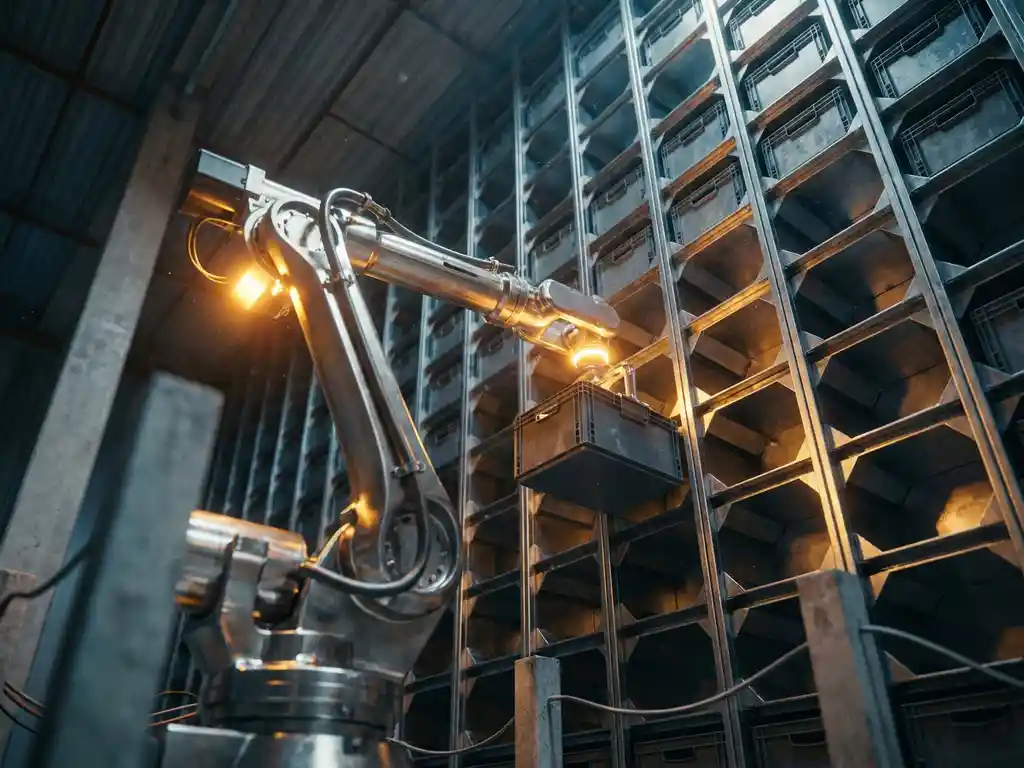
Robotic picking in a fulfillment center means using autonomous machines to locate, retrieve, and deliver individual products or totes to packing or dispatch stations without manual intervention. The robots handle the physical movement of goods through the warehouse, replacing or augmenting human pickers across some or all stages of the order fulfillment process. The questions below unpack how these systems work, which types exist, and what makes them perform.
How does robotic picking actually work in a warehouse?
Robotic picking works by having autonomous machines receive pick instructions from a warehouse management or control system, navigate to the correct storage location, retrieve the required item or tote, and transport it to a human operator or packing station. The entire sequence is managed by software that coordinates robot movement, inventory tracking, and order logic in real time.
Most modern robotic picking systems follow a Goods-to-Person (GTP) model. Instead of sending a worker to walk the warehouse floor, the system brings the product directly to a stationary workstation. This eliminates travel time, which typically accounts for a large share of manual picking labor, and allows operators to focus entirely on handling and packing.
The physical retrieval process depends on the system architecture. In grid-based and tower-based AS/RS environments, robots navigate horizontally beneath or across a storage structure, then climb or reach vertically into the correct location to extract a tote. The tote is then transported to a pick station where a human or robotic arm completes the item-level pick. Advanced systems complete deposit and retrieval in a single vertical cycle, eliminating wasted motion and reducing cycle time.
Software sits at the center of the entire operation. A warehouse control system or robotic control layer manages robot coordination, prevents collisions, prioritizes orders, and keeps inventory records accurate across every transaction.
What types of robotic picking systems are used in fulfillment centers?
Fulfillment centers use several distinct types of robotic picking systems, each with different trade-offs in storage density, throughput, and cost. The main categories are autonomous mobile robots (AMRs), robotic arms, shuttle systems, mini-load cranes, grid-based storage robots, and vertical tower AS/RS systems.
Goods-to-Person systems
Goods-to-Person systems bring storage containers directly to operators rather than routing workers through aisles. This category includes grid-based cube storage robots, vertical carousel systems, and tower-based AS/RS platforms. These systems excel at high-volume, high-SKU environments where pick accuracy and throughput consistency are critical. Tower-based architectures, such as those using hexagonal vertical grids, can utilize full building height up to 16 meters while keeping every storage location directly accessible.
Person-to-Goods and hybrid systems
AMRs guide human pickers through optimized routes rather than replacing them entirely, reducing walking distance without requiring fixed infrastructure. Robotic arms handle item-level picking at workstations, gripping individual products from bins or conveyor feeds. Hybrid deployments combine AMRs for transport with robotic arms for item handling, allowing warehouses to automate incrementally without committing to a full system replacement.
How does robotic picking differ from manual picking?
Robotic picking differs from manual picking in speed consistency, labor dependency, and error rate. Manual picking relies on human workers navigating storage areas, which introduces variability in pace, accuracy, and fatigue. Robotic systems maintain consistent cycle times regardless of shift length, time of day, or order volume spikes.
Manual picking also consumes significant floor space through wide aisles required for human navigation. Robotic systems, particularly Goods-to-Person architectures, eliminate those aisles and allow storage structures to be packed far more densely. This translates directly into more storage positions within the same building footprint.
Labor cost is the most immediate operational difference. Manual picking scales linearly with headcount. Robotic picking scales by adding autonomous units to an existing infrastructure, which means throughput increases without proportional increases in labor cost. However, robotic systems require upfront capital investment, integration effort, and ongoing software maintenance, so the total cost comparison depends on order volume, SKU count, and operational hours.
Error rates in robotic picking are generally lower than manual picking for tote-level retrieval, since robots follow precise instructions and every location is tracked by the control system. Item-level accuracy at the pick station still depends on the quality of barcode scanning, vision systems, or operator verification in place.
What products and SKU types are best suited for robotic picking?
Robotic picking systems perform best with products that fit into standardized totes, have consistent dimensions, and are picked frequently enough to justify automation. High-SKU environments with thousands of distinct product lines, such as e-commerce, spare parts, pharmaceuticals, and FMCG, are strong candidates because robots can access any location without manual search.
Items that are fragile, irregularly shaped, or require tactile judgment during picking are more challenging for fully automated item-level robots, though tote-level retrieval systems handle them well since a human operator completes the final pick at the workstation. This makes Goods-to-Person systems suitable for a broad product range, including fashion apparel, food and grocery, and healthcare consumables.
SKU velocity also matters. Fast-moving products benefit most from high-throughput robotic systems because the time savings per pick accumulate quickly. Slow-moving or long-tail SKUs benefit from dense storage systems that keep every item accessible without manual searching or reshuffling, since those items are harder to locate efficiently in traditional racking.
How does a robotic picking system integrate with a warehouse management system?
A robotic picking system integrates with a warehouse management system (WMS) through standard APIs that pass order data, inventory updates, and pick confirmations between the two platforms. The WMS holds the business logic for order prioritization and inventory ownership, while the robotic control system manages physical execution, robot routing, and real-time location tracking.
Integration typically works in one of two ways. In a tightly coupled setup, the WMS sends individual pick tasks directly to the robotic control system, which executes them and returns confirmation. In a loosely coupled setup, the robotic system operates with its own inventory layer and syncs stock levels with the WMS at defined intervals or transaction points.
Well-designed robotic platforms expose standardized integration interfaces that reduce the engineering effort required to connect with existing WMS platforms. This is particularly important for operations that already run established WMS software and need the robotic layer to fit into the existing technology stack rather than replace it. The Hexxabotics control system connects to external warehouse management systems through standard APIs, making it compatible with existing operational environments without requiring custom middleware.
What metrics define the performance of a robotic picking system?
The key performance metrics for a robotic picking system are throughput rate, storage density, pick accuracy, system uptime, and cycle time. These metrics together determine whether the system delivers the operational and financial outcomes the fulfillment center requires.
- Throughput rate: Measured in picks or totes per hour, this reflects how many retrieval cycles the system completes within a given period. Distributed robotic systems scale throughput linearly by adding robots without modifying infrastructure.
- Storage density: The number of storage positions per square meter of floor space. Vertical systems that use full building height convert cubic volume into usable locations, increasing density significantly over flat storage.
- Pick accuracy: The percentage of orders retrieved and delivered without error. Automated systems eliminate mis-picks caused by navigation errors, though item-level accuracy at the workstation depends on additional verification steps.
- System uptime: The percentage of operating time the system is available for picking. Distributed architectures with no single point of failure maintain throughput even when individual robots are charging or undergoing maintenance.
- Cycle time: The time from pick instruction to tote delivery at the workstation. Systems that complete deposit and retrieval in one continuous vertical motion reduce cycle time compared to those requiring separate trips.
Total cost of ownership is also a critical long-term metric. Systems with no in-rack electrification, fewer mechanical components, and modular expansion reduce both capital expenditure and ongoing maintenance costs compared to infrastructure-heavy alternatives.
How Hexxabotics helps with robotic picking in fulfillment centers
Hexxabotics delivers a next-generation AS/RS built specifically to address the limitations that make conventional robotic picking systems difficult to scale. The system is designed for fulfillment centers that need high storage density, consistent throughput, and the flexibility to grow without rebuilding infrastructure.
- 100% direct access: Every tote location is directly reachable with no digging, reshuffling, or queuing, ensuring fast and reliable retrieval across the entire storage grid.
- Independent scalability: Storage capacity grows by extending the hexagonal tower structure. Throughput grows by adding autonomous Hexxabots. Neither change requires redesigning the other.
- No in-rack electrification: The passive steel structure contains no embedded motors or wiring, reducing failure points, simplifying maintenance, and lowering energy consumption.
- Distributed resilience: Parallel robot operation eliminates single points of failure. If one unit is unavailable, the system continues operating without throughput loss.
- Standard API integration: The Hexxabotics control system connects directly to existing warehouse management systems, reducing integration complexity and deployment time.
If you are evaluating automated picking systems for a fulfillment center and want to understand how a hexagonal AS/RS fits your specific operation, get in touch with Hexxabotics to discuss your requirements.