
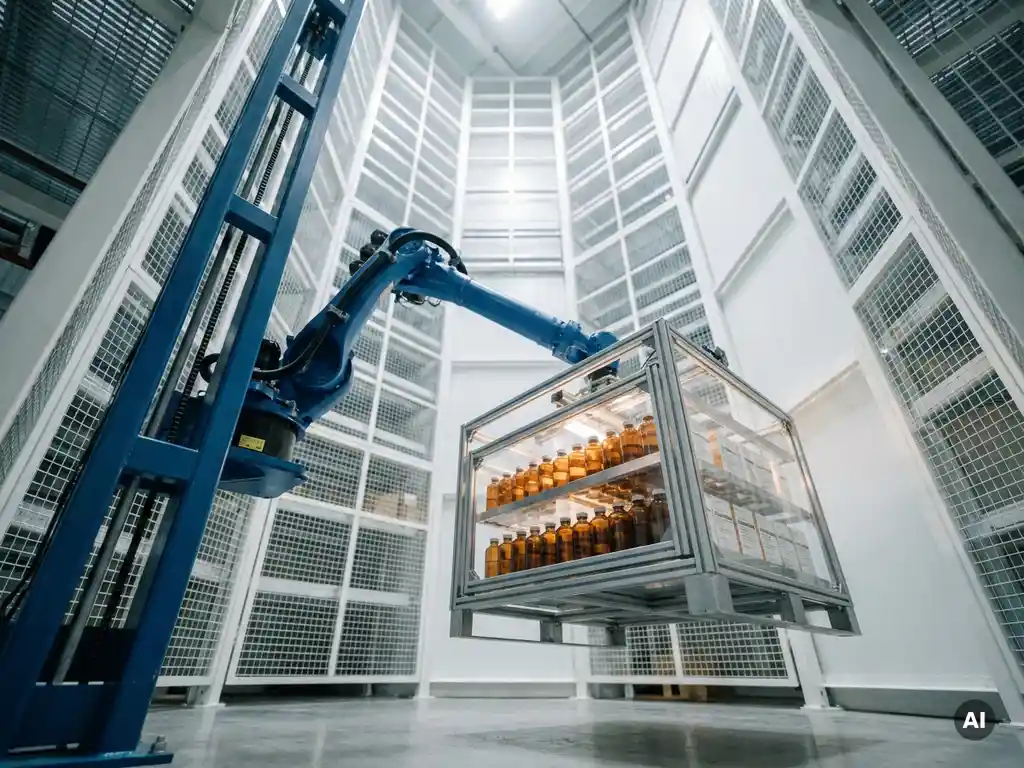
High-density storage directly affects pharmaceutical batch traceability by changing how inventory is physically organized and how retrieval logic must operate. When every storage location is directly accessible and digitally tracked, traceability accuracy improves because the system can enforce lot-specific retrieval without manual searching or reshuffling. The challenge arises when dense storage systems lack direct access, forcing operators to move products to reach a required batch, which introduces error and breaks the audit trail. The sections below address the specific questions pharmaceutical operations teams face when evaluating high-density automated storage for regulated environments.
How does storage location accessibility affect batch traceability accuracy?
Storage location accessibility determines whether a system can retrieve a specific batch without disturbing other inventory. When every tote is directly reachable, the control system can enforce precise lot selection, expiry sequencing, and batch isolation. When products must be moved to reach a required item, each unplanned movement is a traceability event that may not be logged, creating gaps in the audit trail.
In pharmaceutical warehouses, batch traceability accuracy depends on the system’s ability to retrieve the correct lot at the correct time without operator intervention. A storage architecture that requires digging through stacked inventory to reach a specific batch introduces two risks: physical mixing of lots during the repositioning process, and incomplete movement records if those interim moves are not captured by the warehouse management system.
Direct-access automated storage eliminates both risks by design. Because each tote position is individually addressable and retrievable, the control system can direct retrieval to a specific lot or batch without touching adjacent inventory. Every movement is a system-initiated, logged event rather than an operator decision. This makes the digital record an accurate reflection of physical stock movement, which is the foundation of reliable pharmaceutical batch traceability.
What GMP requirements govern batch traceability in automated warehouses?
Good Manufacturing Practice and Good Distribution Practice guidelines require that pharmaceutical products remain identifiable by batch throughout storage and distribution. Automated warehouses must maintain a complete, accurate record of where each batch is stored, when it moves, and who or what system authorized that movement. The specific requirements vary by jurisdiction, but the underlying principle is consistent: the batch must be traceable from receipt to dispatch without gaps.
In practice, GMP-aligned automated warehouses must satisfy several operational requirements. Inventory records must reflect physical stock in real time. Batch and lot numbers must be captured at goods receipt and retained throughout the storage lifecycle. Retrieval must be controllable by batch, not just by SKU. Expiry-sensitive products must be retrievable in the correct sequence. And every inventory movement must generate a timestamped, attributable record that can be produced during an audit or regulatory inspection.
Automated storage and retrieval systems support these requirements through software-managed inventory logic rather than through the hardware alone. The control system, warehouse management system, or warehouse execution system must be configured and validated to enforce batch-controlled retrieval, log all movements, and prevent unauthorized access to specific lots. Hardware that provides direct access to every storage location makes this software logic easier to implement reliably, because the system never needs to perform unplanned moves that could bypass the logging framework.
It is important to note that GMP and GDP compliance depends on the complete implementation, including software configuration, validation documentation, operating procedures, environmental controls, and customer processes. No storage hardware alone should be described as GMP certified or GDP compliant without reference to the full validated system.
Can high-density AS/RS systems maintain FEFO and lot segregation simultaneously?
Yes, high-density AS/RS systems can maintain First Expired, First Out sequencing and lot segregation simultaneously, provided the control software is configured to enforce both rules and the hardware architecture supports direct access to any tote at any time. The two requirements are not in conflict when retrieval is software-directed rather than operator-directed.
FEFO requires that the tote or lot with the earliest expiry date is always selected first for a given SKU. Lot segregation requires that different batches of the same product are not physically mixed and that retrieval can be directed to a specific lot when required. In a conventional dense storage system where products are stacked, satisfying both requirements simultaneously is difficult because reaching an earlier-expiry tote buried beneath a later-expiry tote requires moving inventory, which disrupts segregation and creates unlogged movements.
A direct-access storage architecture resolves this conflict. Because the retrieval system can reach any tote without moving others, it can select the correct lot based on expiry date, batch number, or any other software-defined rule, without touching adjacent inventory. The control system applies FEFO logic at the point of retrieval instruction, and lot segregation is maintained because no physical repositioning occurs.
The practical implementation requires that expiry dates and lot numbers are captured accurately at goods receipt, stored in the inventory management system, and linked to specific tote locations. The retrieval logic must then be validated to confirm that FEFO selection and lot-specific retrieval operate correctly under real operational conditions, including edge cases such as split lots, partial tote quantities, and concurrent orders for the same SKU from different batches.
What traceability data should an AS/RS control system log for each tote movement?
For each tote movement in a pharmaceutical AS/RS, the control system should log the tote identifier, the source location, the destination location, the timestamp, the initiating instruction or order reference, the batch or lot number associated with the tote contents, and the identity of the system or operator that authorized the movement. This data set forms the minimum audit trail required to reconstruct the history of any batch at any point in its storage lifecycle.
Beyond the minimum, regulated pharmaceutical operations benefit from additional data capture at key process points:
- Goods receipt: Batch number, lot number, expiry date, quantity, supplier reference, and tote assignment recorded at the point of induction into the system.
- Storage assignment: The specific location assigned to each tote, with timestamp and system logic reference, so the allocation decision is auditable.
- Retrieval events: The order or instruction that triggered retrieval, the batch selected, the selection rule applied (for example, FEFO), and the destination of the retrieved tote.
- Partial picks or tote splits: Where a tote contains multiple units and only some are removed, the quantity removed, the remaining quantity, and the updated tote status must be recorded.
- Returns and exceptions: Any tote returned to storage after retrieval, or any exception event such as a damaged tote or a system-flagged discrepancy, must generate a logged record with cause and resolution.
- Dispatch confirmation: Final confirmation that a specific batch left the facility as part of a specific order, linking the storage record to the outbound shipment documentation.
The completeness of this data set determines whether the warehouse can respond effectively to a batch recall, a regulatory audit, or a customer query about product origin. Systems where inventory movements are digitally controlled and every robot action generates a system record provide a structurally stronger audit trail than environments where operators make manual decisions that may or may not be captured in real time.
How does scalable throughput impact traceability system load in pharmaceutical operations?
Scalable throughput increases the number of inventory movements per hour, which directly increases the volume of traceability data the system must capture, process, and store. In pharmaceutical operations, every movement is a compliance event, so throughput scaling must be matched by equivalent scaling of the traceability and logging infrastructure to avoid gaps or delays in the audit trail.
This is a practical concern that is often underestimated during system design. A warehouse that processes 500 picks per hour generates a manageable volume of movement records. A warehouse that scales to 4,000 or 8,000 picks per hour generates a proportionally larger data stream, and if the warehouse management system or execution layer cannot process and persist those records in real time, the audit trail becomes unreliable under peak load.
One of the structural advantages of systems that decouple storage capacity from throughput is that throughput can be increased incrementally by adding robotic units rather than redesigning the entire infrastructure. This incremental scaling gives operations teams the opportunity to validate traceability system performance at each throughput level before increasing further. A sudden jump from low to very high throughput carries more risk of exposing logging bottlenecks than a staged increase that allows the software and data infrastructure to be stress-tested progressively.
Pharmaceutical operations should therefore treat traceability system load as a formal capacity planning variable alongside storage positions and pick rates. The WMS, WES, or control system must be validated not only for correct batch selection logic but also for the ability to maintain complete, accurate, real-time records at the maximum throughput the operation is designed to reach.
When should pharmaceutical warehouses revalidate their AS/RS after a configuration change?
Pharmaceutical warehouses should revalidate their AS/RS whenever a configuration change could affect the system’s ability to maintain batch traceability, enforce retrieval rules, or generate a complete audit trail. This includes changes to software logic, storage structure, robot fleet size, integration interfaces, and operating procedures that govern how inventory is managed.
Not every change requires full revalidation, but the assessment of whether revalidation is needed should follow a structured change control process. The key question is whether the change affects any validated function. Relevant triggers include:
- Software updates to the control system, WMS, or WES that modify retrieval logic, batch selection rules, or movement logging behavior.
- Structural expansion of the storage grid, where new locations are added and must be confirmed as correctly addressable and traceable within the system.
- Addition of robotic units that increase throughput, where the traceability data infrastructure must be confirmed as capable of handling the higher movement volume.
- Changes to integration interfaces between the AS/RS control system and external systems such as the WMS or ERP, particularly where batch or lot data passes across those interfaces.
- Changes to SKU allocation rules that affect which products are stored in which zones, especially if those rules interact with batch control or expiry management logic.
- Physical relocation of the system, which requires recommissioning and confirmation that all location addresses, robot calibration, and software mappings remain accurate.
The scope of revalidation should be proportionate to the scope of the change. A minor software patch that does not touch batch logic may require only regression testing of affected functions. A major structural expansion or a new integration may require a more comprehensive validation exercise including installation qualification, operational qualification, and performance qualification steps relevant to the regulated functions of the system.
Change control documentation should record the nature of the change, the assessment of its impact on validated functions, the revalidation activities performed, and the approval to return the system to regulated use. This documentation is itself part of the traceability record for the system’s operational history.
How Hexxabotics helps with pharmaceutical batch traceability in high-density storage
Hexxabotics addresses the core traceability challenges that pharmaceutical warehouses face when moving to high-density automated storage. The system is built around direct access to every tote at every location, which means retrieval logic can enforce batch, lot, and FEFO rules without physically disturbing adjacent inventory. Key capabilities relevant to pharmaceutical traceability include:
- 100% direct access to all storage locations, eliminating the need to move products to reach a required batch and preventing unlogged repositioning events.
- Software-managed retrieval through the Hexxabotics Control System, which coordinates robot actions and integrates with WMS or WES platforms via standard APIs to enforce batch and expiry logic.
- Digitally controlled inventory movements, where every robot action generates a system record, supporting a complete and auditable movement history for each tote.
- Independent scaling of capacity and throughput, allowing pharmaceutical distributors to increase storage positions or pick rates without redesigning the infrastructure, and to validate traceability performance at each stage of growth.
- No in-rack electrification, reducing infrastructure complexity and simplifying the physical environment that must be qualified during validation activities.
The system supports batch traceability and regulated pharmaceutical workflows. Compliance with GMP, GDP, or other regulatory frameworks depends on the complete implementation, including software configuration, validation, and operating procedures specific to each deployment. If you are evaluating pharmaceutical warehouse automation for a distribution or fulfillment operation, contact Hexxabotics to discuss how the direct-access AS/RS architecture can be configured for your traceability and compliance requirements.
Related Articles
- What are the biggest compliance risks in pharmaceutical cold storage?
- How do you design a warehouse layout that supports multiple shifts?
- How do you integrate autonomous mobile robots into an existing warehouse?
- What are the benefits of autonomous mobile robots in warehousing?
- Should you choose an AMR system or a fixed-rail AS/RS in 2026?