
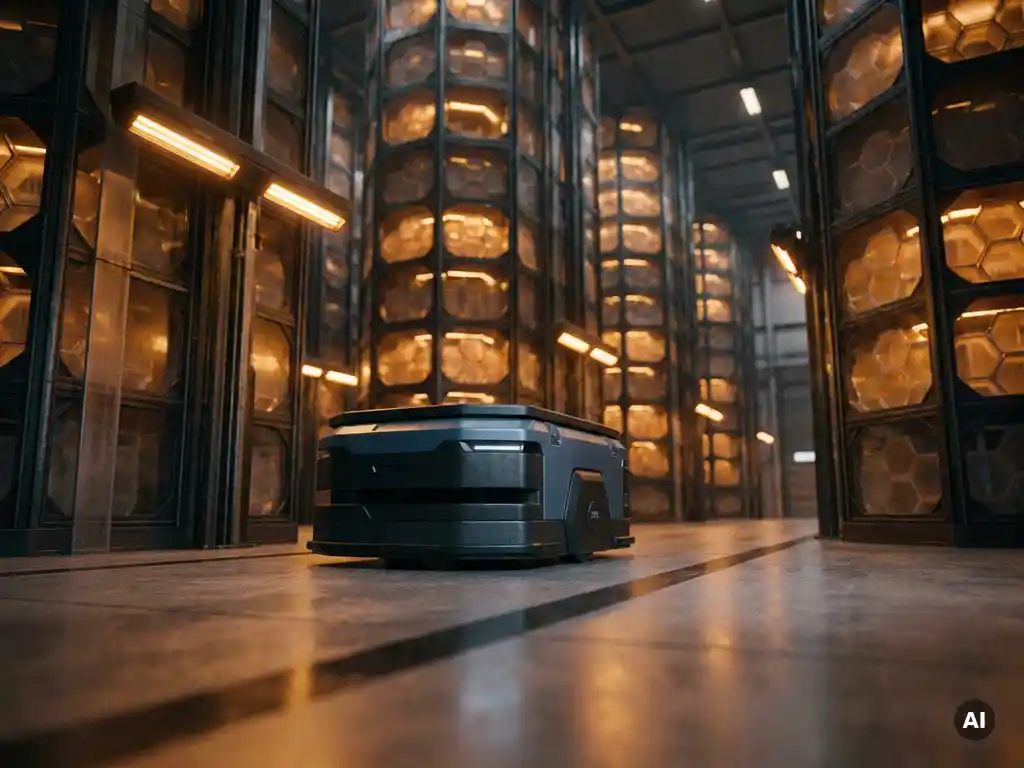
In 2026, the choice between an AMR system and a fixed-rail AS/RS depends primarily on your storage density requirements and how you expect your operation to scale. If you need maximum cubic storage utilization within a compact footprint, a fixed-rail or grid-based automated storage and retrieval system typically outperforms AMR-based storage. If you need flexible routing, low upfront infrastructure investment, or frequent layout changes, an AMR system may serve you better. The sections below break down the key differences across density, throughput, infrastructure, integration, and operational fit.
What are the core differences between AMR systems and fixed-rail AS/RS?
An AMR system uses autonomous mobile robots that navigate freely across warehouse floors using onboard sensors and software, without fixed tracks or rails. A fixed-rail AS/RS uses robots or shuttles that travel along predetermined rails or within a defined grid structure to store and retrieve goods from fixed locations. The fundamental difference is between free-roaming flexibility and structured, high-density precision.
AMRs are designed to work in open floor environments, often transporting shelves, bins, or totes between storage zones and pick stations. They adapt to changing layouts and can coexist with human workers. Fixed-rail automated storage and retrieval systems, by contrast, are engineered to maximize every cubic meter of available building height, using vertical towers, shuttle systems, or grid-based architectures to pack storage locations as tightly as geometry allows.
The tradeoff is significant. AMRs offer operational flexibility but sacrifice density. Fixed-rail AS/RS delivers density and precision but requires a committed structural installation. In warehouse automation in 2026, most operations choosing between the two are really choosing between floor-level agility and vertical storage efficiency.
How does storage density compare between AMRs and fixed-rail AS/RS?
Fixed-rail AS/RS systems achieve substantially higher storage density than AMR systems. AMRs operate on the warehouse floor and require aisle space for navigation, which means a significant portion of the floor footprint is consumed by robot travel rather than storage. Fixed-rail and grid-based AS/RS systems eliminate floor-level navigation entirely, converting vertical height into usable storage locations.
The density gap becomes especially pronounced in high-bay environments. Hexagonal or grid-based AS/RS architectures can utilize building height up to 16 meters, turning cubic volume into revenue-generating storage rather than empty air above floor-level shelving. A well-designed AS/RS can achieve space utilization rates well above 90% of the available cubic volume, while AMR-based storage typically leaves a large proportion of the building height unused.
For operations managing large SKU counts in limited square footage, such as e-commerce fulfillment, spare parts warehousing, or 3PL logistics, the density advantage of a fixed-rail or vertical AS/RS is often the deciding factor. AMR systems are better suited to environments where storage density is secondary to routing flexibility or where the product mix changes frequently enough to make fixed infrastructure impractical.
Which system handles throughput scaling more effectively?
Throughput scaling works fundamentally differently in each system. In most fixed-rail AS/RS designs, storage capacity and throughput are tightly linked to the same core infrastructure, meaning adding throughput often requires structural changes. In a well-architected AMR system, you can add robots incrementally. However, the most advanced AS/RS platforms have broken this dependency entirely, allowing throughput to scale by adding autonomous units without touching the storage structure.
How AMR systems scale throughput
AMR systems scale throughput relatively easily in principle: you add more robots to the fleet. Because the robots navigate freely, new units integrate into the existing environment without physical infrastructure changes. The ceiling on this approach is floor congestion, which becomes a real constraint as robot density increases. More robots competing for the same floor paths eventually creates traffic management challenges that software alone cannot fully resolve.
How advanced AS/RS systems scale throughput
Next-generation AS/RS architectures, particularly those using distributed autonomous robots rather than centralized cranes or lifts, decouple throughput from storage capacity entirely. Adding robots increases picking output linearly without requiring structural redesign. This is a significant departure from traditional fixed-rail systems, where a centralized crane or conveyor represented a hard throughput ceiling. Distributed robot operation also eliminates single points of failure, meaning the system continues operating if one unit goes offline, maintaining stable throughput even during peak demand periods.
What infrastructure and installation requirements does each system need?
AMR systems have lower upfront infrastructure requirements. They need a flat, clean floor surface, a reliable wireless network, and defined charging stations. No fixed rails, no structural rack installation, and no major civil engineering work. This makes them faster to deploy and easier to relocate if the facility changes.
Fixed-rail AS/RS installations require a more substantial upfront commitment. The rack or grid structure must be engineered to the building, anchored to the floor, and in many cases designed around the building’s ceiling height and load-bearing capacity. Traditional systems also require embedded electrification within the rack structure for lifts, conveyors, or shuttle power, which adds installation complexity, maintenance requirements, and energy infrastructure.
More recent AS/RS designs have reduced this burden considerably. Systems that carry no embedded electronics, motors, or electrification within the rack itself simplify installation significantly. The steel structure becomes a passive framework, and all active components are concentrated in the robots. This approach lowers the engineering overhead of installation, reduces ongoing maintenance complexity, and makes the system easier to reconfigure or relocate compared to traditional electrified rack systems.
When does an AMR system outperform a fixed-rail AS/RS?
An AMR system outperforms a fixed-rail AS/RS in scenarios where layout flexibility, low installation cost, or coexistence with human workers is the primary requirement. Specifically, AMRs are the stronger choice when a warehouse changes its layout frequently, when the operation involves large, irregularly shaped items that do not fit standardized totes, or when the business needs to automate incrementally without committing to a full structural installation.
AMRs also perform well in environments where storage density is not the primary constraint. If a facility has abundant floor space and the bottleneck is labor rather than storage capacity, deploying AMRs to handle transport tasks between fixed shelving and pick stations can deliver a strong return without the capital commitment of a full AS/RS installation.
Additionally, AMR systems are well suited to operations in leased facilities where permanent structural modifications are restricted, or in early-stage automation programs where the operation is still defining its long-term requirements. The lower barrier to entry makes AMRs an effective first step, even if a denser, higher-throughput system becomes the right answer later.
How do AMR and AS/RS systems integrate with existing warehouse management software?
Both AMR systems and AS/RS systems integrate with warehouse management software (WMS) through standard APIs, though the depth and complexity of that integration vary. AMRs typically connect via REST APIs or middleware layers that translate WMS task assignments into robot navigation instructions. AS/RS systems use a warehouse control system (WCS) or warehouse execution system (WES) as an intermediary layer that manages robot coordination, inventory logic, and task sequencing before passing data upstream to the WMS.
For AMR systems, integration is generally straightforward because the robots handle transport tasks that map directly to simple WMS commands: move this item from location A to location B. The WMS does not need to understand robot navigation, only task completion.
AS/RS integration is more involved because the system manages precise inventory locations within a three-dimensional structure. The control system must track every tote’s exact position, manage robot assignments across multiple concurrent tasks, and synchronize retrieval sequences with downstream picking workstations. Modern AS/RS platforms expose this complexity through standard API interfaces, allowing the WMS to issue high-level commands while the control system handles execution internally. The practical result for the warehouse operator is similar: the WMS sees inventory locations and order completions, without needing to manage the mechanics of how the robot system operates.
The key integration consideration is not which system type connects more easily, but whether the vendor’s control software supports the communication protocols your WMS already uses. Both AMR and AS/RS vendors have converged on standard API-based integration in 2026, making connectivity less of a differentiator than it was in earlier generations of warehouse robotics.
How Hexxabotics helps you choose the right automated storage system
Hexxabotics offers an alternative to the traditional AMR vs. fixed-rail tradeoff by combining the density advantages of an AS/RS with the scalability logic of a distributed robot system. For industrial automation engineers evaluating warehouse robotics in 2026, the Hexxabotics system addresses the limitations of both approaches:
- Maximum storage density through hexagonal vertical towers that utilize full cubic building height up to 16 meters, with no floor space consumed by robot navigation aisles
- Independent throughput scaling by adding autonomous Hexxabots without structural redesign, eliminating the throughput ceiling common in traditional fixed-rail systems
- No in-rack electrification, reducing installation complexity, maintenance requirements, and energy infrastructure compared to conventional AS/RS
- 100% direct tote access with no digging or reshuffling, ensuring consistent retrieval performance across every storage location
- Standard API integration with existing WMS platforms, reducing integration effort for system integrators and end-user operations alike
- Distributed system resilience with no single point of failure, maintaining stable throughput even when individual units are offline
If your operation needs high-density storage, scalable throughput, and a system that grows with your business without forcing a structural rebuild, explore Hexxabotics or learn more about the technology to see how the architecture fits your specific requirements.
Related Articles
- Can warehouse automation lower your energy consumption?
- How does a hexagonal grid system change warehouse logistics?
- How does predictive maintenance prevent downtime in automated warehouses?
- How do 3PL providers choose between leasing and buying automation equipment?
- What is the difference between fixed automation and flexible automation?