
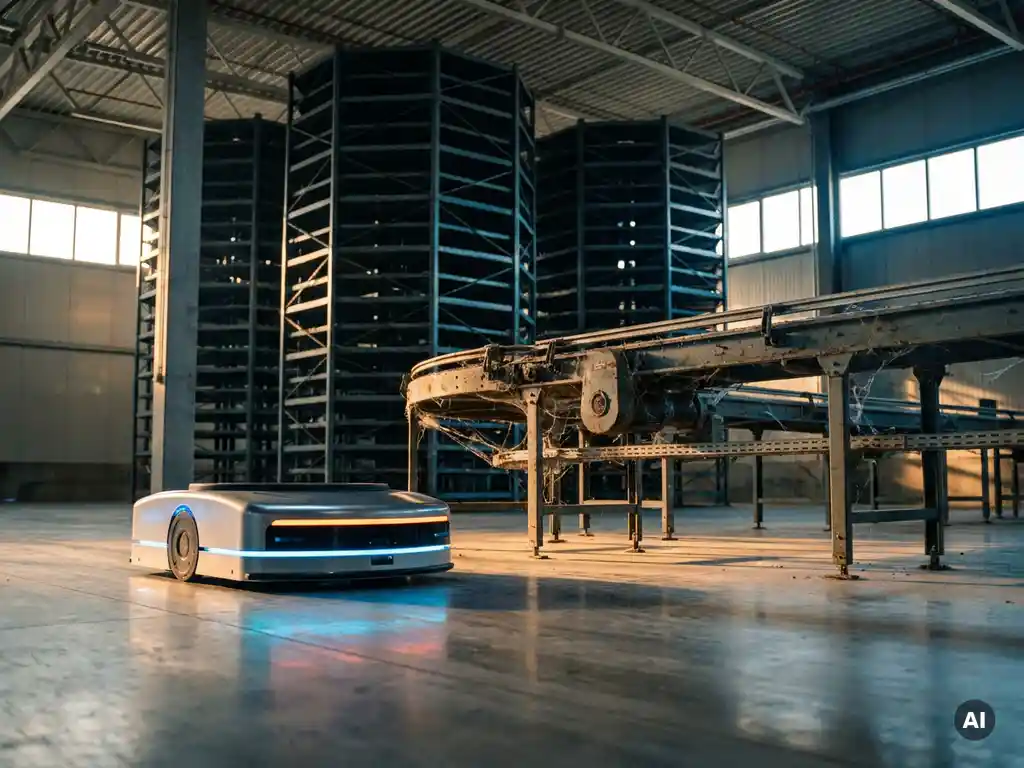
Fulfillment centers are replacing conveyor belts with autonomous mobile robots (AMRs) because fixed conveyor infrastructure cannot adapt to the speed, variability, and scale demands of modern order fulfillment. Conveyor systems require costly redesigns every time layouts change, while AMRs offer flexible, reconfigurable movement that scales with operational needs. The sections below address the most common questions warehouse operators and automation engineers are asking about this shift in 2026.
What limitations of conveyor belts are driving fulfillment centers to switch?
Conveyor belts are being replaced because they are rigid, space-intensive, and expensive to modify. Once installed, a conveyor network locks a facility into a fixed layout. Any change to product flow, throughput requirements, or building configuration demands significant downtime, engineering work, and capital expenditure. For fulfillment centers operating in fast-moving markets, this inflexibility has become a critical liability.
Several specific limitations are accelerating the transition:
- Single points of failure: A breakdown anywhere along a conveyor line can halt the entire flow of goods. There is no inherent redundancy in a fixed belt system.
- Low space utilization: Conveyor systems occupy floor space and rarely exploit vertical height, leaving significant cubic volume unused.
- Scaling requires rebuilding: Increasing throughput on a conveyor system typically means adding more belts, sorters, and merge points, which compounds complexity rather than resolving it.
- High maintenance overhead: Motors, rollers, belts, and sensors distributed across long runs create many potential failure points, each requiring regular inspection and replacement.
- Limited SKU flexibility: Conveyor-based sorting works well for predictable, uniform product flows but struggles when SKU counts grow and order profiles become more varied, as they have in e-commerce fulfillment.
The cumulative effect is that conveyor-heavy operations face diminishing returns as order volumes increase. The infrastructure that once provided efficiency becomes the bottleneck preventing it.
How do AMRs work in a warehouse environment?
Autonomous mobile robots navigate warehouse floors independently using onboard sensors, cameras, and mapping software to move goods between locations without fixed tracks or guides. Unlike automated guided vehicles (AGVs), AMRs build dynamic maps of their environment and reroute in real time around obstacles, workers, and changing conditions. They receive task assignments from a central control system and execute them without human intervention.
In a typical fulfillment center deployment, AMRs perform one or more of the following functions:
- Goods-to-person delivery: Robots transport inventory pods or totes directly to stationary pick stations, eliminating the need for workers to walk the floor.
- Horizontal transport: AMRs move product between receiving, storage, picking, packing, and dispatch zones, replacing manual carts and conveyor segments.
- Vertical retrieval within AS/RS systems: In three-dimensional storage architectures, robotic units climb within storage towers to retrieve totes and bring them to ground level for processing.
The control layer is critical. A warehouse management system or dedicated robot control platform coordinates all units simultaneously, assigns tasks based on priority and proximity, manages battery charging cycles, and ensures robots do not conflict with one another. The result is a distributed, parallel operation where many robots work concurrently rather than a single sequential flow as with conveyor systems.
What’s the difference between AMRs and traditional AS/RS systems?
AMRs and traditional Automated Storage and Retrieval Systems (AS/RS) serve related but distinct purposes. Traditional AS/RS systems, such as mini-load cranes and shuttle systems, use fixed mechanical infrastructure to store and retrieve goods within a defined grid. AMRs are mobile robotic units that navigate freely and can be redeployed across different tasks and zones. The key distinction is that AS/RS is infrastructure-bound while AMRs are infrastructure-independent.
Traditional AS/RS: strengths and constraints
Conventional AS/RS designs offer high density and reliable retrieval in controlled environments. However, they rely on centralized lifting mechanisms, fixed vertical conveyors, and embedded electrification within the rack structure. Throughput is constrained by the number of cranes or shuttles, and scaling typically requires structural changes. When a central crane reaches capacity, the entire system slows, and adding more throughput often means duplicating expensive core infrastructure.
AMR-based and next-generation AS/RS: distributed by design
Modern AMR-based storage systems eliminate the centralized bottleneck by distributing both horizontal transport and vertical access across many independent robotic units. Each robot operates autonomously, and adding more units increases throughput linearly without requiring changes to the storage structure itself. Systems like Hexxabotics’ hexagonal AS/RS take this further by separating storage capacity from throughput performance entirely, so operators can scale each dimension independently based on operational demand.
For warehouse automation engineers evaluating both approaches, the practical difference comes down to flexibility and failure resilience. A distributed robotic system continues operating at reduced capacity if one unit goes offline. A traditional AS/RS with a single crane or centralized lift has no equivalent fallback.
How much does switching from conveyor belts to AMRs cost?
The cost of replacing conveyor belts with AMRs varies widely depending on facility size, throughput requirements, the number of robots needed, and how much existing infrastructure can be reused. There is no universal figure, but the total investment typically includes hardware (robots and charging infrastructure), software licensing, integration with existing warehouse management systems, and installation. Decommissioning and removing legacy conveyor systems adds a further cost that is often underestimated.
Several factors influence where a project lands on the cost spectrum:
- Fleet size: Throughput requirements determine how many AMRs are needed. Systems designed for linear throughput scaling allow operators to start with a smaller fleet and add units as demand grows, reducing upfront capital commitment.
- Storage architecture: If conveyor replacement is combined with a move to high-density robotic storage, the total project cost increases but the long-term return on investment improves significantly through better space utilization and lower labor costs.
- Integration complexity: Systems that connect to existing WMS platforms through standard APIs reduce software integration costs compared to proprietary closed systems that require custom development.
- Infrastructure requirements: Some robotic storage systems require no electrification within the rack structure, which reduces installation complexity, lowers ongoing energy costs, and simplifies future relocations.
Total cost of ownership over a five- to ten-year horizon is often more informative than upfront capital cost. Conveyor systems carry ongoing maintenance, spare parts, and downtime costs that compound over time, whereas distributed robotic systems with fewer centralized components tend to have lower and more predictable maintenance profiles.
Which fulfillment operations are best suited for AMR deployment?
AMR deployment delivers the greatest operational benefit in fulfillment environments characterized by high SKU counts, variable order profiles, and a need to scale throughput without rebuilding infrastructure. E-commerce fulfillment, omnichannel retail distribution, pharmaceutical order picking, and third-party logistics (3PL) operations are among the strongest fits because all of them require flexible, high-accuracy retrieval across large and frequently changing product ranges.
More specifically, operations that benefit most from autonomous mobile robots share several characteristics:
- High order variability: When no two orders look alike and batch sizes are small, the dynamic routing of AMRs outperforms the fixed sequencing of conveyor systems.
- Dense storage requirements: Facilities that need to maximize storage positions within a limited footprint benefit from robotic systems that exploit vertical height rather than spreading inventory across wide floor areas.
- Seasonal or promotional peaks: Operations that experience significant demand spikes benefit from systems where throughput can be increased by deploying additional robots rather than installing additional fixed infrastructure.
- Frequent product range changes: Fashion, FMCG, and food and grocery operations regularly rotate SKUs. Robotic systems with direct-access storage avoid the reshuffling delays that affect dense fixed systems when product locations need to change.
- Multi-temperature or regulated environments: In pharmaceutical and food operations where compliance and traceability matter, software-driven robotic systems provide better inventory control and audit trails than manual or semi-automated conveyor flows.
What should warehouse operators evaluate before replacing conveyor systems?
Before replacing conveyor belts with AMRs or robotic storage systems, warehouse operators should evaluate throughput requirements, storage density goals, integration complexity, scalability needs, and total cost of ownership over the expected system lifespan. Rushing to replace working infrastructure without a clear operational baseline leads to undersized or oversized deployments that fail to deliver the anticipated return.
A structured evaluation should address the following areas:
- Current and projected order profiles: Understand peak daily order volumes, average lines per order, and how these are expected to change over three to five years. This determines the minimum throughput the replacement system must sustain.
- Building constraints: Measure usable floor area and ceiling height. Systems that can utilize full cubic volume up to significant heights deliver far greater storage density within the same footprint than floor-level conveyor alternatives.
- Independent scalability: Evaluate whether the candidate system allows storage capacity and throughput to be scaled independently. Systems where adding capacity forces infrastructure redesign will recreate the same rigidity problem that conveyor systems present.
- Single points of failure: Assess how the system handles individual unit failures. Distributed robotic architectures maintain throughput when one unit goes offline; centralized crane or lift systems do not.
- WMS integration: Confirm that the robotic system connects to existing warehouse management software through standard APIs. Custom integrations increase cost and create long-term dependency on proprietary interfaces.
- Relocation and reconfiguration flexibility: For operators who may change facilities or expand to new sites, systems that can be relocated and reconfigured without major re-engineering offer a significant long-term advantage over permanently installed infrastructure.
Engaging an automation engineer or systems integrator early in the evaluation process helps translate operational requirements into specific technical criteria, reducing the risk of selecting a system that performs well in a demonstration but fails to meet real-world demands at scale.
How Hexxabotics helps fulfillment centers move beyond conveyor systems
Hexxabotics provides a next-generation AS/RS designed specifically to address the limitations that are driving fulfillment centers away from conveyor-based infrastructure. The system replaces fixed conveyor flows with a fully distributed robotic architecture built around a hexagonal vertical storage grid, autonomous Hexxabots, and standardized totes.
Key capabilities relevant to fulfillment center automation include:
- Storage capacity and throughput scale independently: Add storage locations by extending the structure; add throughput by deploying more Hexxabots. No structural redesign is required for either.
- 100% direct access: Every tote is directly retrievable without digging or reshuffling, eliminating the retrieval delays common in dense fixed systems.
- No in-rack electrification: The tower structure contains no embedded motors, cables, or powered components, reducing failure points, lowering energy consumption, and simplifying maintenance.
- Distributed resilience: Parallel robot operation eliminates single points of failure. If one unit stops, the rest of the system continues at full capacity.
- Up to 16 meters of vertical density: The hexagonal geometry converts full cubic building volume into usable storage, maximizing revenue-generating positions within a compact footprint.
- Standard API integration: The Hexxabotics Control System connects to existing WMS platforms without custom engineering, reducing integration cost and time.
For warehouse operators and automation engineers evaluating fulfillment center automation options in 2026, Hexxabotics offers a technically differentiated path beyond conveyor replacement toward a fully scalable, resilient robotic storage and retrieval operation.