
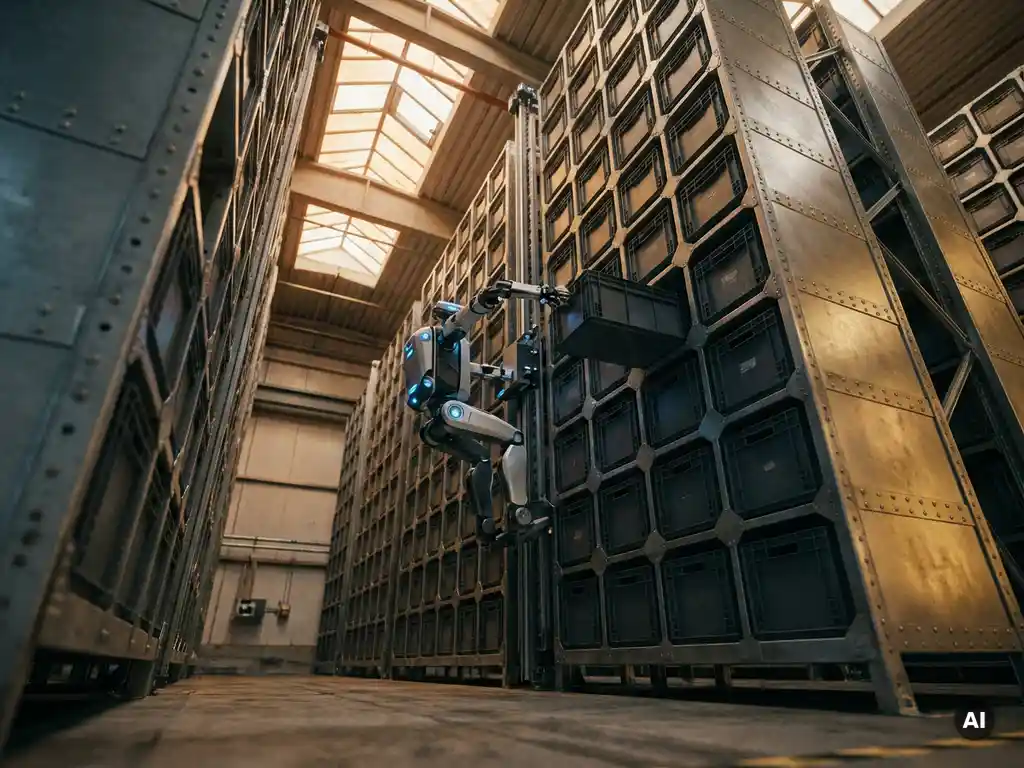
Automated slotting optimization reduces travel time in warehouses by placing the most frequently picked items in the most accessible storage locations, cutting the distance workers or robots must travel per order. The logic is straightforward: shorter paths per pick multiply across thousands of daily transactions into measurable throughput gains and lower labor costs. The sections below unpack how the optimization actually works, from the data it analyzes to the systems that make it possible.
What factors does automated slotting optimization actually analyze?
Automated slotting optimization analyzes pick frequency, order profiles, item velocity, product dimensions, weight, and co-occurrence patterns to determine the best storage location for every SKU. The goal is to match item characteristics to location attributes so that the highest-demand items are always within the shortest reach, whether that means a physical aisle or a vertical storage position.
The most influential factor is pick velocity, which ranks SKUs by how often they are retrieved within a given time window. High-velocity items earn positions closest to packing stations or dispatch points. Low-velocity items move to deeper, less accessible zones where travel costs are lower because they are accessed infrequently.
Beyond velocity, slotting systems evaluate:
- Order co-occurrence: Items frequently ordered together are slotted near each other to reduce multi-line pick travel
- Physical dimensions and weight: Heavy or bulky items are placed at ergonomic heights or in positions that minimize handling strain and reduce damage risk
- Replenishment frequency: Fast movers with small unit sizes may need frequent replenishment, so their slot position must also account for restocking efficiency
- Seasonal and promotional patterns: Demand shifts predictably around campaigns or seasons, requiring the slotting model to anticipate future velocity, not just reflect historical data
- Storage zone constraints: Temperature zones, hazardous material requirements, or security restrictions limit where certain SKUs can be placed regardless of velocity
When all these factors feed into a single optimization engine, the system can generate slot assignments that balance competing priorities rather than optimizing for one variable at the expense of another.
How does slotting optimization calculate the shortest pick path?
Slotting optimization calculates the shortest pick path by modeling the warehouse as a network of nodes and distances, then assigning SKUs to locations that minimize the total travel required to fulfill a representative set of orders. The calculation combines historical order data with spatial mapping to find assignments where the aggregate distance across all picks is as low as possible.
The process typically works in two stages. First, the system builds a travel distance matrix that maps the physical distance between every storage location and every pick or dispatch point. Second, it runs an optimization algorithm that matches SKU velocity and co-occurrence data against that matrix, seeking the assignment configuration with the lowest total weighted travel distance.
In practice, the algorithm does not aim for a perfect mathematical optimum, which would be computationally prohibitive at scale. Instead, it uses heuristics and iterative improvement methods to arrive at a solution that is significantly better than the current layout within a practical computation time. The resulting slot assignments are then validated against real order profiles before being implemented.
For automated systems like robotic AS/RS, the path calculation extends into three dimensions. Horizontal travel beneath the storage grid and vertical travel within storage towers are both factored in, meaning the system can assign totes to heights and positions that minimize total robot cycle time rather than just floor-level travel distance.
What’s the difference between static and dynamic slotting optimization?
Static slotting optimization assigns items to fixed locations based on a one-time analysis, while dynamic slotting optimization continuously reassigns items as demand patterns change. Static slotting is simpler to implement but degrades in effectiveness as product velocity shifts. Dynamic slotting maintains near-optimal assignments over time but requires real-time data integration and a system capable of executing frequent location changes.
Static slotting
In a static model, a slotting study is conducted periodically, often quarterly or annually, and items are physically relocated based on the findings. Between studies, the layout remains fixed. This approach works reasonably well for stable product ranges with predictable demand, but it struggles when SKU velocity shifts rapidly, such as during promotional periods or seasonal peaks. The warehouse gradually drifts away from its optimized state until the next formal review.
Dynamic slotting
Dynamic slotting connects the optimization engine to live inventory and order management data, triggering reassignments automatically when velocity thresholds change. A SKU that spikes in demand during a promotion is moved to a high-accessibility zone within hours rather than waiting for the next quarterly review. This responsiveness is particularly valuable in e-commerce fulfillment and fast-moving consumer goods environments where demand volatility is constant. The trade-off is operational complexity: every reassignment requires a physical move or a system update, and those moves consume labor or robot capacity that must be balanced against the efficiency gains they produce.
How does automated storage and retrieval change slotting logic?
Automated storage and retrieval systems change slotting logic by replacing physical worker travel with robot cycle time as the primary optimization target. In a manual warehouse, slotting reduces the distance a picker walks. In an AS/RS environment, slotting reduces the time a robot spends traveling horizontally and vertically to reach a tote, which shifts the optimization model toward minimizing machine cycle times rather than ergonomic or pedestrian path considerations.
In a goods-to-person AS/RS, the picker never travels to the product. Instead, the system brings the tote to a fixed workstation. This changes which location attributes matter most. The relevant variable is no longer proximity to a dispatch area but rather how quickly a robot can retrieve a tote from its assigned position and deliver it to the workstation. Totes with high pick frequency should be stored at positions that require the least robot travel, whether that means lower vertical positions within a tower, locations closer to the workstation, or positions that allow a robot to complete a deposit and retrieval in a single continuous motion.
Systems built around distributed robot architectures, such as those using autonomous units that navigate horizontally beneath a storage grid and detachable climbers that access vertical positions within each tower, offer a structural advantage here. Because every storage location is directly accessible without reshuffling other totes, the slotting logic does not need to account for blocking or sequencing constraints. Every position in the grid is equally accessible in principle, which means the optimization engine can focus purely on travel time rather than also managing retrieval order dependencies.
This 100% direct access model eliminates a significant source of slotting complexity that affects grid-based cube storage systems, where a tote buried beneath others requires digging, and the slotting logic must account for depth as a cost factor. When every location is directly reachable, the slotting model becomes cleaner and the optimization more precise.
When should a warehouse re-slot its inventory?
A warehouse should re-slot its inventory when pick path efficiency has measurably degraded, when the product range has changed significantly, or when demand patterns have shifted enough that the current slot assignments no longer reflect actual velocity. Specific triggers include the introduction of new SKUs, the discontinuation of existing ones, seasonal demand transitions, and post-promotional periods when fast movers return to normal velocity.
Beyond event-driven triggers, warehouses benefit from monitoring a few key performance indicators that signal when re-slotting is overdue:
- Rising average travel time per pick: If robots or pickers are consistently traveling further than baseline, the current slot assignments have drifted from optimal
- Congestion at specific zones: When high-velocity items cluster in the same area, traffic bottlenecks form even if individual pick paths are short
- Increasing order fulfillment time: Longer cycle times that cannot be explained by order volume alone often trace back to suboptimal slotting
- High replenishment frequency in low-accessibility locations: Fast movers placed far from replenishment points create unnecessary handling costs
For warehouses running dynamic slotting software, these triggers are monitored automatically and reassignments happen continuously. For operations using periodic static reviews, industry experience suggests that re-slotting studies are most valuable before peak trading periods, after major catalog changes, and whenever a new product category is introduced that has different velocity characteristics from the existing range.
What tools and systems enable automated slotting optimization?
Automated slotting optimization is enabled by a combination of warehouse management systems with built-in slotting modules, dedicated slotting optimization software, and the data infrastructure that feeds them. The most effective implementations connect these tools directly to order history, inventory data, and physical system constraints so that optimization decisions reflect real operating conditions rather than assumptions.
The core tools include:
- Warehouse management systems (WMS) with slotting modules: Most enterprise WMS platforms include slotting functionality that analyzes velocity and generates location recommendations within the system’s existing data environment
- Dedicated slotting optimization software: Standalone tools offer more sophisticated algorithms and deeper analytics than WMS modules, making them suitable for large, complex operations with high SKU counts and frequent demand changes
- Warehouse control systems (WCS) and robot control systems: In automated environments, the control layer that manages robot movements must communicate with the slotting logic to execute location assignments and update robot routing in real time
- Order management and ERP integration: Slotting decisions improve significantly when the optimization engine has access to forward-looking demand signals, such as confirmed purchase orders or promotional calendars, rather than only historical pick data
- Standard APIs for system integration: Modern AS/RS platforms expose APIs that allow slotting software and WMS platforms to exchange location data, inventory status, and retrieval commands without custom integration work
The quality of the output depends heavily on data quality. Slotting software is only as accurate as the order history and velocity data it receives. Warehouses with clean, granular pick data at the SKU and order level will generate more precise slot assignments than those relying on aggregated or incomplete records.
How Hexxabotics helps with automated slotting optimization
Hexxabotics removes the structural constraints that make slotting optimization complex in conventional AS/RS systems. Because every tote in the hexagonal storage grid is directly accessible without digging or reshuffling, the slotting engine can optimize purely for robot travel time rather than also managing retrieval sequencing or depth penalties. Key advantages include:
- 100% direct access to every storage location, eliminating blocking constraints that distort slotting decisions in cube storage systems
- Independent scalability of capacity and throughput, allowing slot assignments to remain stable as the system grows without infrastructure redesign
- Distributed robot architecture with no single point of failure, so slotting changes can be executed without taking the system offline
- Standard API integration with external WMS and slotting software, reducing the effort required to connect optimization tools to the physical system
- Vertical density up to 16 meters, giving the slotting model a larger three-dimensional assignment space and more granular control over travel time per retrieval
If you are evaluating how an AS/RS architecture can support more precise and responsive slotting optimization, explore Hexxabotics to understand how the system’s design translates directly into picking efficiency gains.
Related Articles
- Why is robot navigation accuracy critical in automated storage systems?
- What are autonomous mobile robots used for in warehouses?
- When should a 3PL provider invest in automated fulfillment systems?
- What does robotic picking mean in a fulfillment center?
- How do digital twins help prevent warehouse operational failures?