
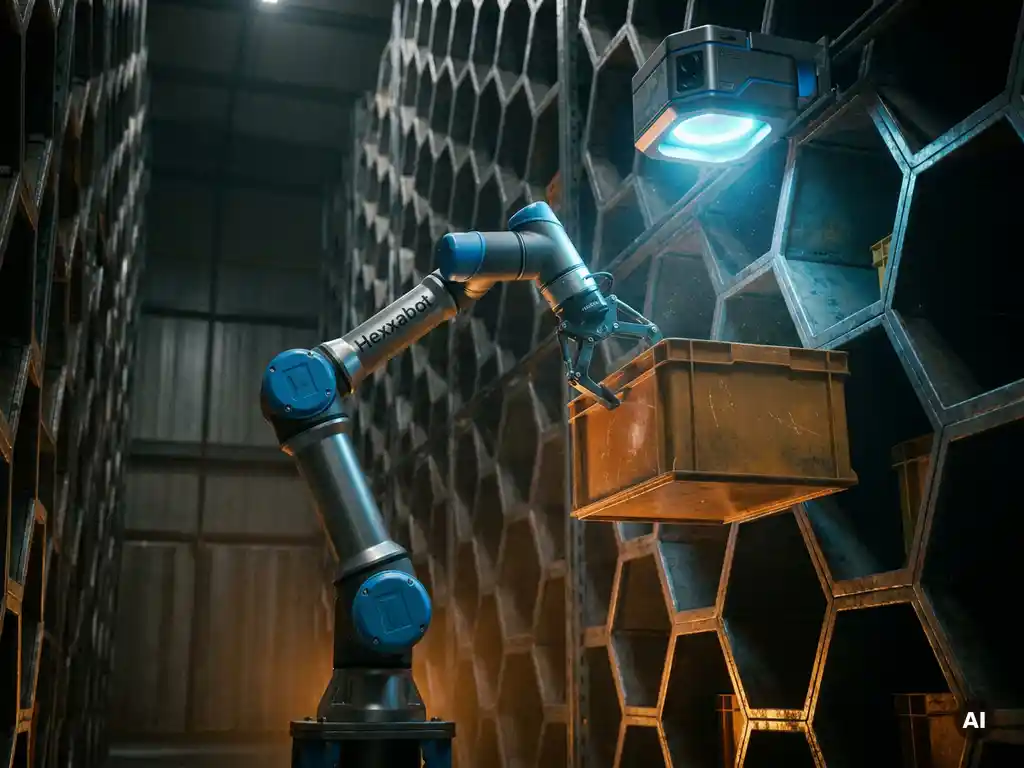
Computer vision improves quality control in automated warehouses by enabling real-time, automated inspection of items during storage and retrieval operations. Instead of relying on manual checks or simple barcode reads, machine vision systems use cameras and image analysis algorithms to verify product condition, label accuracy, tote integrity, and dimensional compliance at machine speed. The result is fewer errors reaching downstream operations, reduced returns, and greater confidence in inventory accuracy. The sections below address the most common questions engineers and operations professionals ask when evaluating computer vision for warehouse quality inspection.
What types of defects can computer vision detect in a warehouse?
Computer vision systems in warehouse environments can detect a wide range of defects, including damaged packaging, missing or misread labels, incorrect item placement, dimensional mismatches, foreign objects inside totes, and surface-level product damage such as tears, dents, or contamination. Detection capability depends on camera resolution, lighting setup, and the trained inspection model, but modern systems routinely flag defects that human inspectors miss under time pressure.
In practice, warehouse quality inspection applications group detectable defects into a few core categories:
- Packaging integrity: Crushed corners, torn seals, broken closures, or deformed containers that may indicate product damage or create downstream handling problems.
- Label and barcode verification: Smeared print, incorrect label placement, missing labels, or barcode symbologies that fail to meet readability standards.
- Dimensional compliance: Items or totes that exceed specified height, width, or weight tolerances, which can interfere with automated handling equipment.
- Contamination and foreign objects: Debris, incorrect items, or loose components inside a tote that should not be there.
- Quantity and presence checks: Verifying that the expected number of units is present and correctly oriented before a tote is committed to storage or dispatch.
The breadth of detectable defects expands significantly when machine vision is combined with depth sensors or structured light, allowing the system to build a three-dimensional profile of the contents rather than relying on a single two-dimensional image.
How does computer vision work inside an AS/RS environment?
Inside an Automated Storage and Retrieval System, computer vision works by positioning cameras at key inspection points, typically at induction conveyors, goods-to-person workstations, or directly on robotic handling units, and triggering image capture as items pass through. The captured image is processed by an inference engine that compares it against trained reference data and returns a pass, fail, or flag result within milliseconds.
The integration with an AS/RS is tighter than in a conventional conveyor-based warehouse because the system controls precisely when and where each tote appears. This deterministic movement creates ideal conditions for machine vision: consistent positioning, predictable lighting zones, and known item profiles tied to inventory records. When a tote arrives at a workstation, the control system already knows what the tote should contain, so the vision system only needs to confirm conformance rather than identify unknown items from scratch.
In high-density systems where robots perform the retrieval, inspection can be embedded into the retrieval cycle itself. A camera mounted at the handoff point captures the tote as it exits the storage structure, and any anomaly triggers an automatic divert before the tote reaches the operator. This approach keeps quality checks out of the critical path of human picking, which protects throughput while still catching problems early.
The architecture also supports bidirectional quality checks. At induction, vision confirms that items entering the system meet acceptance criteria. At retrieval, it verifies that stored items have not degraded or shifted during storage. Together, these checkpoints create a closed-loop quality record for every tote in the system.
What’s the difference between computer vision and traditional barcode scanning for quality checks?
The key difference is scope. Traditional barcode scanning confirms identity, answering the question “Is this the right item?” Computer vision confirms both identity and condition, answering “Is this the right item, and is it in acceptable condition?” Barcodes return a binary match or no-match result. Vision systems return a rich data output that includes spatial, dimensional, and visual attributes the barcode cannot encode.
What barcode scanning does well
Barcode and RFID scanning excel at fast, reliable identity verification. A one-dimensional or two-dimensional code, when readable, confirms the SKU, batch number, or serial number in under a millisecond. The infrastructure is mature, low-cost, and deeply integrated into existing warehouse management systems. For operations where product condition is assumed to be acceptable and only identity matters, scanning remains the most efficient choice.
Where computer vision extends beyond scanning
Computer vision adds a layer of inspection that scanning cannot provide. It can read a barcode that has shifted position or is partially obscured, assess whether the label itself is legible to a human receiver, check that the product inside the tote matches the expected profile, and flag physical damage that a barcode would never encode. In quality-sensitive applications such as pharmaceutical fulfillment, food and grocery, or high-value spare parts, this additional layer of verification reduces costly errors that scanning alone would pass through undetected.
Many modern warehouse automation systems combine both technologies rather than choosing between them, using barcode reads for identity confirmation and vision for condition and compliance checks at the same inspection station.
How accurate is computer vision for warehouse quality control?
Modern computer vision systems used in warehouse quality control routinely achieve detection accuracy above 95 percent for well-defined defect categories under controlled lighting conditions. For standard label verification and dimensional checks, accuracy rates are typically even higher. The practical accuracy of any deployment depends on image resolution, lighting consistency, model training quality, and how clearly the defect classes are defined.
Several factors influence real-world accuracy in an automated warehouse setting:
- Training data quality: A model trained on a large, diverse set of representative defect images will generalize better than one trained on a small or unbalanced dataset.
- Lighting control: Consistent, diffuse illumination reduces false positives caused by shadows, reflections, or ambient light variation. Dedicated lighting enclosures at inspection stations significantly improve reliability.
- Camera resolution and positioning: Higher-resolution sensors and fixed camera angles reduce ambiguity in borderline cases.
- Defect definition clarity: Clearly defined acceptance criteria, expressed as annotated examples in the training set, produce more consistent results than loosely defined quality standards.
- Confidence thresholds: Systems can be tuned to flag borderline cases for human review rather than forcing a binary pass or fail, which effectively raises the practical accuracy of decisions that reach operators.
It is worth noting that accuracy comparisons between computer vision and human inspection should account for human fatigue, shift variability, and throughput constraints. A vision system operating at the same accuracy rate as a rested human inspector at the start of a shift will typically outperform that same inspector several hours into a high-volume shift.
How does computer vision integrate with warehouse management systems?
Computer vision integrates with warehouse management systems (WMS) primarily through standard APIs or middleware layers that pass inspection results, images, and metadata back to the WMS in real time. When an item fails inspection, the WMS receives a structured event that triggers the appropriate workflow, such as diverting the tote, placing a quality hold, alerting a supervisor, or updating the inventory record with a defect flag.
Integration depth varies by implementation. At the most basic level, the vision system sends a pass or fail signal tied to a tote identifier, and the WMS acts on that signal without storing the image data. At a more advanced level, the vision system writes inspection images, confidence scores, and defect classifications directly into the WMS or a connected quality management system, creating a complete audit trail for every tote that passed through an inspection point.
For AS/RS environments, the control system that manages robot coordination plays an important intermediary role. It knows the exact location and movement state of every tote, so it can synchronize inspection triggers with tote arrivals, pass location context to the vision system, and act on results before the tote reaches the next handling stage. Systems that expose standard APIs for external integration, as most modern AS/RS platforms do, simplify this coordination considerably and reduce the custom engineering effort required to connect vision inspection into the broader operational stack.
Data from vision inspections also feeds longer-term quality analytics. Patterns in defect frequency by supplier, SKU, time of day, or storage location can surface systemic issues that individual inspection events would never reveal on their own.
When should a warehouse invest in computer vision for quality control?
A warehouse should invest in computer vision for quality control when the cost of undetected defects, whether through returns, customer complaints, regulatory penalties, or downstream production errors, exceeds the cost of deploying and operating an automated inspection system. For high-volume, high-SKU operations where manual inspection creates a throughput bottleneck or inconsistency risk, the business case is typically strong.
Several operational signals indicate that the investment is well timed:
- Return rates or customer complaints driven by damaged or incorrect items are trending upward and manual checks are not catching the root cause.
- Throughput requirements have grown to a point where manual inspection stations are the constraint in the inbound or outbound flow.
- Regulatory requirements in sectors such as pharma, food, or aerospace demand documented inspection records that manual processes struggle to produce at scale.
- The warehouse is introducing or expanding an AS/RS, which creates natural inspection points and deterministic item movement that machine vision can exploit effectively.
- SKU complexity is high and product profiles change frequently, making it difficult to train and retain human inspectors to consistent standards across all variants.
Timing the investment alongside an AS/RS deployment is particularly effective. The structured, predictable movement of totes through an automated retrieval system reduces the integration complexity of vision inspection and lowers the total cost of the combined solution compared to retrofitting vision onto an existing manual or semi-automated operation.
How Hexxabotics supports quality control in automated warehouses
Hexxabotics provides a next-generation AS/RS architecture that creates the ideal physical and operational conditions for computer vision quality inspection to perform at its best. Because every tote in the system is directly accessible without digging or reshuffling, and because retrieval occurs in one continuous vertical motion, totes arrive at inspection and goods-to-person workstations in a consistent, predictable sequence that simplifies vision integration.
- 100% direct tote access means every item can be inspected on demand without disrupting surrounding inventory.
- No in-rack electrification simplifies the physical installation of cameras and lighting at handoff points, with no interference from powered rack infrastructure.
- Independent throughput scaling allows inspection capacity to grow alongside robot count without rebuilding the underlying structure.
- Standard API integration connects the Hexxabotics Control System to external WMS and quality management platforms, enabling inspection results to flow directly into existing operational workflows.
- Distributed robot operation eliminates single points of failure, so an inspection event that triggers a divert does not stall the entire system.
For industrial automation engineers evaluating how to build quality control into a scalable warehouse automation strategy, Hexxabotics offers a system architecture designed to support it from the ground up. Explore the Hexxabotics platform to see how the hexagonal AS/RS integrates with quality inspection workflows at your scale.