
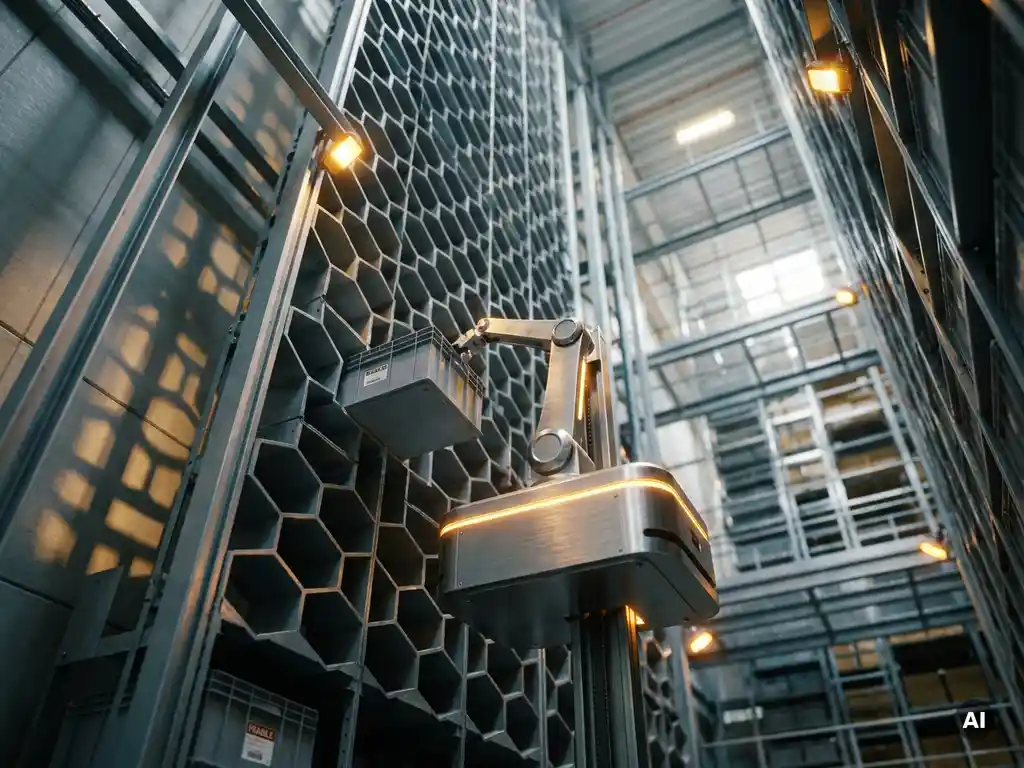
Autonomous mobile robots deliver measurable benefits in warehousing by increasing storage density, accelerating order fulfillment, reducing reliance on manual labor, and enabling flexible scaling without major infrastructure changes. They navigate independently, coordinate through software, and integrate with existing warehouse management systems to keep operations running continuously. The sections below address the most common questions about how AMRs work, what they deliver, and when they make sense to deploy.
How do autonomous mobile robots actually work in a warehouse?
Autonomous mobile robots in a warehouse navigate and perform tasks independently using onboard sensors, software-driven path planning, and real-time coordination from a central control system. They receive task assignments, move through the warehouse without fixed tracks or rails, and interact with storage infrastructure to retrieve or deposit goods, all without human direction for individual movements.
Most AMR systems separate the robots from the storage structure itself. Robots operate beneath or within a grid, receiving instructions from a warehouse control system that manages routing, task sequencing, and collision avoidance. Because multiple robots operate simultaneously and independently, the system continues functioning even when individual units are charging or undergoing maintenance.
In vertical AS/RS environments, this logic extends upward. Robots navigate horizontally at floor level to position themselves beneath the correct storage tower, then climb vertically to access the required storage location directly. The retrieval and deposit cycle happens in a single continuous motion, eliminating the back-and-forth travel that reduces efficiency in traditional conveyor- or crane-based systems. Every storage location remains directly accessible, so no inventory reshuffling is needed to reach a specific tote.
What storage and space efficiency gains do AMRs deliver?
AMRs significantly improve storage density by removing the need for fixed aisles, embedded lifting mechanisms, or electrified rack structures. Because the robots carry out all movement independently, the storage structure itself can be passive, allowing the full cubic volume of a building to be used for storage rather than infrastructure.
In conventional racking systems, a large portion of floor space is consumed by access aisles and the mechanical systems that serve them. AMR-based storage eliminates most of this overhead. Vertical storage systems driven by autonomous robots can reach heights of up to 16 meters, converting building height directly into usable storage positions rather than adding structural complexity.
The geometry of the storage structure also plays a role. Hexagonal tower designs, for example, achieve higher space utilization per square meter than cubic or rectangular grid configurations because the repeating geometry minimizes wasted volume between storage locations. The result is a significantly higher number of storage positions within the same building footprint, which directly reduces real estate costs per stored unit.
How do AMRs improve warehouse throughput and order fulfillment speed?
AMRs improve throughput by enabling parallel, simultaneous task execution across many robots at once, rather than relying on a small number of high-capacity machines like cranes or conveyors. Because each robot operates independently, throughput scales linearly as more units are added, and the system avoids the bottlenecks that occur when a central piece of equipment reaches its processing limit.
Order fulfillment speed improves for several reasons. Robots operate continuously, including during periods when human pickers would need to rest or rotate. Task assignment is handled dynamically by the control system, which sequences jobs to minimize travel distance and eliminate empty trips. In systems designed for dual-cycle operation, a robot deposits one tote and retrieves another in the same vertical interaction, doubling the output per movement.
Distributed operation also provides resilience during peak demand. When one robot stops for charging or maintenance, the remaining units absorb its workload without any single point of failure bringing down the entire system. This stability is particularly valuable during high-volume periods like promotional events or seasonal spikes, where traditional systems often struggle to maintain consistent output.
What’s the difference between AMRs and AGVs in warehouse automation?
The key difference between autonomous mobile robots and automated guided vehicles is how they navigate. AGVs follow fixed physical paths, typically defined by magnetic strips, wires, or reflective markers embedded in the floor. AMRs navigate dynamically using sensors and onboard intelligence, allowing them to plan routes, avoid obstacles, and adapt to changing environments without physical guidance infrastructure.
AGVs: predictable but rigid
AGVs are well-suited to repetitive, high-volume tasks along fixed routes where the environment is stable and predictable. Their reliance on physical path infrastructure means that changing the layout requires physical modification of the guidance system, which adds time and cost. They also struggle to adapt in real time when an obstacle blocks their predefined path.
AMRs: flexible and scalable
AMRs, by contrast, use onboard sensors, cameras, and mapping software to understand their environment and make routing decisions independently. This makes them far more adaptable to changes in warehouse layout, inventory volume, or operational priorities. Adding more AMRs to a system typically requires only software configuration, not physical infrastructure changes, which makes throughput scaling significantly faster and less expensive than with AGV systems.
For warehouse operators evaluating the two technologies, the choice often comes down to how frequently the operation changes. Stable, high-volume environments with fixed workflows may still benefit from AGVs. Warehouses with variable SKU mixes, changing storage layouts, or growing throughput demands are generally better served by AMR-based systems.
How do autonomous mobile robots integrate with existing warehouse systems?
Autonomous mobile robots integrate with existing warehouse systems primarily through software APIs that connect the robot control system to a warehouse management system (WMS) or warehouse execution system (WES). This allows the WMS to pass order and inventory data to the robot fleet, while the robot control system handles task sequencing, routing, and physical execution.
Most modern AMR platforms are designed with standard API connectivity in mind, which means integration does not require replacing or fundamentally restructuring existing software infrastructure. The WMS continues to manage inventory records, order logic, and reporting, while the robot control layer handles the operational layer of physical movement and storage access.
From a hardware perspective, AMR systems typically require minimal changes to existing facilities. Because the robots navigate autonomously and the storage structure is passive, there is no need to embed sensors, power rails, or communication hardware into the rack structure itself. This reduces both the cost and complexity of installation, and it also makes the system easier to relocate or reconfigure if the facility layout changes in the future.
When does it make sense to deploy AMRs over traditional automation?
AMRs make the most sense when a warehouse operation requires flexibility, scalability, or space efficiency that traditional fixed automation cannot provide cost-effectively. They are particularly well-suited to environments with high SKU counts, variable order profiles, limited floor space, or a need to scale throughput incrementally without rebuilding core infrastructure.
Traditional automation, such as conveyor systems, fixed cranes, or shuttle-based AS/RS, performs well in high-volume environments with stable, predictable workflows. But these systems are expensive to modify once installed, and scaling them typically means adding more of the same heavy infrastructure. When demand changes or the product mix shifts, rigid systems can become a constraint rather than an asset.
AMR-based systems are designed to grow alongside the operation. Storage capacity and throughput can be scaled independently: capacity grows by extending the storage structure, and throughput grows by adding robots. Neither change requires stopping operations or redesigning the system architecture. This independent scalability is a significant advantage for businesses in growth phases, those managing seasonal demand variation, or those operating across multiple fulfillment sites where a consistent, reusable architecture reduces engineering effort per deployment.
How Hexxabotics helps with autonomous mobile robot warehousing
Hexxabotics delivers a next-generation robotic AS/RS built specifically around the principles that make AMRs effective: distributed operation, independent scalability, and passive storage infrastructure. The system is designed to address the limitations of conventional warehouse automation head-on.
- Maximum storage density: Hexagonal vertical towers convert full cubic building volume into usable storage, reaching up to 16 meters in height with no embedded motors or electrified rack structures.
- Independent scalability: Storage capacity and throughput scale separately. Add towers to grow capacity. Add Hexxabots to grow throughput. No structural redesign required.
- Direct access to every tote: Every storage location is directly accessible without reshuffling, enabling fast, reliable retrieval across the entire inventory.
- Resilient distributed operation: Parallel robot operation eliminates single points of failure, maintaining stable throughput even during peak demand or individual unit downtime.
- Simple integration: Standard API connectivity links the Hexxabotics Control System to existing WMS platforms, minimizing deployment complexity.
Whether you are evaluating AMR warehousing for a new facility or looking to replace a rigid legacy system, Hexxabotics provides a scalable, high-density architecture built for long-term operational performance. Learn more about the Hexxabotics approach and find out how the system can be configured for your specific throughput and capacity requirements.
Related Articles
- What are the long-term operational costs of warehouse automation?
- Can warehouse automation lower your energy consumption?
- How does a hexagonal grid system change warehouse logistics?
- How does predictive maintenance prevent downtime in automated warehouses?
- Should you choose an AMR system or a fixed-rail AS/RS in 2026?