
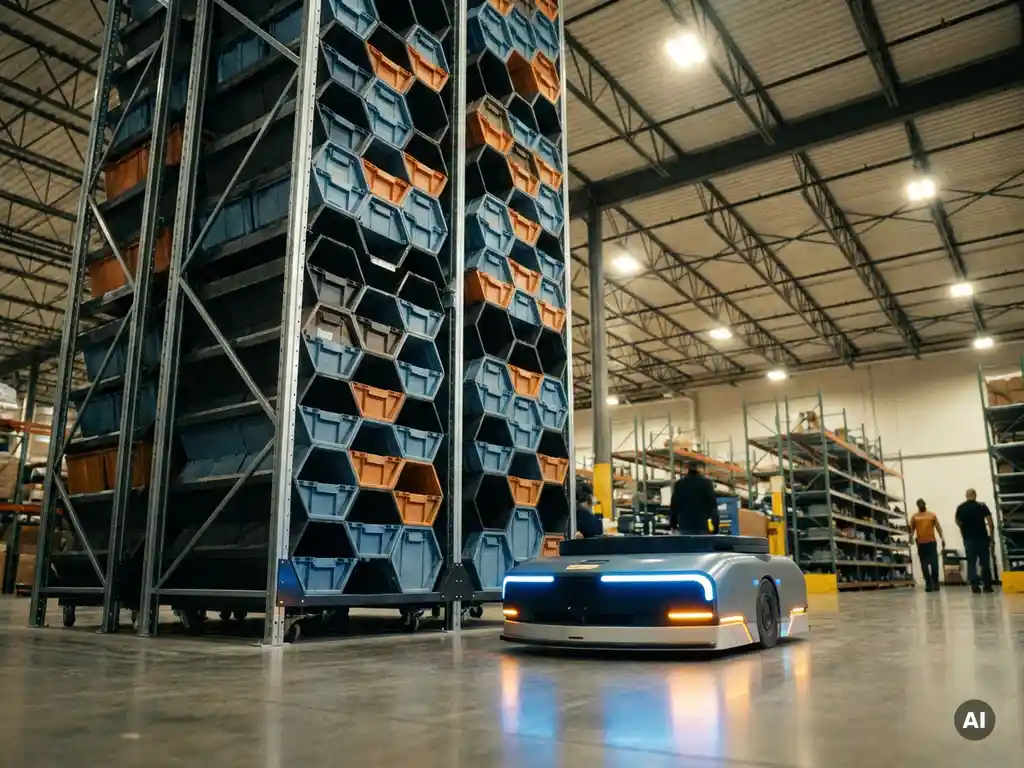
Integrating autonomous mobile robots into an existing warehouse is achievable without a full facility rebuild. Most AMR systems are designed to work within your current footprint, connecting to existing warehouse management systems through standard APIs and requiring minimal structural changes. The key is understanding what each phase of integration actually demands, from infrastructure preparation to software connectivity, deployment timelines, and long-term scaling.
What infrastructure changes does an existing warehouse need for AMRs?
Most existing warehouses require only modest infrastructure changes to accommodate autonomous mobile robots. AMRs do not need fixed tracks, embedded floor wiring, or dedicated power rails running through the storage structure. The primary requirements are a flat, clear floor surface, defined navigation zones, reliable Wi-Fi coverage, and designated charging areas for the robots.
Unlike older automated systems that demanded permanent structural modifications, modern AMR deployments focus on operational zoning rather than physical construction. That means designating robot travel lanes, establishing safety perimeters around human work areas, and ensuring the floor can support the combined load of the robots and their payload. In most cases, standard industrial flooring meets this requirement without resurfacing.
Power infrastructure is a common concern, but it is less demanding than many engineers expect. Robots charge at docking stations positioned at the perimeter of the storage zone or at workstations, so electrical work is limited to those fixed points. Systems like Hexxabotics take this further by eliminating in-rack electrification entirely: no embedded motors, no powered racks, no cabling running through the storage structure. This significantly reduces both installation complexity and long-term maintenance exposure.
The practical checklist for infrastructure readiness typically includes:
- Floor condition assessment and leveling where necessary
- Wi-Fi network audit and coverage expansion if needed
- Electrical work at charging station locations only
- Safety barrier or zone marking installation
- Clearance of overhead obstructions in robot travel paths
How do autonomous mobile robots connect to a warehouse management system?
Autonomous mobile robots connect to a warehouse management system (WMS) through standard software APIs, typically REST or similar interfaces. The robot control system acts as an intermediary layer, receiving task instructions from the WMS and translating them into robot movement commands. This means the WMS continues to manage inventory logic while the robot system handles physical execution.
The integration architecture generally involves three layers working together. The WMS sits at the top, managing orders, inventory positions, and fulfillment priorities. Below it, a fleet management or robot control system coordinates individual robot assignments, traffic, and charging schedules. At the lowest layer, each robot executes its assigned task autonomously based on the instructions it receives.
For most modern warehouse management platforms, this integration follows established protocols that do not require custom development. The robot vendor provides an API specification, and the WMS integration team maps the relevant data fields: location IDs, tote identifiers, task status, and completion confirmations. The Hexxabotics Control System, for example, manages robot coordination and inventory logic internally while exposing standard API endpoints for external WMS connectivity, reducing the burden on the integrator.
A practical consideration is data latency. Real-time inventory accuracy depends on the robot system reporting task completions back to the WMS promptly. Well-designed AMR systems confirm each deposit and retrieval immediately, keeping the WMS inventory record synchronized without manual reconciliation.
What’s the difference between AMRs and traditional AS/RS in an existing facility?
The core difference between AMRs and traditional AS/RS in an existing facility is flexibility versus fixed infrastructure. Traditional AS/RS systems, such as mini-load cranes or shuttle systems, are built around centralized mechanical equipment permanently installed within the rack structure. AMRs operate as independent mobile units that navigate the facility without being tied to fixed rails, lifts, or embedded conveyor systems.
Infrastructure commitment
Traditional AS/RS requires substantial upfront structural work. Cranes need dedicated aisles, precise rail installations, and often purpose-built buildings with specific height and load specifications. Shuttle systems embed motors and power throughout the rack structure, making relocation or reconfiguration costly. AMRs, by contrast, can be deployed within an existing building envelope with far fewer permanent modifications, making them a more practical fit for facilities that were not originally designed for automation.
Throughput and failure risk
Traditional AS/RS systems concentrate throughput on a small number of central machines. A single crane failure can halt an entire aisle or zone. AMR-based systems distribute operation across multiple independent units, so if one robot goes offline for charging or maintenance, the remaining fleet continues working. This distributed architecture eliminates the single point of failure that makes centralized systems vulnerable during peak demand periods.
The distinction becomes especially relevant when comparing scalability. In a traditional AS/RS, increasing throughput often means adding another crane or shuttle system, a significant capital and structural commitment. With an AMR-based approach, throughput scales by deploying additional robot units into the same architecture without mechanical redesign.
How long does it take to deploy autonomous mobile robots in a warehouse?
Deploying autonomous mobile robots in a warehouse typically takes between a few weeks and several months, depending on the scale of the installation, the complexity of the WMS integration, and the level of infrastructure preparation required. A phased deployment in a prepared facility with a compatible WMS can begin producing results within weeks of installation starting.
The deployment timeline breaks into four main phases. First, site preparation covers floor assessment, network infrastructure, and safety zoning. This phase is often the most variable in duration, depending on the existing facility condition. Second, hardware installation involves assembling the storage structure and positioning charging stations. Third, software integration connects the robot control system to the WMS and validates data exchange. Fourth, commissioning and testing runs the system through real order scenarios before going live.
A factor that compresses timelines significantly is modular system architecture. Systems built around repeatable structural units, rather than bespoke engineering for each project, reduce on-site installation time and eliminate the need for custom mechanical design. The Hexxabotics approach uses a consistent architectural logic across deployments, which means integrators can move faster because the engineering decisions are already resolved.
Scaling an existing deployment adds less time than the initial installation, since the infrastructure framework is already in place. Adding towers or robots to an operational system can often happen during regular warehouse operations without shutting down the facility.
How do you scale AMR performance after the initial deployment?
Scaling AMR performance after initial deployment works through two independent levers: adding storage capacity by extending the physical structure, and increasing throughput by deploying additional robot units. These two dimensions can be adjusted separately, which means you do not need to redesign the system every time operational requirements change.
This independence is one of the most operationally significant advantages of well-designed AMR-based storage systems. In traditional AS/RS, storage and throughput are tightly coupled: adding capacity often affects performance, and increasing throughput can require structural changes. With a distributed robot architecture, the two scale independently because throughput is a function of how many robots are active, not how many storage locations exist.
In practice, scaling throughput means commissioning additional robot units and integrating them into the fleet management system. The control software distributes tasks across the expanded fleet automatically, and performance scales roughly linearly as each new unit adds parallel working capacity. There is no centralized crane or conveyor that becomes a bottleneck as the fleet grows.
Scaling storage capacity means extending the structural framework, adding tower modules to increase the number of available storage positions. Because the architecture is modular and uses a consistent geometry, expansion does not require redesigning the existing installation. Crucially, this kind of expansion can happen during live operations, so the warehouse does not need to pause fulfillment while capacity grows.
How Hexxabotics helps with AMR warehouse integration
Hexxabotics offers a purpose-built answer to the challenges of integrating autonomous mobile robots into an existing warehouse. The system is designed from the ground up to minimize infrastructure demands, simplify WMS connectivity, and scale without structural redesign. Key advantages include:
- No in-rack electrification: The storage structure contains no embedded motors, cabling, or powered components, reducing installation complexity and long-term maintenance requirements
- Direct access to every tote: Hexxabots perform deposit and retrieval in one continuous vertical motion, with no reshuffling or digging required across up to 16 meters of vertical storage
- Independent scalability: Storage capacity and throughput scale separately: add towers for more positions, add robots for more picks, without rebuilding infrastructure
- Standard API integration: The Hexxabotics Control System connects to external WMS platforms through standard interfaces, reducing integration effort for system integrators
- Distributed resilience: No single point of failure: if one robot stops, the rest of the fleet continues operating at full capacity
Whether you are planning a first-time AMR deployment or looking to replace a system that has reached its scaling limits, Hexxabotics is built to deliver predictable performance from day one. Explore the Hexxabotics system or learn more about the company to find out how the architecture fits your facility requirements.
Related Articles
- What is the difference between cold chain and ambient pharmaceutical storage?
- How do you design a warehouse for omnichannel fulfillment in 2026?
- What is the role of natural light and ventilation in warehouse design decisions?
- How do you design a warehouse layout that supports multiple shifts?
- What are the biggest challenges of implementing warehouse automation?