
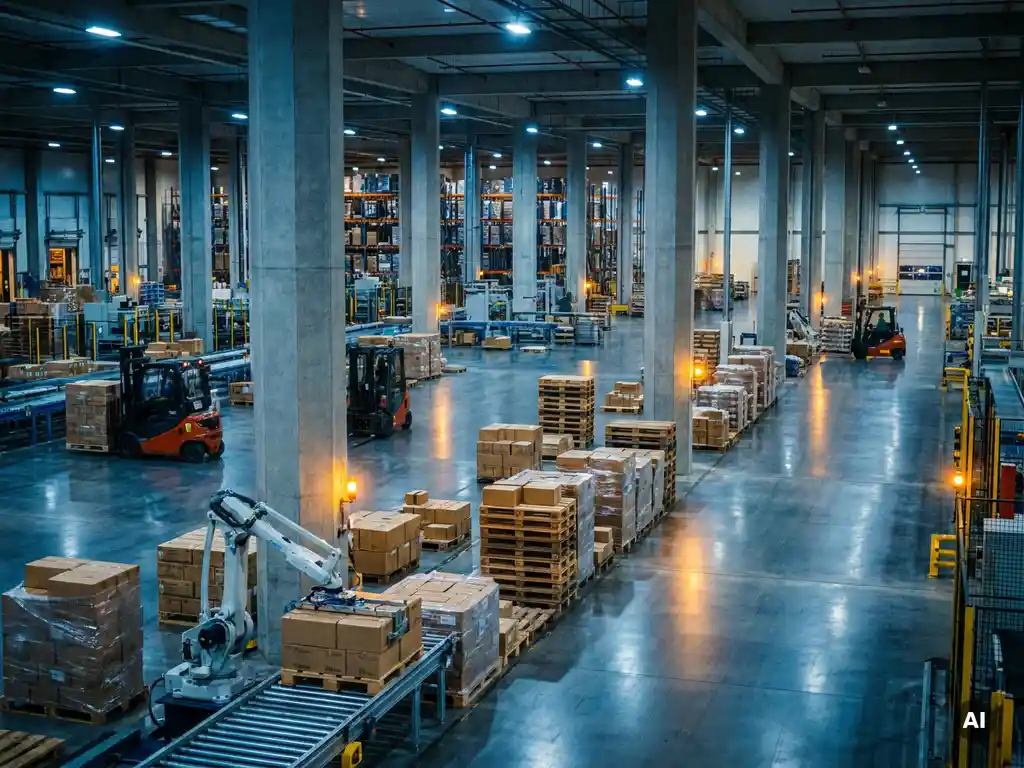
Cross-docking is a logistics strategy where incoming goods are transferred directly from inbound to outbound transport with little or no storage time in between. Instead of placing inventory into storage and retrieving it later, cross-docking moves products through a facility in a continuous flow, reducing handling time and eliminating most warehousing costs. The sections below unpack how the process works, what it demands from a warehouse layout, and where it fits alongside automated storage and retrieval systems.
How does cross-docking actually work in a warehouse?
In a cross-docking warehouse, inbound vehicles unload goods at receiving docks, and those goods are immediately sorted, consolidated if needed, and transferred across the facility floor to outbound docks for loading onto delivery vehicles. The entire transit through the building is measured in hours rather than days, and inventory rarely touches a storage rack at all.
The cross-docking process typically follows a straightforward sequence:
- Inbound vehicles arrive at receiving docks and unload pallets or cases.
- Goods are scanned, verified, and sorted by destination or route.
- Products are moved across the staging floor, sometimes broken down and repackaged into outbound loads.
- Outbound vehicles at the opposite docks are loaded and dispatched.
- A warehouse management system tracks each movement to maintain order accuracy and traceability.
There are two broad variants of cross-docking. Pre-distribution cross-docking means the supplier has already allocated and labelled goods before they arrive, so the facility simply sorts and routes them. Post-distribution cross-docking means the facility itself determines allocation based on real-time demand signals once the goods arrive. Post-distribution requires more sophisticated coordination software but gives the operator more flexibility to respond to shifting demand.
The defining characteristic of the cross-docking process is that dwell time is the enemy. Every hour a product sits on the staging floor is a cost. The model only delivers its promised efficiency when inbound and outbound schedules are tightly synchronized.
What warehouse layout features does cross-docking require?
Cross-docking warehouse design is fundamentally different from a conventional storage-oriented layout. The building must be shaped and equipped to support continuous flow rather than inventory accumulation. The most common configuration is an I-shaped or T-shaped facility with receiving docks on one side and shipping docks on the opposite side, creating a clear path for goods to travel across the floor.
Several layout features are essential for an effective cross-docking operation:
- High dock door density: More dock doors per linear meter of wall means more simultaneous inbound and outbound movements, which increases throughput without increasing floor area.
- Wide, unobstructed staging lanes: The central floor area must allow forklifts, pallet jacks, and conveyor systems to move freely without navigating around racking.
- Short travel distances: The building depth, the distance between inbound and outbound docks, should be minimized. Longer travel distances slow transfer times and increase labor costs.
- Sortation technology: Conveyor belts, automated sorters, or scanning tunnels accelerate the routing of individual cartons or pallets to the correct outbound lane.
- Staging buffers: Even in a pure cross-docking model, small staging areas are needed to hold goods while outbound vehicles are loaded or while consolidation is completed.
Because the cross-docking warehouse layout prioritizes horizontal flow, it uses floor space very differently from a storage warehouse. The floor is the asset, not the rack. This means facilities designed primarily for cross-docking often have lower clear heights than high-bay storage buildings, because vertical space is less relevant when nothing is being stored long-term.
What’s the difference between cross-docking and traditional warehousing?
The core difference between cross-docking and traditional warehousing is whether inventory is stored. Traditional warehousing holds goods in racking or shelving for days, weeks, or months until orders are placed. Cross-docking eliminates that storage step entirely, treating the warehouse as a transfer point rather than a holding facility.
This distinction has cascading effects on nearly every operational and financial dimension of the facility.
Storage costs and inventory holding
In a traditional warehouse, inventory represents tied-up capital. Businesses pay for the space, the racking, the labor to put goods away and retrieve them, and the carrying cost of stock that may sit unsold. Cross-docking removes most of these costs because goods do not dwell long enough to require formal storage infrastructure. The trade-off is that cross-docking requires a reliable and predictable supply chain: if inbound shipments are late or misaligned with outbound demand, the model breaks down.
Labor and handling
Traditional warehousing involves multiple handling touches: receiving, putaway, storage, picking, packing, and dispatch. Cross-docking compresses this into receiving, sorting, and dispatch. Fewer touches generally mean lower labor costs per unit and fewer opportunities for damage or error. However, the labor that does exist in a cross-docking facility must work quickly and accurately under tight time pressure, which creates different workforce management challenges.
Traditional warehousing also allows more flexibility in timing. A warehouse can receive goods during quiet periods and pick orders during peak periods. Cross-docking requires both inbound and outbound activity to happen simultaneously, which demands more precise scheduling and carrier coordination.
When does cross-docking reduce costs, and when does it not?
Cross-docking reduces costs most effectively when products have predictable, high-volume demand, short shelf lives, or supply chains where goods are already allocated before they reach the facility. It performs poorly when demand is unpredictable, SKU counts are very high, or inbound shipment timing cannot be reliably synchronized with outbound requirements.
The scenarios where cross-docking delivers clear cost advantages include fresh food and grocery distribution, where perishability makes storage undesirable; retail replenishment, where stores order predictably and suppliers ship in full-pallet quantities; and large promotional events, where a defined volume of specific products needs rapid distribution across many locations simultaneously.
Cross-docking becomes costly or impractical when the product mix is highly variable. A facility managing thousands of slow-moving or irregular SKUs cannot rely on cross-docking for most of its volume because inbound and outbound flows will rarely align precisely enough to avoid storage. Attempting to run cross-docking across a mixed assortment often results in excessive staging time, which negates the model’s core benefit.
There is also an infrastructure cost consideration. A purpose-built cross-docking facility with high dock door density and wide staging lanes can be expensive to construct or retrofit. If the volume of goods flowing through the facility is insufficient to utilize that capacity, the fixed costs per unit shipped rise rather than fall.
How does cross-docking affect automated storage and retrieval system design?
Cross-docking and AS/RS design address fundamentally different operational problems. Cross-docking eliminates storage; an automated storage and retrieval system optimizes storage. When both strategies coexist in the same facility, the AS/RS typically handles the portion of inventory that cannot or should not flow through cross-docking: slower-moving products, variable SKUs, long-tail assortments, and items requiring precise inventory control.
This distinction matters for warehouse design because the two functions make competing demands on floor space and building geometry. Cross-docking needs horizontal flow space and dock door access. An AS/RS needs vertical height and a compact footprint to maximize storage density. Integrating both in a single facility requires deliberate zoning: the cross-docking staging area and the AS/RS storage zone must be physically separated but logistically connected through a warehouse management or execution system that routes each SKU to the appropriate process.
The architectural separation of capacity and throughput is particularly relevant here. In a coordinated fulfillment architecture, fast-moving products that arrive in predictable quantities flow through cross-docking lanes, while medium-velocity and slower-moving inventory is directed into automated storage. An autonomous AS/RS designed for direct access without reshuffling complements cross-docking well because it can retrieve stored items rapidly when they are needed to complete an outbound order that began as a cross-dock movement.
The practical implication for engineers designing these hybrid facilities is that the AS/RS should not be sized or positioned as though it will handle all volume. Its role is to manage the inventory that cross-docking cannot handle efficiently, which means it must be flexible enough to accommodate a shifting mix of SKUs as demand patterns change over time.
Which industries benefit most from cross-docking?
Cross-docking delivers the greatest benefit in industries where products move in high volumes, have short shelf lives, or arrive pre-sorted and pre-allocated for specific destinations. Retail, grocery, food service, automotive parts distribution, and parcel logistics are the sectors where cross-docking is most widely and successfully deployed.
Grocery and fresh food distribution is perhaps the clearest use case. Perishable goods cannot sit in storage, supplier shipments are frequent and predictable, and store replenishment schedules are regular enough to align inbound and outbound flows reliably. Large grocery retailers have built entire distribution networks around cross-docking principles for this reason.
Retail general merchandise benefits from cross-docking during promotional periods and seasonal peaks, when large quantities of specific products need to move from suppliers to stores within a narrow time window. Outside of those peaks, the same distribution center may rely more heavily on conventional storage for its everyday assortment.
Automotive parts distribution uses cross-docking for high-frequency, high-volume components that flow continuously between manufacturers and assembly plants. The just-in-time supply chain model that underpins much of automotive manufacturing depends on transfer facilities that can move parts quickly without accumulating inventory.
Parcel and courier networks use cross-docking at their hub facilities as the core of their entire operating model. Parcels arrive from regional collection points, are sorted by destination, and depart on outbound routes, all within a few hours. This is cross-docking at its most pure and most time-sensitive.
Industries with highly variable demand, large and unpredictable SKU counts, or products requiring significant value-added processing before dispatch are generally less suited to cross-docking as a primary strategy. For those operations, a combination of automated storage and targeted cross-docking for specific product categories tends to produce better results than a single-strategy approach.
How Hexxabotics helps with warehouse design and storage automation
When a warehouse operation includes both cross-docking flows and a stored inventory that demands fast, flexible retrieval, the storage system becomes a critical component of the overall design. Hexxabotics provides a three-dimensional robotic AS/RS built to handle exactly the inventory that cross-docking cannot: variable SKUs, slower-moving products, and long-tail assortments that require dense, directly accessible storage rather than staging space.
Key capabilities relevant to mixed cross-docking and storage environments include:
- Direct access to every tote: no reshuffling or digging, which supports rapid retrieval when stored items need to join an outbound cross-dock order
- Independent scaling of capacity and throughput: storage locations and robot units can be added separately, so the system adapts as the balance between cross-docked and stored volume shifts
- Vertical density up to 16 meters: the AS/RS occupies a compact footprint, leaving floor space available for cross-docking staging lanes
- No in-rack electrification: simplified infrastructure that reduces installation complexity in facilities where cross-docking areas are already demanding significant building services
- Standard API integration: connects to existing WMS or WES platforms that coordinate both the cross-docking flow and the automated storage zone
If you are designing or redesigning a warehouse that needs to handle both high-velocity throughput and a complex stored assortment, learn more about Hexxabotics and explore how a coordinated fulfillment architecture can serve both operational goals without compromising either.
Related Articles
- How do regulatory agencies inspect pharmaceutical warehouses in 2026?
- How does track-and-trace technology work in pharmaceutical logistics?
- How do you design a warehouse for robotic picking systems?
- Can warehouse automation lower your energy consumption?
- What is the difference between an AMR and an AGV in warehousing?