
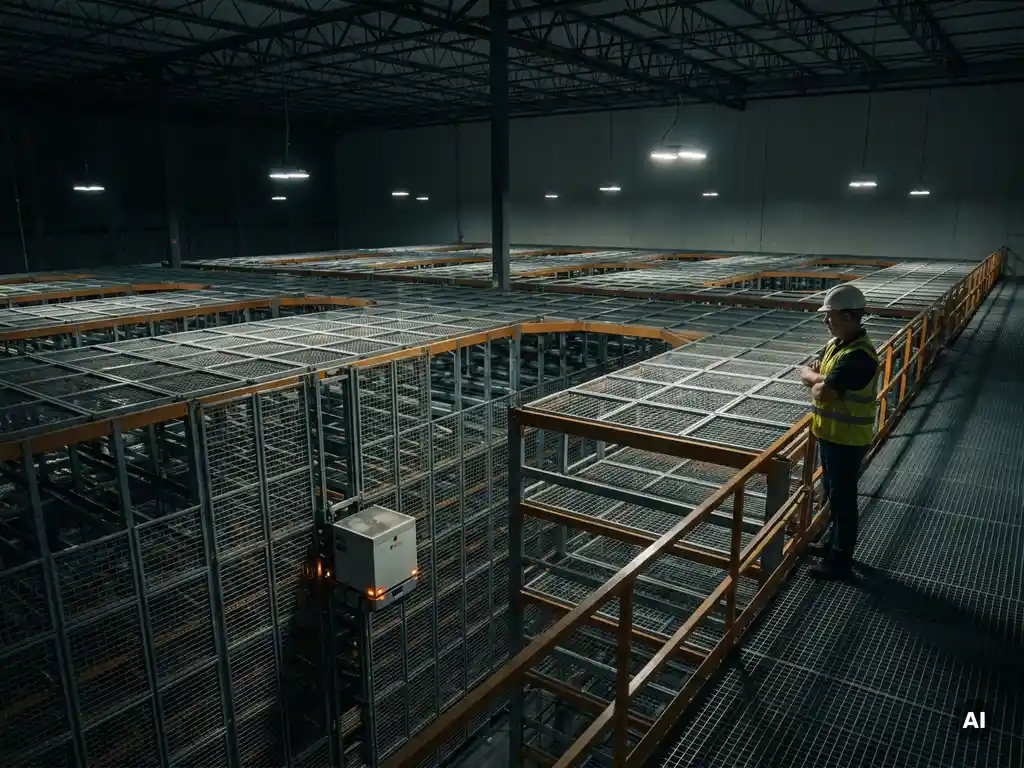
Warehouse automation fundamentally shifts the warehouse manager’s role from physical coordination to strategic oversight. Instead of directing people to pick, move, and store goods manually, managers in an automated warehouse focus on system performance, data analysis, and continuous improvement. The role does not disappear – it evolves into something more technical, more analytical, and in many ways more impactful. The sections below unpack exactly how that shift plays out across skills, daily tasks, decision-making, and implementation.
What new skills do warehouse managers need in an automated warehouse?
Warehouse managers in an automated environment need a blend of technical literacy, data interpretation, and systems thinking. The most critical new skills are the ability to read performance dashboards, understand robot coordination logic, troubleshoot software-driven workflows, and communicate effectively with both operations teams and technology vendors. These skills sit alongside – not in place of – traditional logistics knowledge.
The practical skill shift breaks down into three areas. First, technical fluency: managers do not need to write code, but they must understand how automated storage and retrieval systems operate, how robots are tasked, and how control software interfaces with warehouse management systems via APIs. Second, data literacy: automated warehouses generate continuous performance data, and managers who can interpret throughput rates, cycle times, error logs, and capacity utilization will make better decisions faster. Third, change management: implementing and scaling automation requires managing team transitions, retraining staff, and maintaining operational confidence during periods of change.
Soft skills remain equally important. Automated systems surface problems quickly and precisely, so managers need to act on that information without hesitation. Clear communication between the operations floor, IT teams, and senior leadership becomes a daily requirement rather than an occasional need.
How does automation change day-to-day warehouse management tasks?
Automation removes the majority of reactive, task-level management from a warehouse manager’s daily routine. Tasks like directing pickers to locations, managing manual replenishment cycles, and resolving stock discrepancies caused by human error are largely handled by the system. The manager’s daily focus shifts toward monitoring system health, reviewing performance metrics, and planning capacity against incoming demand.
In a warehouse running an AS/RS system, a typical day involves reviewing overnight throughput reports, checking robot uptime and error flags, coordinating with inbound teams on tote volume, and adjusting task priorities within the control software if order profiles have changed. Exception handling still requires human judgment – when a robot unit requires attention, when a tote is flagged, or when a client SLA is at risk – but these exceptions are surfaced clearly by the system rather than discovered through manual checks.
The volume of administrative tasks also changes. Inventory accuracy improves significantly in automated environments because every storage and retrieval event is logged in real time. This reduces the time managers spend on cycle counts, discrepancy investigations, and manual reconciliation. That recovered time can be redirected toward planning, process refinement, and team development.
Does warehouse automation reduce the need for warehouse managers?
Warehouse automation does not eliminate the need for warehouse managers – it reduces the number of frontline supervisors needed for manual task coordination while increasing the value placed on managers who can oversee complex automated systems. The overall headcount in a warehouse typically decreases, but the warehouse manager role itself becomes more strategic and is often retained or elevated.
The reason is straightforward: automated systems require human oversight to perform at their best. Robots execute tasks reliably, but they operate within parameters set and maintained by people. Someone must define slotting logic, respond to system alerts, manage integrations with external platforms, plan for seasonal volume changes, and ensure the system is configured correctly as the business evolves. These responsibilities require judgment that automation does not replace.
What does reduce is the need for large supervisory teams managing manual pickers across wide floor areas. A single manager overseeing an automated system can effectively govern a much larger operational throughput than would be possible in a manually operated warehouse. The span of control widens, and the nature of leadership shifts from task assignment to system governance.
How do warehouse managers oversee robot performance and uptime?
Warehouse managers oversee robot performance through a centralized control system that provides real-time visibility into each robot unit’s status, task completion rate, battery level, and error history. Rather than physically monitoring the floor, managers work from dashboards that surface the metrics that matter most to operational continuity and throughput targets.
In systems like Hexxabotics, where autonomous robots operate independently within a distributed grid, the control layer tracks every unit simultaneously. Because the architecture eliminates single points of failure – no centralized crane, no fixed vertical conveyor – a single robot stopping does not halt the system. Managers can identify underperforming units, schedule maintenance windows, and add capacity by deploying additional robots without disrupting live operations.
Effective uptime oversight involves three practical habits:
- Reviewing daily performance logs to identify patterns in error frequency or cycle time degradation before they become larger issues
- Setting alert thresholds in the control software so that managers are notified proactively rather than discovering problems after throughput has already dropped
- Coordinating with maintenance teams on a predictive rather than reactive schedule, using robot usage data to anticipate servicing needs
The distributed nature of modern AS/RS systems also means that managers can monitor the system’s aggregate performance rather than tracking individual units constantly. If throughput is stable and error rates are low, the system is operating as intended. Deviations from baseline are the signal to act.
How does automation affect warehouse manager decision-making?
Automation makes warehouse manager decision-making faster, more data-driven, and more forward-looking. Because the system logs every transaction in real time, managers have access to accurate, current information about inventory levels, throughput rates, and order status at any moment. This removes the guesswork that often slows decisions in manually operated warehouses.
The nature of the decisions also changes. In a manual warehouse, many decisions are reactive – responding to a mis-pick, a staffing gap, or a misplaced pallet. In an automated warehouse, the system handles those events autonomously or flags them immediately. Managers are freed to make proactive decisions: adjusting slotting strategies based on demand patterns, planning capacity expansion ahead of peak season, or optimizing pick sequencing to improve cycle times.
Automation also introduces a new category of decision: system configuration. Managers must decide how to prioritize tasks within the control software, how to allocate robot resources across competing order types, and when to adjust operational parameters as business needs shift. These decisions require understanding how the system behaves under different conditions, which is why technical literacy becomes such a valued skill in this environment.
One important implication is that decision quality becomes more visible. When a manager makes a configuration change, the system’s performance data reflects the outcome almost immediately. This creates a tighter feedback loop between decisions and results, which accelerates learning but also raises accountability.
What is the warehouse manager’s role during an automation implementation?
During an automation implementation, the warehouse manager is the operational anchor – the person who bridges the gap between the technology being installed and the business processes it must support. This role involves translating operational requirements into system configuration decisions, managing staff through the transition, and ensuring that go-live is treated as the beginning of optimization rather than the end of the project.
In the early stages, the warehouse manager’s primary contribution is requirements definition. They know the order profiles, the SKU mix, the seasonal demand patterns, and the service level commitments that the system must support. Without that input, even a technically excellent AS/RS system can be configured in ways that do not match the operational reality.
During installation and testing, the manager coordinates between the implementation team and the warehouse’s existing operations. In many cases, automation is introduced while the facility continues to run, which requires careful sequencing and clear communication to prevent disruption. Managers who have mapped their current processes in detail before implementation begins are far better positioned to manage this period effectively.
After go-live, the warehouse manager takes ownership of the system’s ongoing performance. This means learning the control software deeply, establishing reporting routines, and building the internal knowledge base that will allow the team to maintain and scale the system independently over time. The most successful implementations are those where the warehouse manager treats the technology as a tool they own, not a system they simply operate.
How Hexxabotics supports the evolving warehouse manager role
Hexxabotics is designed to give warehouse managers the control, visibility, and flexibility they need to lead an automated operation confidently. The system’s architecture directly addresses the challenges managers face when overseeing complex warehouse automation:
- Centralized control with distributed resilience: The Hexxabotics Control System provides a single management layer for robot coordination, inventory logic, and safety, while the distributed robot architecture means no single failure point can halt operations
- Independent scalability: Managers can increase storage capacity by extending the structure and increase throughput by adding autonomous Hexxabots, without stopping operations or redesigning infrastructure
- 100% direct tote access: Every storage location is directly accessible with no digging or reshuffling, which simplifies inventory management and reduces exception handling
- Standard API integration: The system connects with existing warehouse management systems, so managers work within familiar planning tools while gaining the performance advantages of an advanced AS/RS system
- No in-rack electrification: The passive rack structure reduces maintenance complexity, giving managers fewer infrastructure failure points to monitor and manage
For warehouse managers preparing to lead an automated operation or evaluating how to scale an existing one, Hexxabotics offers a system built around the operational realities they face every day. Explore how the platform works and what it can deliver for your facility at hexxabotics.com.
Related Articles
- What is an autonomous mobile robot used for in logistics?
- What is the difference between short-term savings and long-term automation ROI?
- What is a warehouse execution system and how does it differ from a WMS?
- What is total cost of ownership for warehouse automation?
- What is the difference between AMRs and AGVs in warehouses?