
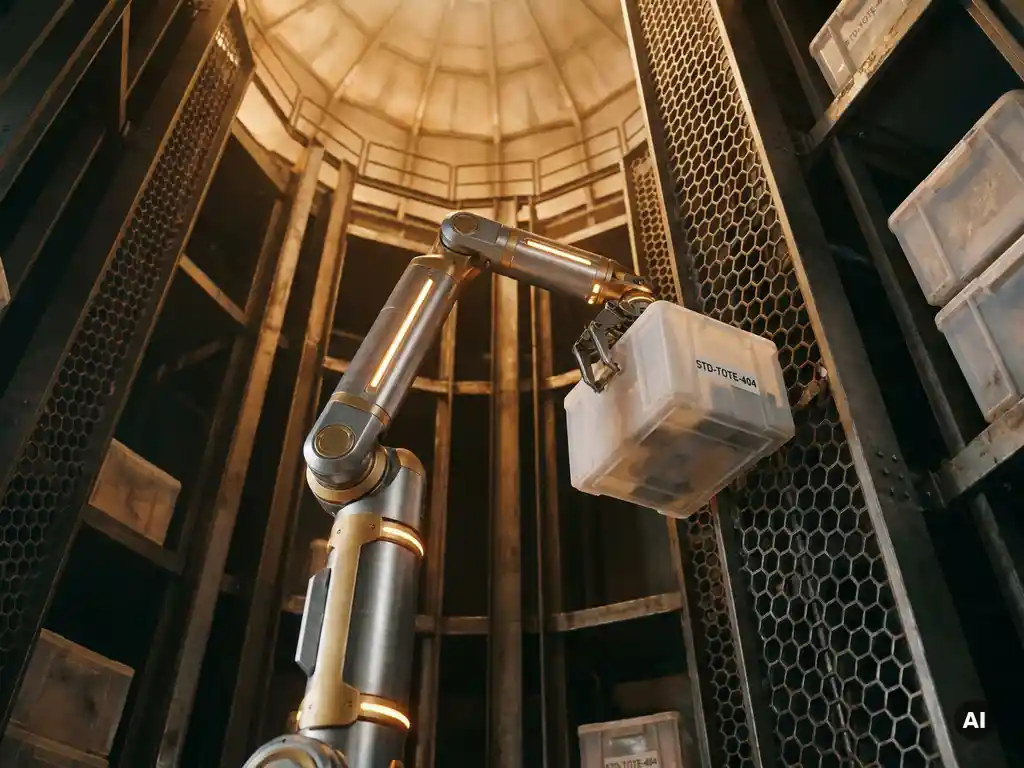
A warehouse execution system (WES) is a software layer that sits between a warehouse management system (WMS) and the physical automation equipment on the floor, translating high-level inventory instructions into real-time work orders for robots, conveyors, and other automated systems. A WMS tells you what needs to move and where it belongs in inventory; a WES determines how and when that movement actually happens. The distinction matters most once a warehouse introduces automated equipment, because that is the point where real-time orchestration becomes a separate and critical function. The sections below work through the most common questions engineers and operations leaders ask when evaluating these systems.
How does a warehouse execution system actually work?
A warehouse execution system works by receiving order and inventory data from a higher-level system, breaking that data into granular tasks, and then dispatching those tasks to automation equipment in real time while continuously monitoring performance and adjusting priorities. It operates in the present moment, not in planned batches, which is what separates it from planning-oriented software.
In practical terms, when an order arrives, the WES calculates the most efficient sequence of picks, assigns those picks to available robots or automated storage systems, tracks each unit of work as it progresses, and reroutes tasks on the fly if a machine becomes unavailable or a higher-priority order enters the queue. It also manages the interfaces between different types of equipment so that a tote retrieved from an AS/RS system arrives at a pick station at precisely the right moment, rather than queuing up and creating congestion.
The result is that throughput becomes a managed, dynamic variable rather than a fixed ceiling. The WES continuously balances load across all available resources, which is why warehouses running complex automation typically see measurable improvements in picks per hour once a WES is in place compared to running the same equipment without one.
What’s the difference between a WES, WMS, and WCS?
A WMS (warehouse management system) manages inventory: it tracks stock locations, controls receiving and shipping, and drives order fulfillment logic. A WCS (warehouse control system) communicates directly with physical equipment such as conveyors and sorters at the machine level. A WES sits between the two, handling real-time task orchestration and workflow execution across both manual and automated processes.
What a WMS does
A WMS is fundamentally a record-keeping and planning system. It knows where every SKU is located, calculates optimal put-away paths, generates pick lists, and manages inventory accuracy. It operates on a slightly longer time horizon, often working in planned waves or batches. Most WMS platforms are not designed to communicate directly with robots or conveyors in real time, and they do not monitor machine states or adjust task sequences based on equipment availability.
What a WCS does
A WCS operates at the equipment layer. It sends direct signals to PLCs, conveyors, sorters, and other hardware, managing the physical movement of items through the facility. A WCS does not understand inventory logic or order priorities; it simply executes the commands it receives. In warehouses with only fixed conveyor infrastructure, a WCS may be sufficient. Once autonomous robots or AS/RS units enter the picture, the coordination complexity grows beyond what a WCS alone can handle.
Where a WES fits
A WES absorbs work from the WMS, translates it into executable tasks, and then coordinates those tasks across both automated and manual resources in real time. It effectively bridges the gap that opens up when a WMS is too abstract for equipment-level decisions and a WCS is too narrow to understand order priorities. Many modern WES platforms also incorporate WCS functionality, reducing the need for a separate control layer.
When does a warehouse need a WES instead of just a WMS?
A warehouse needs a WES when it introduces automated equipment that requires real-time task coordination beyond what a WMS can provide. If every process in a facility is manual, a WMS is typically sufficient. The moment conveyors, autonomous robots, or automated storage and retrieval systems enter the operation, a WES becomes necessary to manage the interaction between those systems and the broader fulfillment workflow.
Specific triggers that indicate a WES is needed include:
- Deploying an AS/RS, goods-to-person system, or autonomous mobile robots that need dynamic task assignment
- Running multiple types of automation that must be coordinated with each other and with manual pick zones
- Operating in an environment with highly variable order profiles, such as e-commerce, where wave-based planning creates throughput bottlenecks
- Needing to prioritize orders dynamically based on shipping cutoffs, carrier windows, or SLA commitments
- Managing peak demand periods where static task sequences cause queuing and system slowdowns
In short, complexity is the driver. A WES pays for itself when the cost of poor orchestration, missed shipments, idle automation, congested workstations, exceeds the cost of the software itself. For operations running high-density automated storage with multiple robots, that crossover point arrives quickly.
Can a WES and WMS run together in the same warehouse?
Yes, a WES and WMS are designed to run together and are most effective when they do. The WMS handles inventory ownership, order management, and fulfillment logic, while the WES handles real-time execution across the automation layer. The two systems communicate through standard APIs, with the WMS passing order data down to the WES and the WES returning status updates and inventory confirmations upward.
In a well-integrated stack, the WMS remains the system of record for inventory. It does not need to know which specific robot retrieved a tote or which conveyor lane it traveled through; it only needs to know that the order was fulfilled accurately and on time. The WES owns that middle layer of execution detail, which means neither system has to do work it was not designed for.
Most modern WES platforms are built with this coexistence in mind. They expose standard integration interfaces that connect to major WMS vendors without requiring custom development, which significantly reduces deployment complexity. When evaluating automation systems, it is worth confirming that the WES component integrates with your existing WMS through documented APIs rather than proprietary connectors, since proprietary integrations create long-term maintenance risk.
What are the key features to look for in a warehouse execution system?
The key features to prioritize in a warehouse execution system are real-time task orchestration, multi-system integration, dynamic prioritization, scalability, and robust reporting. Beyond those core capabilities, the right feature set depends on the specific automation technology being deployed and the operational complexity of the facility.
When evaluating WES platforms, look for the following:
- Real-time task dispatching: The system must assign and reassign work dynamically based on current equipment states, not pre-planned batches
- Multi-equipment coordination: It should manage heterogeneous environments where AS/RS units, autonomous robots, conveyors, and manual stations all operate simultaneously
- Dynamic order prioritization: The ability to elevate or defer orders based on shipping windows, SLAs, or carrier cutoffs without disrupting ongoing work
- Standard API connectivity: Clean integration with WMS platforms and automation hardware through documented, vendor-neutral interfaces
- Scalability without redesign: The WES architecture should support adding robots or storage locations without requiring software restructuring
- System health monitoring: Live visibility into equipment states, task queues, and throughput rates so operators can identify and respond to issues before they cascade
- Resilience and fault handling: Automatic rerouting of tasks when individual machines go offline, so a single failure does not halt the broader operation
For warehouses running AS/RS technology specifically, fault tolerance and distributed task management are particularly important. Systems where throughput depends on a single crane or centralized lift mechanism create a single point of failure that no WES can fully compensate for. Choosing automation hardware with distributed operation built in reduces the burden placed on the WES to work around structural bottlenecks.
How Hexxabotics supports warehouse execution at the hardware level
The effectiveness of any warehouse execution system depends heavily on the automation hardware it coordinates. Hexxabotics designs its AS/RS system to reduce the orchestration burden on the WES layer by eliminating the structural bottlenecks that make real-time coordination difficult.
- Distributed robot operation: Hexxabots operate in parallel with no centralized crane or lift shaft, so throughput scales linearly as robots are added and no single failure point can halt the system
- 100% direct tote access: Every storage location is directly reachable without reshuffling, which means the WES can dispatch retrieval tasks without accounting for dig-down sequences or repositioning cycles
- Independent capacity and throughput scaling: Storage locations and robot count scale separately, giving the WES consistent, predictable resources to work with as the operation grows
- Standard API integration: The Hexxabotics Control System connects to external WMS and WES platforms through standard interfaces, reducing integration complexity and deployment time
For engineering and operations teams evaluating warehouse automation systems, the combination of intelligent execution software and well-architected hardware is what determines real-world throughput performance. Explore how the Hexxabotics AS/RS system is built to support scalable, resilient warehouse execution.
Related Articles
- What are the biggest compliance risks in pharmaceutical cold storage?
- What are GMP requirements for pharmaceutical warehouse storage?
- How do you implement track-and-trace in an existing warehouse system?
- How does SKU count affect the complexity of warehouse layout planning?
- What are audit trail requirements for pharmaceutical warehouses in 2026?