
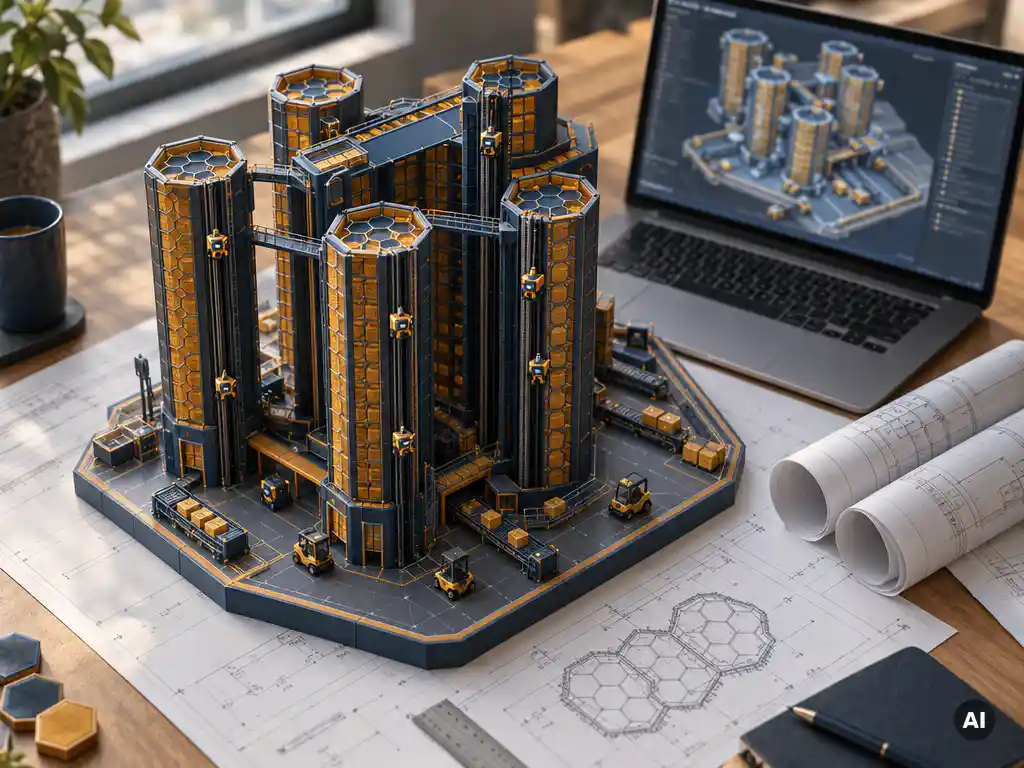
Simulation software plays a central role in warehouse layout planning by allowing engineers and planners to model, test, and optimize a warehouse design before any physical construction begins. It translates layout decisions, equipment configurations, and operational logic into a virtual environment where performance can be measured, stress-tested, and refined. The sections below address the most common questions engineers ask when evaluating simulation tools for warehouse automation projects.
What can simulation software actually model in a warehouse?
Warehouse simulation software can model the physical layout, material flow, equipment behavior, inventory logic, and workforce interactions of a warehouse environment. It captures how goods move through a facility from receiving to dispatch, including storage, retrieval, sorting, consolidation, and exception handling. Modern tools can simulate both static layout geometry and dynamic operational behavior simultaneously.
In practical terms, this means a simulation can represent conveyor routing, storage rack configurations, Goods-to-Person workstation throughput, robot travel paths, and order release sequencing. It can also model inventory rules such as FIFO or FEFO logic, replenishment triggers, and batch management behavior.
For automated systems specifically, simulation can replicate the decision logic that governs how robots are dispatched, how tasks are queued, and how the system responds to competing demands. This is particularly valuable for AS/RS environments where robot coordination, tote routing, and workstation pacing all interact in ways that are difficult to reason through analytically.
How does simulation software detect layout bottlenecks before construction?
Simulation software detects layout bottlenecks by running the warehouse design under realistic demand conditions and identifying where throughput degrades, queues form, or resources become saturated. Because the model runs in accelerated time, planners can observe the cumulative effect of peak demand scenarios, shift changes, and equipment interactions that would take weeks to observe in a live facility.
Common bottlenecks that simulation surfaces include:
- Conveyor merge points where traffic from multiple zones competes for a single lane
- Workstation imbalances where one operator or station becomes the rate-limiting step
- Lift or vertical transport constraints that limit how quickly totes reach picking stations
- Aisle congestion in manual or semi-automated zones during peak order waves
- Inventory replenishment conflicts that stall retrieval operations
By identifying these failure points in the model, planners can reconfigure the layout, add equipment, or adjust operational logic before committing to construction. The cost of changing a simulation model is negligible compared to modifying installed infrastructure.
What’s the difference between 2D layout tools and 3D warehouse simulation?
Two-dimensional layout tools are primarily spatial planning instruments. They show where equipment, aisles, and zones are positioned on a floor plan, but they do not simulate how the operation actually performs over time. Three-dimensional warehouse simulation adds a time dimension and operational logic, allowing planners to observe dynamic behavior rather than just static geometry.
A 2D layout tool is useful for checking that a racking configuration fits within a building footprint, that fire exits remain accessible, or that aisle widths meet equipment clearance requirements. These are necessary checks, but they cannot reveal how the layout performs under load.
Three-dimensional warehouse simulation goes further by modeling vertical space utilization, robot travel in three dimensions, and the interaction between horizontal and vertical movement. This is particularly relevant for high-bay storage systems that exploit building height rather than floor area. A system designed to use up to 16 meters of vertical height, for example, requires simulation that can model vertical access cycles, not just horizontal flow. A flat floor plan cannot represent that behavior.
For warehouse automation planning involving dense, vertically oriented AS/RS architectures, 3D simulation is the appropriate tool. Two-dimensional planning remains useful as a starting point for space allocation, but it should be treated as one input into a broader simulation process rather than a substitute for it.
How does simulation validate automated storage and retrieval system performance?
AS/RS simulation validates system performance by modeling robot behavior, storage logic, retrieval sequencing, and workstation throughput under defined demand profiles. It allows planners to confirm that a given robot fleet size, grid configuration, and task allocation strategy can meet throughput targets before the system is physically installed.
Validation through simulation typically addresses several interconnected questions:
- Can the system meet peak throughput? The simulation runs the AS/RS under the highest expected order volumes to confirm that retrieval rates match downstream demand.
- How does adding robots affect performance? Because capacity and throughput can be treated as independent variables in modular AS/RS architectures, simulation can quantify the marginal throughput gain from each additional robot unit.
- Where do retrieval queues form? If certain storage locations or workstations become congested, the simulation identifies the cause and allows planners to adjust inventory slotting or task sequencing.
- How does the system recover from disruptions? Simulation can model robot failures, replenishment delays, or unexpected order spikes to assess resilience and recovery behavior.
In development environments, a digital twin approach extends this further. A simulated environment operating with logic aligned to the physical robotic system can support software development, flow validation, interface testing, and system modeling before any process depends on physical equipment. This means the control software and operational logic can be tested and refined in parallel with hardware installation, compressing overall project timelines.
When should simulation be used in the warehouse planning process?
Simulation should be used at multiple stages of the warehouse planning process, not only at the design phase. The most valuable applications occur before major decisions are locked in, but simulation also contributes during detailed design, software development, and operational commissioning.
In the early planning phase, simulation helps evaluate competing layout concepts and automation configurations against throughput and capacity requirements. This is when the fundamental decisions about storage technology, flow architecture, and zone allocation are made, and simulation provides the evidence base for those choices.
During detailed design, simulation validates that the selected configuration meets performance targets across a range of demand scenarios, including normal operations, seasonal peaks, and degraded conditions. Changes at this stage are still relatively low cost compared to post-installation modifications.
During software development and integration, a simulated environment allows control system logic, inventory rules, and interface behavior to be tested without requiring physical equipment to be operational. This is particularly valuable when integrating an AS/RS with an existing warehouse management system, because interface errors can be identified and resolved before go-live.
After commissioning, simulation models can be updated to reflect actual operational data, serving as a planning tool for capacity expansions, SKU assortment changes, or throughput upgrades.
What are the limitations of warehouse simulation software?
Warehouse simulation software is a powerful planning tool, but its outputs are only as reliable as the inputs and assumptions that define the model. The most significant limitation is that simulation cannot substitute for validated technical specifications, and planners should treat simulation results as directional rather than contractually precise.
Several practical limitations apply across most simulation tools:
- Input quality determines output quality. If demand profiles, SKU velocity distributions, or equipment cycle times are estimated rather than measured, the simulation will reflect those estimates rather than actual operational behavior.
- Model complexity has limits. Highly complex operational logic, such as pharmaceutical batch management, expiry-aware retrieval, or multi-system orchestration, requires careful implementation to simulate accurately. Simplified representations may miss interactions that matter in practice.
- Simulation does not replace engineering validation. Performance figures generated by simulation should be confirmed through formal technical validation before they are used as contractual commitments or public performance claims.
- Human behavior is difficult to model. In hybrid environments where people and automation interact, the simulation’s assumptions about operator pace, error rates, and decision-making may not reflect real-world variability.
- Maintenance and downtime modeling requires careful calibration. Availability assumptions, recovery times, and degraded-mode behavior need to be grounded in real equipment data rather than optimistic defaults.
Understanding these limitations does not diminish the value of simulation. It means simulation should be used as part of a structured engineering process that combines modeling with technical validation, not as a standalone source of performance guarantees.
How Hexxabotics supports warehouse layout optimization
Hexxabotics applies simulation and digital twin methodology as a core part of its system development and deployment process. For engineers evaluating AS/RS options for warehouse automation planning, the Hexxabotics approach addresses several of the challenges that simulation is designed to solve:
- A digital twin environment allows software logic, flow behavior, and interface integration to be validated before physical equipment is operational
- The architecture separates storage capacity from throughput performance, so simulation can model each dimension independently and guide decisions about grid size and robot fleet composition
- Direct-access storage means retrieval logic is predictable and simulatable without the complexity of reshuffling or digging sequences
- The modular structure supports phased expansion, which simulation can model as a staged capacity and throughput roadmap rather than a single fixed design
- Standard API integration with warehouse management systems can be tested in a simulated environment before live deployment
If you are planning a warehouse automation project and want to understand how a three-dimensional AS/RS architecture performs under your specific demand profile, learn more about Hexxabotics and get in touch to discuss how simulation and engineering validation can support your project from layout concept through to commissioning.
Related Articles
- How do you design a warehouse to reduce travel time for workers?
- What is direct-access storage and how does it support drug recalls?
- How do regulatory agencies inspect pharmaceutical warehouses in 2026?
- What documentation is required for controlled substance warehousing?
- What is the difference between an AMR and an AGV in warehousing?