
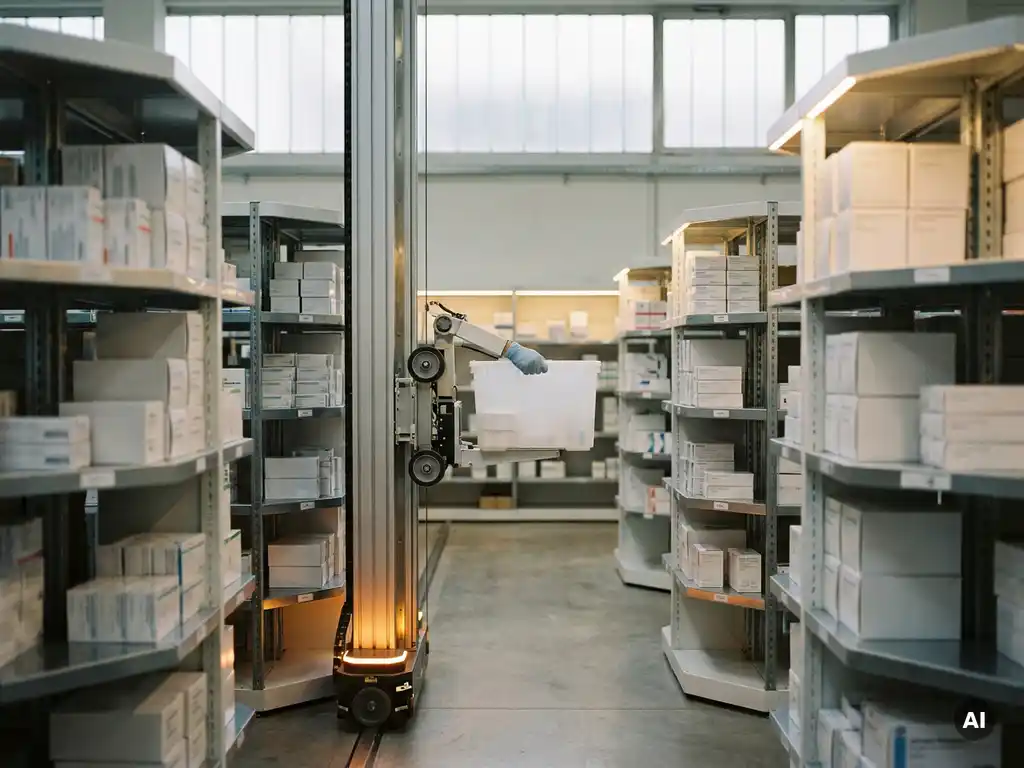
Pharmaceutical warehousing is the specialized storage, handling, and distribution of medicinal products under conditions that protect their safety, efficacy, and integrity throughout the supply chain. Unlike general warehousing, it operates within a tightly regulated framework that governs everything from temperature control to batch traceability. The sections below answer the most common questions professionals ask when evaluating or upgrading a pharma warehouse operation.
What regulations govern pharmaceutical warehouse storage?
Pharmaceutical warehouse storage is governed primarily by Good Distribution Practice (GDP) guidelines and, where manufacturing or repackaging occurs, Good Manufacturing Practice (GMP) requirements. In most markets, national medicines agencies enforce these standards, while the European Medicines Agency (EMA) publishes the GDP guidelines that apply across EU member states. In the United States, the FDA sets equivalent requirements under 21 CFR regulations.
GDP guidelines define how medicinal products must be transported, stored, and handled to maintain their quality from the point of manufacture to the end user. Key obligations for warehouse operators include:
- Maintaining appropriate storage conditions for every product category held on site
- Implementing qualified temperature monitoring systems with documented calibration
- Controlling access to storage areas and maintaining clear segregation between product statuses
- Applying batch traceability so every unit can be tracked from receipt to dispatch
- Conducting regular self-inspections and maintaining records that support regulatory audit
- Qualifying suppliers and customers as part of the distribution chain
The Falsified Medicines Directive (FMD) adds a further layer of obligation for EU-based distributors, requiring verification of unique product identifiers and tamper-evident features at defined points in the supply chain. Warehouse processes and software systems must be capable of supporting these verification steps without introducing bottlenecks into the order flow.
Non-compliance carries serious consequences. Regulatory agencies can suspend distribution licenses, issue product recalls, or impose financial penalties. For pharmaceutical wholesalers and distributors, maintaining a GDP-compliant warehouse is therefore not optional: it is a precondition for operating in regulated markets.
What are the different types of pharmaceutical storage conditions?
Pharmaceutical products require storage conditions matched to their specific stability profiles, and regulatory guidelines define several distinct categories. The most common are ambient (controlled room temperature, typically 15 to 25 degrees Celsius), refrigerated (2 to 8 degrees Celsius), frozen (below minus 15 or minus 20 degrees Celsius depending on the product), and ultra-low temperature (below minus 60 degrees Celsius for certain biologics and vaccines).
Within an ambient warehouse, further distinctions apply. Some products must be protected from light, others from humidity, and some require controlled atmosphere conditions. Narcotics and controlled substances must be held in physically secured areas that meet additional legal requirements beyond standard GDP.
Storage condition categories matter operationally because they directly determine infrastructure requirements. A pharmaceutical distribution center typically manages multiple storage zones simultaneously, and each zone must be independently monitored, documented, and qualified. Products stored outside their approved conditions, even temporarily, can be rendered unfit for release, creating both regulatory and financial risk.
Warehouse design must therefore account for zone segregation from the outset. Products with different storage requirements cannot share the same physical environment, and the transition of products between zones (for example, during picking or order consolidation) must be managed within defined time and temperature limits.
How does cold chain management work in pharmaceutical warehouses?
Cold chain management in pharmaceutical warehouses is the end-to-end process of maintaining products within their required temperature range from receipt through storage, picking, and dispatch. It relies on a combination of qualified refrigerated infrastructure, continuous temperature monitoring, documented procedures, and trained personnel to ensure the cold chain is never broken.
In practice, cold chain management involves several interconnected elements:
- Qualified storage equipment: Refrigerated chambers, cold rooms, or refrigerated units must be validated to demonstrate they can maintain the required temperature range under realistic operating conditions, including door openings and peak load scenarios.
- Continuous temperature monitoring: Sensors placed at defined locations within the storage zone record temperatures at regular intervals. Alarm systems alert staff to excursions before products are compromised.
- Goods-in temperature verification: Products arriving from suppliers must be checked for temperature compliance on receipt. Any excursion during transit must be assessed before the product is accepted into stock.
- Controlled picking and dispatch: Time spent outside refrigerated storage during order assembly must be minimized and documented. Outbound shipments require validated packaging and, where necessary, active or passive cooling systems.
- Deviation management: When a temperature excursion occurs, a documented investigation must determine whether affected products remain fit for use. Products that cannot be confirmed as compliant must be quarantined and assessed for disposal or return.
Cold chain failures are among the most costly events in pharmaceutical distribution, both in terms of product loss and regulatory consequence. Automation systems that reduce manual handling of refrigerated products can help minimize the time products spend outside controlled conditions, supporting both compliance and operational efficiency.
What’s the difference between pharmaceutical warehousing and standard warehousing?
The fundamental difference between pharmaceutical warehousing and standard warehousing is the regulatory and quality framework that governs every aspect of pharmaceutical operations. Standard warehousing optimizes for cost and throughput. Pharmaceutical warehousing must simultaneously optimize for cost, throughput, compliance, product integrity, and full traceability, and any compromise on the compliance dimensions carries legal and public health consequences.
Regulatory and quality obligations
A standard warehouse operates within general health and safety legislation. A pharmaceutical warehouse must comply with GDP and, where applicable, GMP requirements, maintain a quality management system, conduct regular self-inspections, and be prepared for inspection by national medicines agencies. Staff must be trained in GDP principles, and a Responsible Person with defined legal accountability must oversee quality compliance.
Inventory control and traceability
Standard warehouses track inventory at the SKU level for commercial purposes. Pharmaceutical warehouses must track inventory at the batch or lot level, maintaining a complete chain of custody from supplier to customer. This means the warehouse management system must record not just how many units of a product are held, but which specific batches they belong to, their expiry dates, and where they are located within the facility.
First Expired First Out (FEFO), rather than the standard First In First Out (FIFO) approach, governs stock rotation in pharmaceutical operations, ensuring that products approaching their expiry date are dispatched before newer stock. This adds complexity to picking logic that standard warehouse systems are not always designed to handle.
Storage conditions and infrastructure
Standard warehousing typically maintains a single ambient environment. Pharmaceutical warehousing requires multiple qualified storage zones, temperature monitoring infrastructure, segregated areas for quarantined or returned stock, and secure storage for controlled substances. The physical facility must be designed to support these requirements, and any changes to the storage environment must be re-qualified before products are returned to that zone.
How is pharmaceutical warehouse inventory tracked and traced?
Pharmaceutical warehouse inventory is tracked and traced through a combination of batch-level record-keeping, barcode or 2D code scanning at key process points, and a warehouse management or execution system that maintains a complete audit trail. Every movement (receipt, put-away, transfer, picking, and dispatch) is recorded against a specific batch, allowing the full history of any unit to be reconstructed on demand.
The core components of pharmaceutical traceability in a warehouse setting include:
- Batch and lot recording: Every product received is linked to its supplier batch number, manufacture date, and expiry date in the system record.
- Location tracking: The system records exactly where each batch is stored within the facility, enabling both FEFO rotation and rapid retrieval during a recall.
- Scan-on-movement: Products are scanned at receipt, during put-away, at picking, and at dispatch. This creates a documented chain of custody that supports both internal quality management and external regulatory audit.
- FMD verification: In markets covered by the Falsified Medicines Directive, unique identifiers on individual packs are verified against a national or regional repository at defined points, typically at the point of dispensing or before dispatch to end customers.
- Recall readiness: Effective traceability means that if a batch is recalled, the warehouse can identify within minutes which customer orders contained affected units and initiate retrieval or notification procedures.
The quality of traceability depends heavily on the accuracy of the underlying data capture. Manual scanning processes introduce error risk. Automated storage and retrieval systems that record tote and product movements electronically can reduce that risk by eliminating manual scan steps and maintaining a continuous, system-generated location record.
What automation technologies are used in pharmaceutical warehouses?
Pharmaceutical warehouses use a range of automation technologies to improve throughput, reduce picking errors, and support the traceability requirements that manual operations struggle to maintain at scale. The most widely deployed include Automated Storage and Retrieval Systems (AS/RS), A-Frame dispensing systems, Goods-to-Person workstations, conveyor and sortation systems, and orchestration software layers such as Warehouse Execution Systems (WES) and Warehouse Management Systems (WMS).
Each technology addresses a different part of the operational challenge:
- AS/RS systems provide high-density storage and automated retrieval, making it possible to hold large SKU counts within a compact footprint while maintaining direct access to every stored unit. In pharmaceutical environments, direct-access architecture is particularly valuable because it supports FEFO rotation and batch-level retrieval without manual digging or reshuffling.
- A-Frame dispensing systems are designed for high-frequency, standardized pharmaceutical cartons. Products stored vertically in dispensing channels are automatically ejected into the order flow as the order carrier passes through, enabling very high picking rates for compatible SKUs.
- Goods-to-Person workstations bring inventory or order totes to a stationary operator rather than requiring the operator to walk the warehouse, reducing travel time and supporting ergonomic, accurate picking.
- WES and WMS platforms coordinate the different automation zones into a single coherent order flow, managing inventory logic, robot coordination, replenishment triggers, and the data capture required for traceability and compliance.
A well-designed pharmaceutical fulfillment architecture does not force the entire product assortment through a single automation technology. Different SKU profiles (fast-moving standardized cartons, slower-moving long-tail inventory, products requiring special handling) benefit from different automation approaches. Matching the right technology to the right SKU profile is what separates an engineered automation strategy from simply installing equipment.
How Hexxabotics supports pharmaceutical warehousing
Hexxabotics provides a high-density AS/RS system designed to address the specific operational and compliance demands of pharmaceutical storage and distribution. For pharma warehouse operators managing growing SKU counts, tightening space constraints, and increasing traceability requirements, the system delivers several concrete advantages:
- Direct access to every storage location: no digging or reshuffling, which supports FEFO rotation and batch-specific retrieval without process workarounds
- Batch and lot traceability: the system supports the inventory control workflows required in regulated pharmaceutical environments, including audit-ready movement records
- Independent scalability: storage capacity and throughput can be scaled separately, so operations can grow without redesigning infrastructure
- Integration with WMS, WES, and orchestration layers: standard APIs connect the system into existing pharmaceutical warehouse software stacks, including downstream FMD and verification processes
- Compact footprint: the hexagonal vertical structure uses full building height, recovering floor space that conventional racking and aisle configurations consume
If you are evaluating automation options for a pharmaceutical distribution or fulfillment operation, contact the Hexxabotics team to discuss how the system can be configured for your specific SKU profile, compliance requirements, and throughput targets.
Related Articles
- How does humidity control affect pharmaceutical product stability in storage?
- How do regulatory agencies inspect pharmaceutical warehouses in 2026?
- What documentation is required for controlled substance warehousing?
- What is the difference between an AMR and an AGV in warehousing?
- Should you choose an AMR system or a fixed-rail AS/RS in 2026?