
Warehouse design directly impacts GMP compliance for pharmaceuticals by determining how effectively a facility can prevent contamination, maintain product integrity, ensure traceability, and pass regulatory inspection. A well-designed pharmaceutical warehouse is not simply a storage space: it is an engineered environment where layout, material flow, segregation, and documentation systems work together to satisfy the requirements set out in Good Manufacturing Practice guidelines. The sections below address the most common questions pharmaceutical operations teams ask when evaluating or redesigning their warehouse for GMP compliance.
What are the core GMP requirements that warehouse design must satisfy?
GMP pharmaceutical warehouse design must satisfy requirements across five core areas: adequate segregation of materials, controlled environmental conditions, clearly defined and documented material flows, sufficient space to prevent mix-ups, and systems that support full traceability from receipt to dispatch. These requirements apply throughout the entire storage environment, not only to controlled substances or temperature-sensitive products.
Regulatory frameworks such as EU GMP Annex 1 and GDP guidelines set out that premises must be designed, constructed, and maintained to suit the operations carried out within them. In practical terms, this means that the physical layout of a warehouse must actively support compliance rather than simply not obstruct it. Key design obligations include:
- Segregation: Dedicated areas for quarantine, approved stock, rejected materials, returned goods, and products requiring special conditions such as cold chain storage
- Environmental control: Temperature, humidity, and light conditions appropriate to the products stored, with monitoring systems that generate auditable records
- Material flow: Defined pathways that prevent approved and unapproved stock from intermixing, and that separate incoming goods from outgoing orders
- Space adequacy: Sufficient room to handle, inspect, and store products without creating conditions that lead to mix-ups or damage
- Access control: Restricted entry to storage areas to reduce contamination risk and maintain the integrity of audit trails
Critically, GMP compliance is not achieved by any single design feature in isolation. Regulators assess the complete operating environment, which includes how physical infrastructure, software systems, standard operating procedures, and personnel training work together. A warehouse that satisfies the physical requirements but cannot produce reliable batch records or expiry data will still fail a GMP audit.
How does warehouse layout affect contamination and cross-contamination risk?
Warehouse layout affects contamination and cross-contamination risk by determining whether incompatible materials can come into contact during storage, picking, or transit. Poor layout creates conditions where allergens, potent compounds, rejected stock, or returned goods share proximity with approved inventory, increasing the likelihood of mix-ups and regulatory findings.
The most significant layout-related contamination risks in a pharmaceutical warehouse arise from insufficient physical separation between material categories. When quarantine stock is stored adjacent to released inventory without a clear physical barrier or a reliable system-controlled lock, the risk of accidental picking from the wrong location increases substantially. Similarly, when inbound receiving areas and outbound dispatch zones share the same floor space without defined boundaries, cross-flow of materials becomes difficult to control and even harder to document.
Physical segregation in the storage zone
Dedicated, clearly demarcated areas for each material status (quarantined, approved, rejected, and returned) are a baseline GMP requirement. Physical separation can take the form of locked cages, dedicated rooms, or system-enforced location controls within an automated storage system. The choice of method matters less than the ability to demonstrate, during an audit, that the segregation is reliable and consistently applied.
Traffic flow and personnel movement
Personnel movement patterns are a frequently underestimated contamination pathway. When operators walk through multiple storage zones without defined routes, they can inadvertently transfer particulates, introduce contamination from adjacent areas, or create documentation gaps. A layout that concentrates human activity at defined workstations, rather than distributing it across an open warehouse floor, reduces the number of potential contamination touchpoints and makes the process easier to validate and audit.
What role does storage density play in maintaining GMP compliance?
Storage density plays a direct role in GMP compliance because overcrowded storage environments increase the risk of product damage, picking errors, and inadequate environmental monitoring. When a warehouse is operating beyond its designed capacity, the physical conditions that GMP requires (clear labeling, accessible locations, defined segregation) become progressively harder to maintain.
High storage density achieved through poor organization, such as stacking products in aisles, blocking monitoring sensors, or reducing the space available for inspection and handling, is a common finding in GMP audits. Regulators expect that every storage location is accessible, clearly identified, and that the environmental conditions at that location are within specification.
However, high storage density is not inherently incompatible with GMP compliance. The distinction lies in how that density is achieved. Automated high-density storage systems that provide direct access to individual totes or locations, without requiring operators to move surrounding stock to reach a target item, can actually support compliance more effectively than conventional racking. When every location is individually retrievable, the system can enforce first-expiry-first-out (FEFO) logic, maintain batch segregation, and generate a complete record of every storage and retrieval event without relying on manual discipline.
The compliance risk associated with density arises when density is achieved through physical compression of stock without corresponding control systems. The solution is not to reduce storage density but to ensure that the method of achieving density is compatible with the traceability, segregation, and accessibility requirements that GMP demands.
How does warehouse automation support GMP documentation and traceability?
Warehouse automation supports GMP documentation and traceability by replacing manual location management and paper-based records with system-generated, timestamped data for every storage and retrieval transaction. Automated systems can record which batch was stored in which location, when it was retrieved, by which process, and in what sequence, creating an audit trail that is both more complete and more reliable than manual alternatives.
Traceability is one of the most scrutinized areas in a pharmaceutical GMP audit. Regulators expect that an operation can demonstrate, for any given product, its complete journey through the warehouse from receipt to dispatch. In a manual or semi-automated environment, this depends heavily on the discipline of individual operators completing paperwork correctly and consistently. Automation removes much of that dependency by capturing transaction data at the point of execution.
Specific documentation and traceability capabilities that warehouse automation can support include:
- Batch and lot tracking: Automated systems can associate every tote or storage location with a specific batch number, preventing mixed-batch storage and enabling precise recall actions if required
- Expiry management and FEFO: System-controlled retrieval logic can enforce first-expiry-first-out sequencing, reducing the risk of expired product reaching dispatch
- Audit trail generation: Every storage, retrieval, and transfer event can be logged with a timestamp, operator or system identifier, and location reference
- Quarantine enforcement: System-level location locks can prevent automated retrieval of quarantined stock regardless of operator instruction, providing a more reliable control than a physical label alone
- Integration with downstream compliance processes: Automated storage systems that connect to a Warehouse Management System or Warehouse Execution System can pass batch and expiry data forward to verification, FMD scanning, and dispatch processes
It is important to note that the automation hardware alone does not confer compliance. The complete implementation, including software configuration, validation documentation, standard operating procedures, and integration with the broader quality management system, determines whether the system meets GMP requirements for a specific operation. Compliance depends on the total solution, not on any individual component.
Which warehouse design features are most commonly flagged in GMP audits?
The warehouse design features most commonly flagged in GMP audits are inadequate segregation between material statuses, insufficient environmental monitoring coverage, poorly defined material flow pathways, overcrowded storage areas, and the absence of reliable, system-enforced traceability. These findings appear repeatedly across pharmaceutical distribution and manufacturing environments regardless of company size.
Auditors typically assess both the physical environment and the operational evidence that the environment is being maintained as designed. A design that looks compliant on paper but shows evidence of workarounds in practice, such as quarantine stock stored outside the designated area due to space pressure, or environmental sensors blocked by excess inventory, will generate findings even if the original design intent was sound.
Common audit findings related to warehouse design include:
- Quarantine and approved stock stored in proximity without reliable system-level or physical separation
- Environmental monitoring gaps where sensors do not cover all storage zones or where data logging is incomplete
- Undefined or inconsistently followed material flow routes, particularly at receiving and dispatch interfaces
- Storage areas operating above designed capacity, creating conditions where labeling, inspection, and handling are compromised
- Manual location management systems that cannot produce a complete and accurate audit trail for batch or expiry queries
- Inadequate pest control or cleaning procedures for the physical environment
- Returned goods or rejected materials stored without clear, enforceable segregation from saleable stock
Many of these findings are design failures rather than operational failures. When the physical layout does not provide sufficient space or infrastructure for compliant operation at realistic throughput volumes, operators are forced to make compromises that regulators will identify. Addressing audit findings sustainably therefore often requires revisiting the underlying warehouse design rather than simply updating procedures.
When should pharmaceutical companies redesign their warehouse for GMP compliance?
Pharmaceutical companies should consider redesigning their warehouse for GMP compliance when recurring audit findings cannot be resolved through procedural changes alone, when storage capacity is insufficient to maintain required segregation at operating volumes, when traceability systems cannot produce reliable batch or expiry records, or when planned SKU growth or throughput increases will exceed the capacity of the current layout.
The decision to redesign is often delayed because the investment appears large relative to the immediate problem. However, the cost of a design-driven compliance failure, including regulatory action, product recall, or operational suspension, typically exceeds the cost of proactive redesign. There are several operational signals that indicate a warehouse has reached the point where incremental improvements are no longer sufficient:
- GMP audit findings are recurring across multiple inspection cycles despite procedural corrective actions
- The facility is regularly operating above its designed storage capacity, forcing compromises in segregation or environmental control
- Traceability queries take significant manual effort to resolve, indicating that the underlying data architecture is inadequate
- SKU count growth is creating long-tail inventory that the current storage system cannot manage without accuracy degradation
- Labor dependency for location management is creating inconsistency in documentation and pick accuracy
- Physical expansion of the building is not feasible, but storage and throughput requirements continue to increase
When redesigning, pharmaceutical operations should evaluate whether automation can address multiple compliance requirements simultaneously rather than solving each problem independently. A high-density automated storage system that enforces FEFO, maintains batch segregation at the location level, and generates a complete audit trail resolves several common GMP design deficiencies within a single infrastructure investment. The design process should begin with an analysis of actual SKU behavior, velocity, and inventory profiles rather than applying a generic layout template to the available floor space.
How Hexxabotics supports GMP-compliant pharmaceutical warehouse design
Hexxabotics provides a high-density Automated Storage and Retrieval System designed to support the traceability, segregation, and operational control requirements that GMP-compliant pharmaceutical warehouses demand. For pharmaceutical distributors and fulfillment operations facing recurring compliance pressure, capacity constraints, or the need to scale without expanding their building footprint, the system addresses several core design challenges at once:
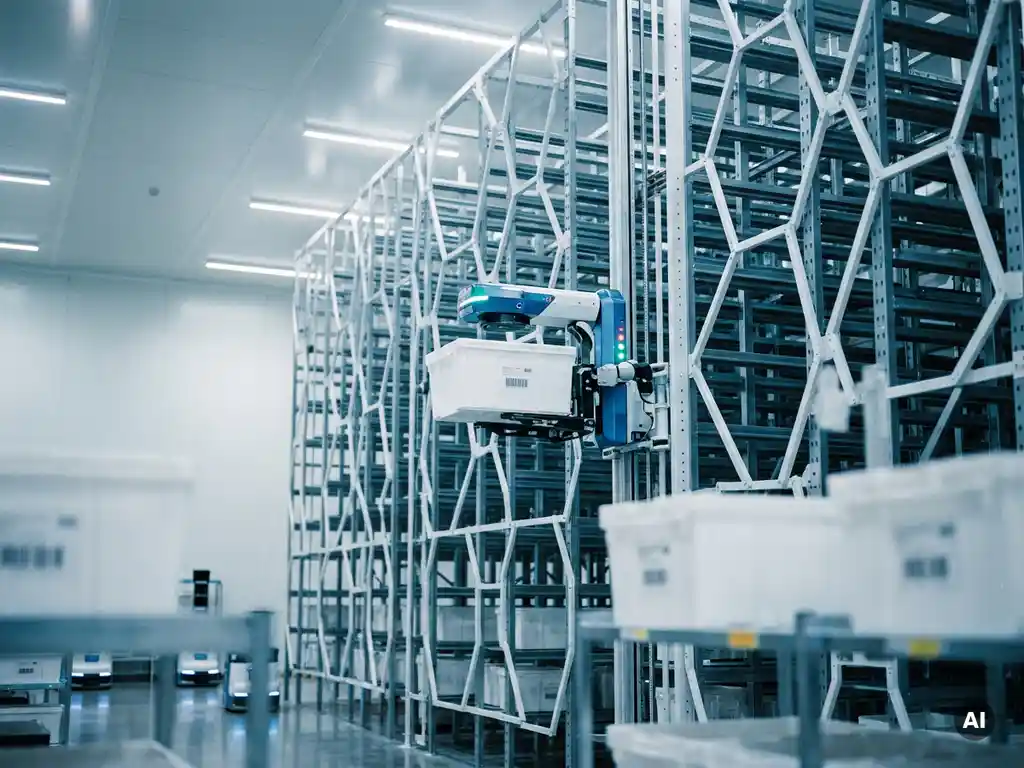
- Direct-access retrieval: Every tote location is individually accessible without moving surrounding stock, supporting FEFO sequencing and batch-level control without manual intervention
- System-enforced traceability: Every storage and retrieval transaction is logged, providing the audit trail that GMP documentation requirements demand
- High density without compliance compromise: The hexagonal vertical structure uses full building height to maximize storage capacity within a compact footprint, reducing the space pressure that leads to segregation failures in conventional racking environments
- Scalable capacity and throughput independently: Storage capacity and retrieval throughput can be scaled separately, allowing operations to grow without redesigning the core infrastructure
- Goods-to-Person operation: Operators work at defined workstations rather than walking through storage zones, reducing contamination pathways and making the process easier to validate
- Integration with WMS and downstream pharmaceutical processes: Standard APIs connect the system to existing warehouse management and execution systems, supporting batch management, FMD verification, and dispatch workflows
The system supports batch traceability and regulated pharmaceutical workflows. Compliance in any specific implementation depends on the complete solution, including software configuration, validation, operating procedures, and environmental controls. To explore how Hexxabotics can be configured for your pharmaceutical storage and compliance requirements, contact the team directly to discuss your operation.
Related Articles
- How does humidity control affect pharmaceutical product stability in storage?
- How do you validate a temperature-mapping study in a pharmaceutical warehouse?
- What is the difference between FIFO and FEFO in pharmaceutical storage?
- How do regulatory agencies inspect pharmaceutical warehouses in 2026?
- What is the difference between cold chain and ambient pharmaceutical storage?