
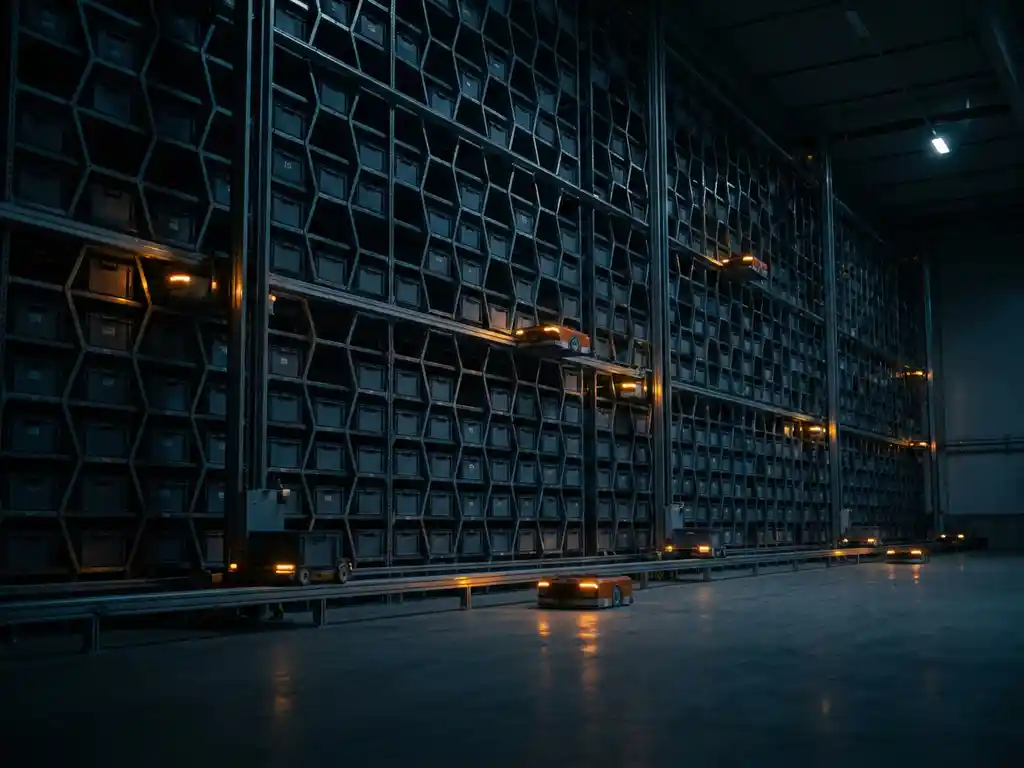
A dark warehouse, also called a lights-out warehouse, is a fully automated storage and fulfillment facility that operates without human workers present on the warehouse floor. Because autonomous robots, software systems, and AS/RS technology handle every storage and retrieval task, there is no need for lighting, heating, or other conditions required for human comfort. The concept applies most directly to operations where goods-to-person automation handles the entire intralogistics cycle, from receiving to dispatch, without manual intervention.
Dark warehouse automation is not a single product but a combination of technologies working in concert. The sections below answer the most common questions about how these facilities work, what makes them possible, and where they are already delivering results in 2026.
How does a dark warehouse actually run without human workers?
A dark warehouse runs without human workers by replacing every manual intralogistics task with autonomous robots, intelligent software, and automated storage systems. Robots receive, store, retrieve, and transport goods continuously. A warehouse management system coordinates all activity, tracks inventory in real time, and routes orders through the facility without any human instruction at the task level.
The operational flow in a lights-out warehouse typically works like this: inbound goods arrive and are loaded into standardized totes or containers, often at automated induction stations. From that point, autonomous robots take over. They transport totes to storage locations, deposit them precisely, and retrieve them on demand when an order is triggered. The warehouse management system and its control layer decide which robot handles which task, which storage location to use, and in what sequence orders should be fulfilled.
At the output side, automated goods-to-person workstations present the correct tote to a packing station. In a fully dark operation, even packing and dispatch can be handled by robotic arms and automated conveyors, though many operations today maintain a small human presence at the final dispatch stage. The key point is that the storage and retrieval core of the warehouse runs entirely without people, which is where the term “dark” originates.
What technologies make a dark warehouse possible?
Dark warehouse automation relies on four core technology categories: Automated Storage and Retrieval Systems (AS/RS), autonomous mobile robots, warehouse control and management software, and sensor and safety infrastructure. Each layer handles a distinct part of the operation, and they must integrate seamlessly for a lights-out facility to function reliably.
Automated Storage and Retrieval Systems
AS/RS technology is the backbone of any dark warehouse. These systems store and retrieve goods without human involvement, using robotic units that navigate vertical and horizontal space to access every storage location directly. Modern AS/RS designs, including grid-based cube storage and three-dimensional hexagonal systems, prioritize direct access to every tote so that no reshuffling or digging is required. This direct-access principle is essential for maintaining throughput in a fully autonomous environment.
Systems like the Hexxabotics AS/RS take this further by combining a hexagonal vertical storage grid with autonomous Hexxabots that navigate beneath the grid and climb vertically inside towers to complete storage and retrieval in one continuous motion. Towers require no embedded electronics or in-rack electrification, which reduces failure points and simplifies the infrastructure a dark warehouse depends on.
Software, sensors, and safety systems
Warehouse control systems coordinate robot routing, task assignment, and inventory logic in real time. They connect to external warehouse management systems through standard APIs, enabling order management, inventory visibility, and system monitoring without manual oversight. Sensor networks, cameras, and safety software ensure that robots operate within defined zones and that the system responds correctly to exceptions, such as a misplaced tote or a robot requiring maintenance. Distributed robot architectures eliminate single points of failure, so if one unit stops, the system continues operating at stable throughput.
What are the main benefits of dark warehouse automation?
The main benefits of dark warehouse automation are significantly reduced labor costs, higher storage density, continuous 24/7 operation, improved accuracy, and lower energy consumption. Together, these advantages allow operators to fulfill more orders from a smaller footprint with fewer errors and at a lower cost per unit handled.
- Labor cost reduction: Removing human workers from the storage and retrieval floor eliminates the largest variable cost in most warehouse operations, including wages, benefits, training, and turnover.
- 24/7 throughput: Robots do not require breaks, shift changes, or rest periods. A lights-out warehouse can process orders continuously, which is particularly valuable for e-commerce operations with overnight and early-morning delivery commitments.
- Higher storage density: Automated systems exploit full cubic volume, including vertical height that human-operated warehouses cannot practically reach. AS/RS technology can utilize building heights of up to 16 meters, converting overhead space into revenue-generating storage.
- Accuracy and traceability: Automated systems log every movement. Inventory accuracy rates in well-designed AS/RS environments are consistently higher than in manual operations because human picking errors are eliminated.
- Energy efficiency: Without lighting, heating, or ventilation requirements for human comfort, energy consumption drops substantially. Systems with no in-rack electrification reduce energy demand further by eliminating powered racks and embedded motors.
- Independent scalability: Capacity and throughput can be scaled independently. Adding storage locations extends the structure; adding robots increases throughput. Neither change requires a structural redesign or operational shutdown.
What are the biggest challenges of running a fully dark warehouse?
The biggest challenges of running a fully dark warehouse are high upfront capital investment, integration complexity with existing systems, the need for robust exception handling, and the difficulty of maintaining operations when unexpected failures occur. These challenges are manageable but require careful planning and the right technology choices from the outset.
Capital expenditure is the most immediate barrier. AS/RS infrastructure, autonomous robots, control software, and the facility modifications required to support them represent a significant investment. The business case depends heavily on order volume, labor costs in the local market, and the expected operational lifespan of the system. For high-volume operations, the return on investment is well established. For lower-volume environments, the calculation is more nuanced.
Integration with existing warehouse management systems and ERP platforms is another common challenge. Dark warehouse technology must connect reliably to upstream and downstream systems through APIs, and data quality across those integrations directly affects operational performance. Poorly structured inventory data or unreliable order feeds can create exceptions that an autonomous system cannot resolve without human intervention.
Exception handling is perhaps the most underestimated challenge. A human worker can improvise when something unexpected happens. An autonomous system needs predefined logic for every exception scenario, from a damaged tote to an unexpected object in a robot’s path. Designing that logic comprehensively, and updating it as operations evolve, requires ongoing engineering investment. Distributed robot architectures help here by ensuring that a single failure does not halt the entire system, but exception management remains a continuous operational discipline.
Which industries are best suited for dark warehouse operations?
Industries best suited for dark warehouse operations are those with high order volumes, repetitive picking tasks, predictable SKU profiles, and strong pressure to reduce labor costs and fulfillment times. E-commerce, food and grocery fulfillment, pharmaceutical distribution, FMCG, and fashion and apparel logistics are among the sectors where lights-out automation delivers the clearest return.
E-commerce fulfillment is the most prominent use case because the economics align closely: high order volumes, time-sensitive delivery commitments, and intense labor market pressure all favor full automation. Grocery and food operations benefit from dark warehouse technology because temperature-controlled environments are expensive to staff and robots are indifferent to cold storage conditions. Pharmaceutical distribution benefits from the traceability and accuracy that automated systems provide, along with the ability to maintain strict batch and expiry controls without human error.
Spare parts logistics and 3PL operations with diverse SKU ranges also benefit significantly. In these environments, direct-access AS/RS technology is particularly valuable because every SKU must be retrievable on demand without reorganizing surrounding inventory. The ability to scale throughput independently of storage capacity also suits 3PL operators who manage multiple clients with varying demand patterns.
Are fully dark warehouses achievable today, or still a future concept?
Fully dark warehouses are achievable today, not a future concept. Multiple large-scale lights-out facilities are operating in 2026 across e-commerce, grocery, and pharmaceutical sectors. The technology required, including AS/RS, autonomous mobile robots, and intelligent warehouse control systems, is commercially available and proven at scale. The question for most operators is not whether it is possible but whether their specific operation justifies the investment.
The degree of “darkness” varies in practice. Many facilities operate with a fully automated storage and retrieval core while maintaining a small human presence at induction, packing, or dispatch stations. True end-to-end lights-out operation, including robotic packing and dispatch, is more common in greenfield facilities purpose-built for automation than in retrofitted existing warehouses. However, the gap between a mostly automated facility and a fully dark one is narrowing as robotic packing and vision-guided handling technology matures.
For industrial automation engineers evaluating the feasibility of a dark warehouse project, the critical factors are order volume, SKU count and variability, building height and footprint, and the availability of AS/RS technology that can scale without requiring infrastructure redesign. Systems designed with distributed robot architectures and no in-rack electrification reduce long-term maintenance complexity and lower the operational risk of committing to a fully autonomous environment.
How Hexxabotics helps with dark warehouse automation
Hexxabotics provides an AS/RS designed specifically for the demands of dark warehouse operations, combining maximum storage density with independently scalable throughput in a system that requires no in-rack electrification and no structural redesign to grow.
- 100% direct access: Every tote is directly accessible without digging or reshuffling, which is essential for maintaining throughput in a lights-out environment.
- Independent scalability: Storage capacity and throughput scale separately. Add locations to increase storage; add Hexxabots to increase throughput. No downtime or infrastructure rebuild required.
- No single point of failure: Distributed robot operation means the system continues running even if individual units require maintenance, maintaining stable performance during peak demand.
- No in-rack electrification: Passive steel structure with no embedded motors or powered racks reduces failure points, lowers energy consumption, and simplifies maintenance in an unmanned environment.
- Up to 16 meters of vertical density: Full cubic volume utilization converts building height into usable storage, maximizing the return on warehouse footprint.
- Standard API integration: The Hexxabotics Control System connects to existing WMS and ERP platforms, enabling seamless coordination across the full dark warehouse operation.
If you are evaluating AS/RS technology for a dark or highly automated warehouse project, contact Hexxabotics to discuss your specific requirements and how the system can be configured for your operation.