
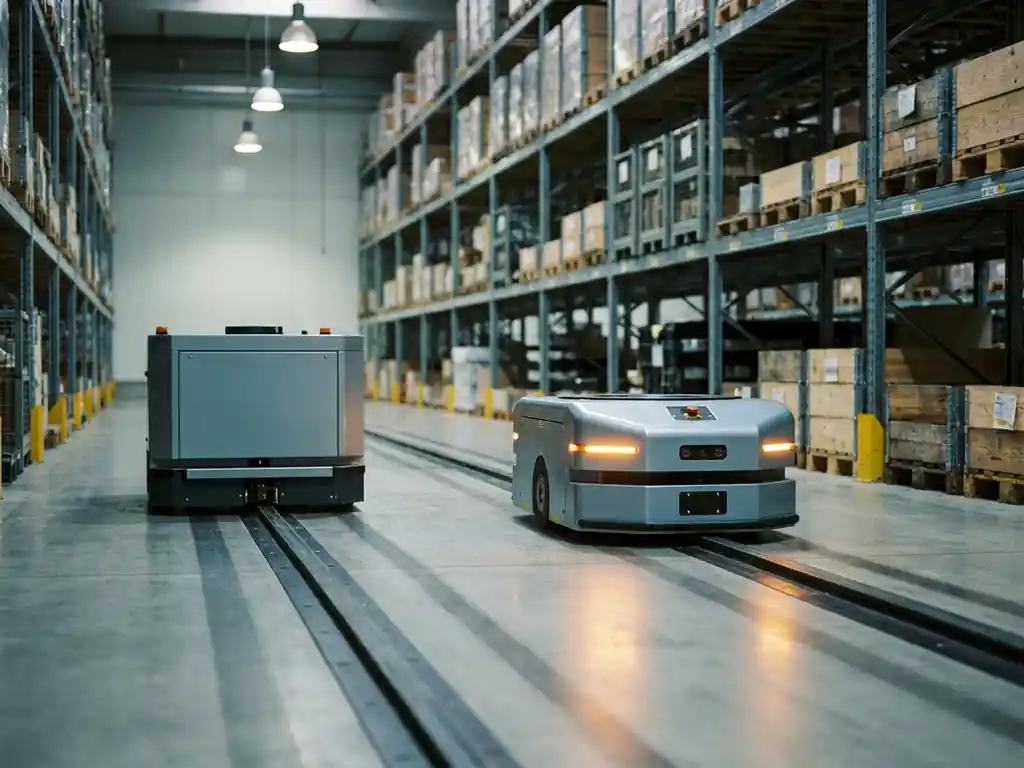
AMRs (Autonomous Mobile Robots) and AGVs (Automated Guided Vehicles) are both mobile robots used in warehouse environments, but they differ fundamentally in how they navigate. AGVs follow fixed physical paths such as magnetic tape, wires, or rails embedded in the floor, while AMRs use onboard sensors, cameras, and software to navigate freely and adapt to changing environments in real time. This distinction shapes every practical decision around cost, flexibility, and long-term scalability. The sections below break down each technology by type, cost, use case, and how both fit into a broader warehouse automation strategy.
Which navigation technology makes AMRs more flexible than AGVs?
AMRs are more flexible than AGVs because they use onboard perception and mapping technology rather than fixed physical infrastructure. Instead of following a pre-laid track, an AMR builds a map of its environment using LiDAR, cameras, and depth sensors, then calculates optimal routes dynamically. This means the robot can reroute around obstacles, adapt to layout changes, and operate in shared human-robot spaces without physical modification to the facility.
The core technologies enabling this flexibility include simultaneous localization and mapping (SLAM), which allows the robot to construct and update its own map while tracking its position within it. Combined with real-time obstacle detection and fleet management software, AMRs can respond to shifting conditions on the warehouse floor without operator intervention.
AGVs, by contrast, depend on external guidance infrastructure. Whether that is magnetic tape on the floor, inductive wire loops, or optical markers, changing the robot’s route requires physically altering or relocating that infrastructure. This makes AGVs well-suited to highly stable, repetitive environments but poorly suited to operations where layouts evolve frequently or floor space is shared with human workers.
What are the main types of AGVs used in warehouses?
The main types of AGVs used in warehouses are unit load carriers, tow vehicles, forklift AGVs, and assembly line AGVs. Each type is optimized for a specific material handling task, and all share the defining characteristic of following a predetermined path through the facility.
- Unit load carriers: Transport individual pallets, totes, or containers between fixed points. These are among the most common AGV types in distribution centers and manufacturing plants.
- Tow vehicles (tugger AGVs): Pull a train of carts along a fixed route, often used for milk-run replenishment cycles in manufacturing environments.
- Forklift AGVs: Automate pallet lifting and placement in racking systems. They handle vertical movement in addition to horizontal transport, making them relevant in high-bay storage environments.
- Assembly line AGVs: Move work-in-progress components between production stations at a controlled pace, often synchronized with manufacturing execution systems.
The right AGV type depends on the load characteristics, route complexity, and throughput requirements of the specific application. In stable, high-volume environments with predictable flows, AGVs deliver consistent and reliable performance within their defined lanes.
What are the main types of AMRs used in warehouses?
The main types of AMRs used in warehouses are goods-to-person AMRs, autonomous forklifts, picking assist robots, and sortation AMRs. Unlike AGVs, AMR types are distinguished less by their guidance method and more by the specific warehouse task they are built to perform.
- Goods-to-person AMRs: Transport shelving units or totes to stationary pick stations, reducing the distance human pickers need to walk. These are widely used in e-commerce fulfillment.
- Autonomous mobile forklifts: Perform pallet handling tasks using free navigation rather than fixed paths, offering more operational flexibility than traditional forklift AGVs.
- Picking assist AMRs: Follow human pickers through aisles, carrying orders and reducing walking time without fully automating the picking decision itself.
- Sortation AMRs: Sort parcels or totes across a distribution grid, often replacing traditional conveyor-based sortation systems in parcel and postal operations.
One important limitation of AMR-based storage systems is storage density. Because AMRs typically operate in open floor space or within shallow shelving systems, they tend to occupy significant floor area relative to the number of storage positions they serve. This is a meaningful trade-off when comparing AMR warehouse solutions against more space-efficient AS/RS technology.
How do AMRs and AGVs compare on cost and implementation time?
AMRs generally carry a higher upfront unit cost than AGVs but require significantly less infrastructure investment to deploy. AGVs are often less expensive per robot but demand floor modifications, guidance system installation, and precise route planning before they can operate, which adds time and capital expenditure to the project. Implementation time for AGVs is typically longer as a result.
For AMRs, the major cost components are the robots themselves and the fleet management software. Because no physical path infrastructure is required, facilities can deploy AMRs faster and with less disruption to ongoing operations. Reprogramming routes or expanding the fleet does not require physical changes to the building.
For AGVs, the infrastructure cost can be substantial depending on the guidance method. Inductive wire systems require floor cutting and cabling. Even simpler magnetic tape systems require careful installation and ongoing maintenance to ensure reliable navigation. When a route needs to change, that infrastructure must be modified or replaced.
Over a longer time horizon, total cost of ownership depends heavily on how often the operation changes. Stable, high-volume environments with fixed workflows tend to favor AGVs on a cost-per-move basis. Operations that evolve frequently, scale rapidly, or require flexible routing tend to find AMRs more cost-effective when accounting for the cost of change rather than just the cost of deployment.
When should a warehouse choose an AGV over an AMR?
A warehouse should choose an AGV over an AMR when the operation involves highly repetitive, predictable material flows in a controlled environment where routes are unlikely to change. AGVs excel in applications such as automated pallet transport between fixed production stations, continuous replenishment along stable manufacturing lines, and high-volume movement between defined loading and unloading points.
Several conditions favor AGVs specifically:
- The floor layout is fixed and will not change frequently over the system’s operating life
- The application requires very high payload capacity, such as full pallet transport
- The operating environment is separated from human workers, reducing the need for dynamic obstacle avoidance
- Budget constraints make lower per-unit robot cost a priority and the infrastructure investment is manageable
- Regulatory or safety requirements in the facility demand predictable, deterministic robot paths
In environments that match these conditions, AGVs deliver reliable throughput at a lower per-unit cost than equivalent AMRs. The trade-off is reduced adaptability, which only becomes a problem when operational requirements shift.
How do AMRs and AGVs fit into a broader AS/RS warehouse strategy?
AMRs and AGVs typically handle horizontal transport within a warehouse, moving goods between storage locations and workstations. In a broader AS/RS strategy, they function as the transport layer rather than the storage layer. The storage layer itself, where goods are held at high density across vertical space, is usually handled by dedicated AS/RS systems that go far beyond what either AMR or AGV technology is designed to do.
Traditional AS/RS systems such as mini-load cranes or shuttle systems store goods in racking and retrieve them on demand. AMRs and AGVs can connect these systems to pick stations or packing areas, but they do not themselves provide the dense, vertically organized storage that modern fulfillment operations require. Choosing the right combination means understanding which technology handles which layer of the operation.
A key consideration is scalability. AMR fleets scale throughput by adding robots. AGV systems scale by adding vehicles and, often, additional infrastructure. Neither technology independently addresses storage density or vertical space utilization. Operations with significant SKU volumes and limited floor space need an AS/RS component that maximizes cubic storage, and the transport technology, whether AMR or AGV, serves that system rather than replacing it.
As warehouse automation strategies mature in 2026, the most capable operations combine multiple technology layers: dense, directly accessible storage at the core, and intelligent transport connecting that storage to human workstations at the edge.
How Hexxabotics fits into your warehouse automation strategy
While AMRs and AGVs solve the transport challenge, Hexxabotics addresses the storage challenge that neither technology is designed for. The Hexxabotics AS/RS system provides a complementary layer that maximizes the value of any transport solution by ensuring that every stored tote is directly accessible, densely organized, and retrievable without reshuffling.
- Independent scalability: Storage capacity and throughput scale separately. Add towers to increase capacity, add Hexxabots to increase throughput, without rebuilding infrastructure.
- 100% direct access: Every tote location is directly accessible. No digging, no delays, no sequencing constraints that create bottlenecks at pick stations.
- No in-rack electrification: The passive hexagonal structure contains no embedded motors, wiring, or lifting systems, reducing failure points and simplifying maintenance.
- Up to 16 meters of vertical density: Full cubic volume utilization converts vertical space into revenue-generating storage within a compact footprint.
- Distributed resilience: Parallel robot operation eliminates single points of failure. If one unit stops, the system continues at stable throughput.
Whether your operation uses AMRs, AGVs, or a combination of both for transport, Hexxabotics provides the high-density storage backbone that makes those transport systems perform at their best. Contact Hexxabotics to discuss how the system integrates with your existing or planned warehouse automation strategy.