
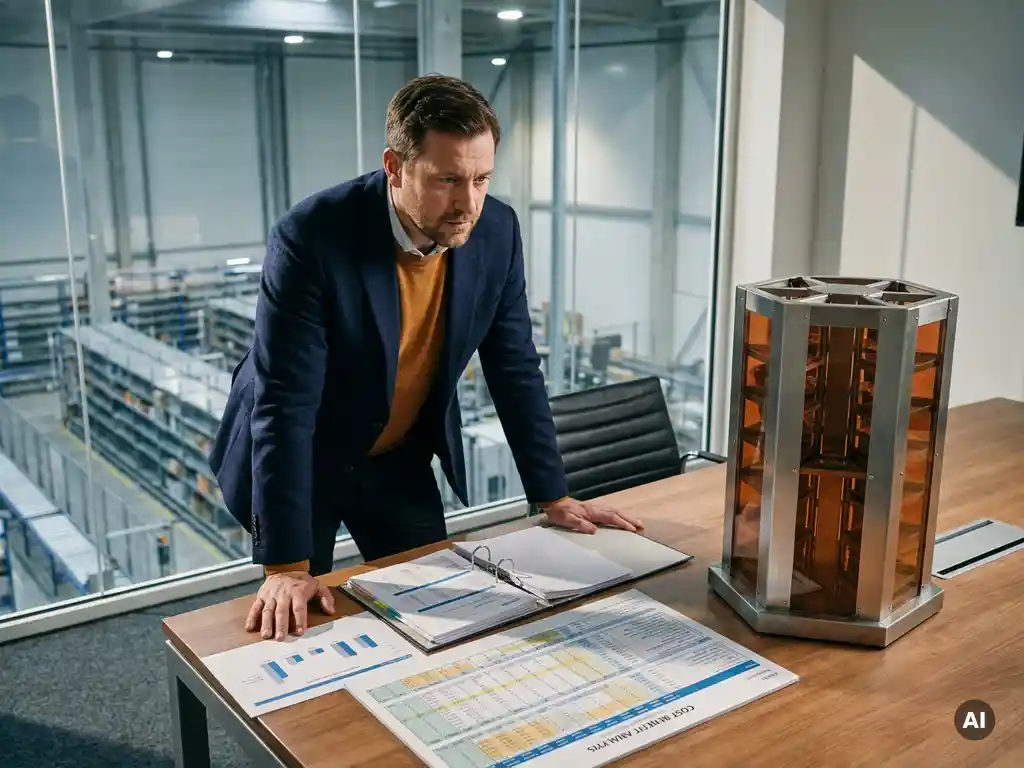
Procurement teams evaluate warehouse automation ROI by analyzing total cost of ownership against measurable operational gains, including labor cost reduction, storage density improvement, throughput increases, and integration expenses. The business case must account for both upfront capital investment and long-term savings across the system’s operational lifespan. The sections below break down each dimension of that evaluation in detail.
What metrics do procurement teams use to measure warehouse automation ROI?
Procurement teams measure warehouse automation ROI using a combination of financial and operational metrics: total cost of ownership (TCO), payback period, labor cost reduction, throughput per hour, storage density gain, system uptime, and error rate reduction. No single metric tells the full story, which is why procurement evaluations typically build a multi-dimensional business case that weighs capital expenditure against quantifiable efficiency gains over a defined period, usually three to seven years.
On the financial side, the most commonly tracked metrics are:
- Payback period: How many years until cumulative savings offset the initial investment
- Net present value (NPV): The discounted value of future savings relative to upfront cost
- Internal rate of return (IRR): The annualized return generated by the investment
- Total cost of ownership: All costs across acquisition, installation, integration, maintenance, and operation
On the operational side, procurement teams look at picks per hour, order accuracy rates, labor hours per unit shipped, and the ratio of storage positions to floor space used. These operational metrics translate directly into financial value, because higher throughput with fewer labor hours reduces cost per order, while greater storage density reduces the cost per storage position and can defer or eliminate the need for facility expansion.
For robotics-based systems in particular, uptime and resilience metrics carry significant weight. A system that achieves high throughput but depends on centralized equipment creates single points of failure that procurement teams factor into risk-adjusted ROI calculations.
How do procurement teams calculate the total cost of ownership for AS/RS?
Total cost of ownership for an AS/RS is calculated by summing all costs across the full system lifecycle: capital expenditure for hardware and structure, installation and commissioning costs, software licensing and integration fees, ongoing maintenance and energy consumption, and the cost of any future scaling or reconfiguration. TCO analysis typically spans five to ten years to capture the full economic picture beyond the initial purchase price.
Capital and installation costs
The upfront investment includes the physical storage structure, robotic units, control software, and the civil or structural work required to prepare the facility. Systems that require embedded electronics, fixed conveyors, or powered rack infrastructure carry higher installation costs and greater long-term maintenance exposure. Systems built around passive steel structures with no in-rack electrification, by contrast, reduce both initial installation complexity and the ongoing cost of maintaining powered components inside the rack.
Operational and maintenance costs
Once deployed, the ongoing cost profile is shaped by energy consumption, maintenance labor, spare parts availability, and software support fees. Distributed robotic architectures that eliminate centralized cranes or lifting systems reduce the consequence of any single component failure, which lowers both maintenance frequency and the cost of unplanned downtime. Energy efficiency also contributes meaningfully to TCO over a multi-year horizon, particularly in high-throughput environments running extended operational hours.
Procurement teams should also account for scalability costs within their TCO model. Systems that require structural redesign or infrastructure duplication to expand throughput carry hidden future costs that are not visible in the initial purchase price but significantly affect long-term value.
What’s the difference between evaluating capacity and throughput in automation ROI?
Capacity and throughput are distinct dimensions of warehouse automation performance, and procurement teams must evaluate them separately. Capacity refers to how many storage positions a system provides, which determines how much inventory can be held within a given footprint. Throughput refers to how many totes or orders the system can process per hour, which determines how quickly inventory can be accessed and fulfilled. A system can have high capacity with low throughput, or high throughput with limited capacity, and the ROI implications of each are very different.
In traditional AS/RS architectures, capacity and throughput are structurally linked. Adding more storage often means adding more cranes or conveyors, which increases throughput infrastructure simultaneously, even when only one dimension needs to grow. This coupling inflates cost and complexity when a warehouse’s needs are asymmetric, for example, when order volumes spike seasonally but inventory levels remain stable.
The most favorable ROI scenarios arise when a system allows capacity and throughput to scale independently. A warehouse can then respond to a growing SKU range by extending storage without rebuilding throughput infrastructure, or handle peak order volumes by adding robotic units without expanding the physical footprint. This architectural flexibility directly reduces the total investment required to meet changing operational demands, which is a significant factor in long-term ROI calculations.
How does storage density affect the ROI calculation for warehouse automation?
Storage density affects warehouse automation ROI by determining how much usable inventory space a system generates within a fixed footprint. Higher density means more storage positions per square meter, which either reduces the facility space needed for a given inventory volume or increases the revenue-generating capacity of an existing building. Both outcomes directly improve the financial return on the automation investment.
The financial impact of density improvements becomes most visible when a warehouse is facing capacity constraints. If automation enables a business to avoid leasing additional space or building a new facility, the avoided real estate cost alone can justify a significant portion of the capital investment. Even where expansion is not imminent, higher density reduces the cost per storage position, which lowers the per-unit cost of holding inventory.
Vertical space utilization is a particularly important dimension of density. Warehouses typically have substantial unused height, and systems that can exploit full building height, up to 16 meters in some architectures, convert that vertical space into productive storage without increasing the building’s floor footprint. The geometry of the storage structure also matters: hexagonal designs, for instance, achieve significantly higher cubic space utilization than conventional rectangular grid systems, which means more storage positions within the same structural volume.
Direct accessibility is a related factor that affects the effective value of density. A high-density system that requires repositioning or digging through inventory to reach a specific tote introduces operational delays that reduce throughput and increase labor cost. Systems where every storage location is directly accessible preserve the full value of their density advantage by ensuring that high storage capacity does not come at the cost of retrieval speed.
What integration costs should procurement factor into an automation business case?
Integration costs that procurement teams should include in an automation business case are warehouse management system (WMS) connectivity, API development and testing, data migration, staff training, process redesign, and the cost of any operational disruption during the cutover period. Integration is consistently one of the most underestimated cost categories in automation projects, and underestimating it leads to ROI projections that do not reflect real-world outcomes.
WMS integration is typically the largest integration cost. The automation system’s control software must communicate reliably with the existing warehouse management platform to synchronize inventory data, order priorities, and fulfillment logic. Systems that offer standard API connectivity reduce the custom development effort required, which lowers both the cost and the timeline risk of integration. Proprietary or closed architectures, by contrast, often require bespoke middleware that adds cost and creates long-term maintenance dependencies.
Procurement teams should also factor in the cost of change management. Automation changes how warehouse staff interact with inventory, and the transition requires training, process documentation, and often a period of parallel operation before full cutover. These costs are real and should be included in the business case rather than treated as absorbed overhead.
Finally, consider the cost of future integrations. As operational needs evolve, the automation system will need to connect with new platforms, support new order channels, or accommodate updated WMS versions. Systems built on open, standardized interfaces reduce the ongoing cost of these future integration events, which contributes positively to long-term TCO.
When does warehouse automation deliver a positive ROI?
Warehouse automation delivers a positive ROI when the cumulative operational savings and efficiency gains exceed the total cost of ownership within the target payback period, typically between three and seven years for well-specified AS/RS deployments. The speed of that payback depends on the volume of operations, the current cost of manual labor, the degree of storage constraint being relieved, and the architectural efficiency of the system chosen.
Automation delivers the strongest and fastest ROI in operations that combine high order volumes, significant labor costs, constrained floor space, and SKU complexity that makes manual picking slow and error-prone. In these environments, the gains from throughput acceleration, labor reduction, and density improvement compound quickly, shortening the payback period substantially.
ROI timelines extend when systems require frequent maintenance, generate unplanned downtime, or demand expensive infrastructure upgrades to scale. This is why architectural resilience and independent scalability are not just operational preferences but financial considerations. A system that maintains stable throughput even when individual robotic units are serviced, and that can add capacity or throughput without rebuilding infrastructure, protects the ROI projection against the operational variability that erodes returns in less resilient systems.
In 2026, the business case for automation is also increasingly supported by the rising cost and availability constraints of warehouse labor in many markets. As labor costs increase, the financial threshold at which automation becomes cost-competitive moves lower, improving the ROI case for a broader range of operation sizes and volumes.
How Hexxabotics helps procurement teams build a stronger automation business case
Hexxabotics is designed to address the ROI factors that procurement teams weigh most carefully, delivering measurable advantages across density, throughput scalability, integration simplicity, and total cost of ownership.
- Independent capacity and throughput scaling: Storage positions and robotic units scale separately, so investment is targeted precisely where growth is needed, without structural redesign
- Maximum storage density: The hexagonal tower architecture converts full cubic building volume into usable storage positions, up to 16 meters in height, reducing cost per storage location
- No in-rack electrification: Passive steel structures with no embedded motors or powered components reduce installation cost, maintenance exposure, and energy consumption across the system’s lifetime
- 100% direct tote access: Every storage location is directly accessible with no digging or reshuffling, preserving throughput performance at high density
- Distributed resilience: No centralized crane or single point of failure means the system maintains stable throughput even when individual units are offline
- Standard API integration: The Hexxabotics Control System connects to existing WMS platforms through standard interfaces, reducing integration cost and timeline risk
For procurement teams building an automation business case, Hexxabotics provides an architecture where the financial levers, density, scalability, uptime, and integration cost all work in the same direction. Explore the Hexxabotics system to understand how the technology translates into measurable ROI for your operation, or learn about Hexxabotics to see the engineering principles behind the design.
Related Articles
- How does warehouse automation change the role of warehouse managers?
- How does machine learning improve demand forecasting in warehouses?
- How do AGVs navigate safely around warehouse workers?
- How does computer vision improve quality control in automated warehouses?
- How does free-roaming robot technology reduce warehouse downtime?