
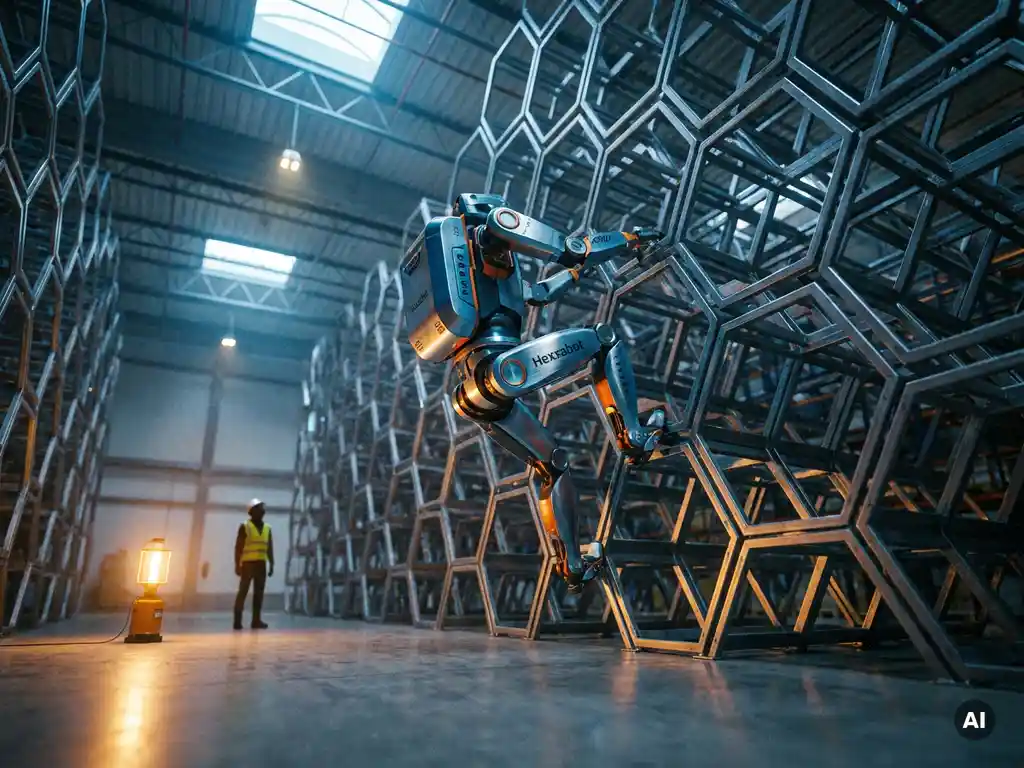
Labor cost displacement factors into automation ROI calculations as the most immediate and measurable financial benefit of deploying robotic systems in a warehouse. It represents the direct reduction in wage expenditure when autonomous equipment replaces or reassigns human labor across storage, retrieval, and movement tasks. For industrial engineers evaluating warehouse automation investments, accurately quantifying this displacement is the foundation of a credible ROI model.
However, labor cost displacement rarely tells the complete story on its own. The full calculation must account for total employment costs, the distinction between full displacement and partial reduction, and the compounding effect of productivity gains that automation unlocks beyond simple headcount reduction. The sections below break down each component of this analysis in detail.
What counts as labor cost displacement in automation ROI?
Labor cost displacement in automation ROI refers to the measurable reduction in direct and indirect labor expenditure that results from deploying automated systems. It includes any cost that was previously associated with human workers performing tasks that the automated system now handles, from picking and put-away to inventory movement and location management.
In a warehouse context, displacement typically covers the following categories:
- Direct wages for pickers, put-away operators, and replenishment staff whose roles are eliminated or significantly reduced
- Overtime premiums that were previously required to meet peak demand windows
- Recruitment and onboarding costs for roles that no longer need to be filled or backfilled
- Temporary and agency labor fees used to cover seasonal or demand-driven surges
- Supervisory labor required to manage manual picking teams
It is important to distinguish displacement from reduction. Full displacement means a role no longer exists in the operation. Partial reduction means a worker’s time is redirected to higher-value tasks, which lowers the effective cost of that role without eliminating the headcount. Both are legitimate inputs to an ROI model, but they carry different financial weights and different timelines for realizing the benefit.
How do you calculate the full labor cost of a warehouse role?
The full labor cost of a warehouse role is calculated by adding base wages to all associated employment costs, including benefits, payroll taxes, training, absenteeism coverage, and management overhead. In most operations, the total employment cost of a warehouse worker runs significantly higher than the base hourly rate alone.
A structured approach to calculating the full cost of a single warehouse role typically includes:
- Base wages: Annual salary or hourly rate multiplied by total working hours
- Employer-side taxes and contributions: Social security, national insurance, pension contributions, and similar statutory costs
- Benefits: Health insurance, paid leave, sick pay, and any other non-wage compensation
- Training and onboarding: Initial training cost plus ongoing upskilling, averaged over the expected tenure of the role
- Absenteeism and turnover: The cost of covering unplanned absences and replacing workers who leave, including agency fees and lost productivity during transition periods
- Supervisory overhead: A proportional share of team lead and floor management costs allocated to the role
Industry experience suggests that the fully loaded cost of a warehouse worker is typically 1.3 to 1.5 times the base wage, though this varies by geography, benefit structure, and operational model. Using only base wages in an automation ROI calculation will consistently understate the financial benefit of labor cost displacement, which skews the payback period in the wrong direction.
Which labor costs does automation actually displace versus reduce?
Automation directly displaces labor costs tied to repetitive, location-dependent tasks such as manual picking, tote retrieval, and inventory movement. It reduces, rather than eliminates, costs associated with exception handling, quality control, system oversight, and goods-to-person workstation operation, where human judgment remains part of the process.
Understanding this distinction matters because it determines how quickly a displaced cost converts to realized savings. Displaced costs drop from the payroll immediately when headcount is reduced. Reduced costs require redeployment planning, and the financial benefit depends on whether the redeployed labor generates measurable value elsewhere or simply shifts cost to another budget line.
Costs typically displaced by AS/RS automation
Automated Storage and Retrieval Systems take over the physical movement of goods between storage locations and workstations. This directly displaces the labor cost of workers who previously walked picking routes, located totes manually, or operated forklifts and conveyors for internal transport. In systems where every storage location is directly accessible without reshuffling, the time previously spent on inventory repositioning is also fully displaced.
Costs typically reduced but not eliminated
Human workers remain involved at goods-to-person stations, where they handle final pick confirmation, quality checks, and exception processing. The labor cost at these stations is reduced relative to a fully manual operation, but it is not eliminated. Similarly, system oversight, maintenance coordination, and inventory exception management require ongoing human input, though typically at a lower headcount than the operation they replace.
How does labor cost displacement fit into a full automation ROI model?
Labor cost displacement is the largest single input in most warehouse automation ROI models, but it sits alongside capital expenditure, operational cost changes, throughput gains, space efficiency improvements, and error rate reductions. A complete ROI model weights all of these factors against the total cost of ownership to produce a payback period and net present value.
A well-structured automation ROI model typically follows this framework:
- Total cost of ownership (TCO): Capital investment, installation, integration, maintenance contracts, energy consumption, and software licensing over the asset’s operational life
- Labor cost displacement: Fully loaded cost of displaced roles, calculated annually and compounded with expected wage inflation
- Throughput value: Revenue or cost impact of increased order processing speed, extended operating hours, and reduced error rates
- Space efficiency gains: Cost avoided through reduced warehouse footprint or deferred real estate expansion, particularly relevant when vertical density replaces horizontal floor space
- Scalability premium: The value of being able to increase capacity or throughput without proportional capital reinvestment
Labor cost displacement typically drives the earliest returns in this model because it converts to cash savings as soon as headcount is reduced. Throughput gains and space efficiency benefits often take longer to quantify but can exceed the labor benefit over a multi-year horizon, particularly in high-growth operations.
What hidden factors skew automation ROI calculations?
The most common factors that skew automation ROI calculations are underestimating integration costs, ignoring wage inflation over the asset’s lifespan, and failing to account for the cost of maintaining parallel manual processes during transition. Each of these can significantly shift the apparent payback period in either direction.
On the cost side, the factors most often underestimated include:
- Integration and commissioning time: Delays between installation and full operational throughput represent a period where capital is deployed but labor savings have not yet materialized
- WMS and API integration effort: Connecting automated systems to existing warehouse management platforms requires engineering time and ongoing maintenance that is frequently underbudgeted
- Retraining and change management: Redeploying displaced workers to new roles carries a cost that is often omitted from initial projections
On the benefit side, the factors most often overlooked include:
- Wage inflation compounding: Labor costs grow year over year. An automation investment made in 2026 will look increasingly favorable as wages rise, but only if the model accounts for this trajectory from the start
- Error cost reduction: Manual picking errors generate returns, reshipments, and customer service costs. Automated retrieval systems with direct-access architecture eliminate the misplacement errors that drive these costs
- Uptime and availability gains: Distributed robotic systems without single points of failure maintain throughput during peak periods when manual operations would require expensive overtime or temporary labor
When does labor cost displacement alone justify an AS/RS investment?
Labor cost displacement alone justifies an AS/RS investment when the fully loaded cost of displaced labor exceeds the annualized total cost of ownership within a commercially acceptable payback period, typically three to five years for capital-intensive automation projects. This threshold is most commonly reached in operations with high headcount, elevated wage rates, significant overtime dependency, or high turnover costs.
The conditions that make a labor-cost-only justification most credible include:
- Operations running two or three shifts where labor costs are multiplied across extended hours
- High-churn environments where recruitment and training costs are a recurring expense rather than a one-time investment
- Geographies or sectors where wage growth is outpacing productivity gains, making the future cost trajectory steeper than the present baseline
- Operations with significant seasonal peaks that currently rely on expensive temporary labor to meet demand
Where labor cost displacement falls short of standalone justification, it almost always tips the overall ROI model into positive territory when combined with space efficiency gains and throughput improvements. In practice, very few automation investment decisions rest on a single cost line. The more relevant question is whether labor displacement provides a strong enough foundation that secondary benefits can close any remaining gap.
How Hexxabotics helps with labor cost displacement and automation ROI
Hexxabotics is designed to maximize the financial case for warehouse automation by addressing the core drivers of labor cost displacement directly through its system architecture. For industrial engineers building an ROI model, the system delivers measurable advantages across the inputs that matter most:
- Direct tote access without reshuffling eliminates the labor time previously spent on inventory repositioning, converting a partial labor reduction into full displacement
- Independent scalability of capacity and throughput means operations can add robots to handle peak demand without hiring temporary labor, removing one of the most expensive recurring cost lines in manual warehouses
- No in-rack electrification and a distributed robot architecture reduce maintenance overhead and eliminate single points of failure, keeping operational costs predictable across the asset’s lifespan
- Vertical storage up to 16 meters converts cubic volume into usable storage, reducing the space cost component of the TCO model and strengthening the overall return
- Standard API integration with existing warehouse management systems lowers integration cost and shortens the time to full operational throughput
If you are building a business case for warehouse automation and want to understand how these factors translate into a concrete ROI model for your operation, learn more about Hexxabotics or explore the full system to start the conversation.
Related Articles
- How does SKU count affect the complexity of warehouse layout planning?
- What are the controlled substance storage requirements for warehouses?
- How does an AMR navigate inside a warehouse?
- What are the safety risks of fully automated warehouse environments?
- Wat is het verschil tussen kortetermijnbesparingen en langetermijn-ROI van automatisering?