
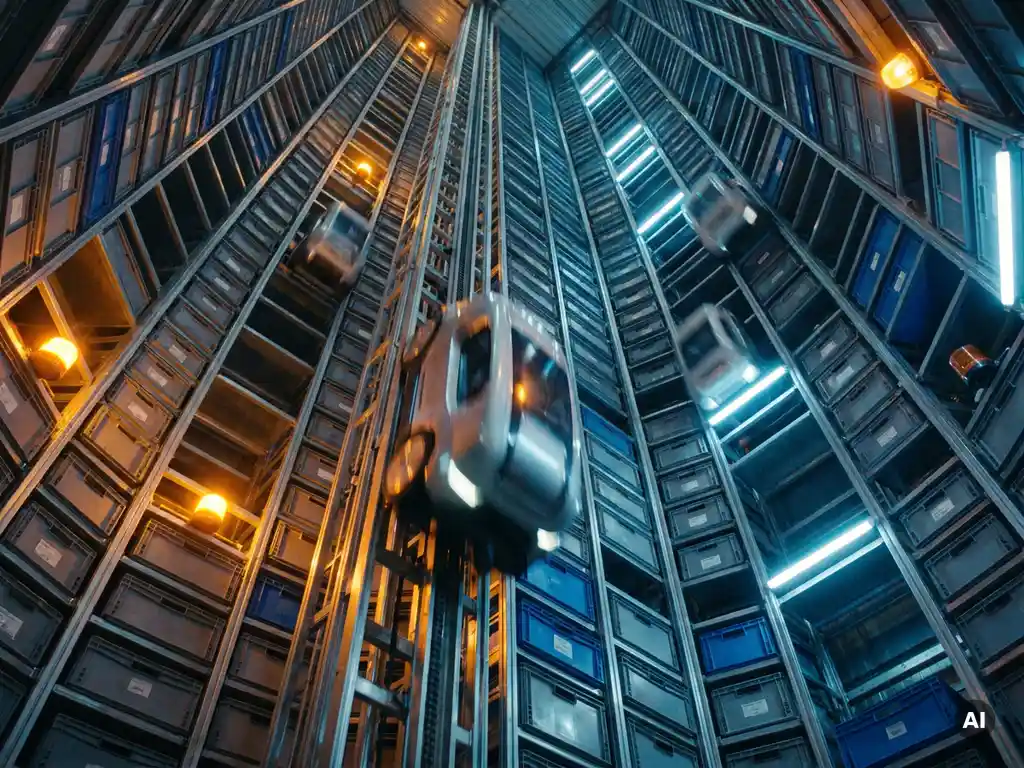
Warehouse automation handles seasonal demand spikes by decoupling storage capacity from throughput performance, allowing operations to scale each dimension independently without rebuilding infrastructure. Modern Automated Storage and Retrieval Systems (AS/RS) are specifically engineered to absorb sudden volume increases through distributed robotic operation, direct-access inventory architecture, and intelligent control software that coordinates resources in real time. The sections below unpack the specific mechanisms, design principles, and preparation strategies that make this possible.
What makes seasonal demand spikes so difficult for warehouses to manage?
Seasonal demand spikes are difficult to manage because traditional warehouse infrastructure is sized for average throughput, not peak throughput. When order volumes surge during events like holiday shopping seasons, promotional campaigns, or harvest cycles, fixed systems hit hard ceilings. Adding temporary labor helps at the margins, but the underlying storage layout, conveyor capacity, and retrieval logic cannot flex quickly enough to absorb the surge without errors, delays, or congestion.
The core tension is structural. Conventional high-bay systems and mini-load cranes are designed around centralized lifting equipment. When that equipment reaches its operational limit, queues form and throughput collapses. The problem is not a lack of inventory space in most cases; it is a bottleneck in how quickly goods can be accessed and moved to fulfillment stations.
Compounding this is the inventory positioning challenge. Many traditional AS/RS designs require reshuffling stored totes to reach a required item, a process that consumes retrieval cycles and slows the entire system precisely when speed matters most. During a demand spike, every wasted cycle has a disproportionate impact on service levels and order lead times.
How does an AS/RS system adapt to sudden volume increases?
An AS/RS system adapts to sudden volume increases by deploying additional autonomous robot units in parallel, increasing active throughput without modifying the physical storage structure. Because each robot operates independently within the grid, the system’s output scales linearly as more units are added. There is no centralized crane or single conveying mechanism that becomes the limiting factor.
The key architectural principle here is distributed operation. When throughput is handled by many independent agents rather than one or two central machines, the system gains resilience alongside capacity. If one robot unit is taken offline for charging or maintenance, the remaining units continue operating and the overall throughput impact is proportional rather than catastrophic. This eliminates the single point of failure that plagues centralized AS/RS designs during peak periods.
Direct inventory access is equally important. In a well-designed AS/RS, every storage location is reachable in one retrieval cycle without digging through other totes. This means the system does not slow down as inventory density increases, which is exactly the condition that exists when a warehouse is stocked to capacity ahead of a seasonal peak.
Can warehouse automation be scaled up without redesigning infrastructure?
Yes, modern AS/RS warehouse automation can be scaled up without redesigning infrastructure, provided the system was built with independent scalability in mind. Capacity and throughput are two separate dimensions, and the best-architected systems allow each to grow on its own terms. Storage capacity expands by extending the modular structure; throughput expands by adding autonomous robot units to the existing grid.
This separation matters enormously in practice. In conventional AS/RS designs, storage and throughput are tightly coupled. Adding more storage locations often means adding more lifting infrastructure, more conveyors, and more embedded electronics, each of which increases cost, complexity, and the engineering effort required. Scaling becomes a significant capital project rather than an operational decision.
A modular hexagonal architecture, for example, allows tower extensions to be added during regular operations without stopping the system. The passive steel structure contains no embedded motors, no powered racks, and no in-rack electrification, which means new sections can be integrated without rewiring or reconfiguring the existing installation. Scaling happens on the operator’s timeline, not around a maintenance shutdown window.
For industrial engineers evaluating scalable warehouse automation, this independence between capacity and throughput is one of the most operationally significant differentiators to assess during a system selection process.
What role does warehouse control software play during peak seasons?
Warehouse control software plays a central role during peak seasons by coordinating robot movements, managing inventory logic, and dynamically prioritizing retrieval tasks based on real-time order demand. Without intelligent orchestration, even a well-designed physical system will underperform when order profiles become complex and unpredictable, which is exactly what happens during seasonal surges.
At the robot coordination level, the software assigns tasks to individual units based on their current position, battery status, and the priority of pending orders. This prevents traffic congestion within the grid and ensures that high-priority orders are fulfilled without manual intervention. The system continuously rebalances workloads across all active robots, maintaining stable throughput even as order patterns shift throughout the day.
Integration with external warehouse management systems (WMS) is equally critical. During peak seasons, order management platforms are processing significantly higher volumes, and the AS/RS control system must receive, interpret, and execute those instructions without latency. Standard API integration allows the control software to function as a responsive execution layer beneath the WMS, translating order priorities into physical retrieval sequences in real time.
Safety management is another dimension the control software handles. With more robots active simultaneously during peak periods, collision avoidance, zone management, and emergency protocols all rely on the control system operating reliably under elevated load conditions.
Which industries benefit most from automation during seasonal surges?
The industries that benefit most from warehouse automation during seasonal surges are those where order volumes spike sharply and predictably, SKU counts are high, and service level expectations remain tight regardless of demand volume. E-commerce fulfillment, food and grocery, fashion and apparel, FMCG, and pharmaceutical distribution all fall into this category.
E-commerce and retail fulfillment
E-commerce operations face some of the most extreme seasonal demand curves of any sector. Peak periods such as major sales events can multiply daily order volumes several times over within hours. Automation enables these operations to maintain picking accuracy and order cycle times without proportional increases in headcount, which is both operationally difficult and expensive to achieve manually during short-duration peaks.
Food, grocery, and FMCG
Food and grocery fulfillment faces seasonal surges tied to holidays, promotional events, and fresh product cycles. The combination of high SKU counts, short shelf lives, and demanding throughput requirements makes direct-access automated storage particularly valuable. FMCG operations face similar promotional demand spikes where the ability to fulfill large volumes quickly, without disrupting baseline operations, determines whether a promotion is profitable or costly.
Fashion, apparel, and spare parts
Fashion and apparel fulfillment deals with seasonal collections that dramatically shift the active SKU mix while maintaining high individual order volumes. Spare parts and 3PL logistics operations benefit from automation’s ability to manage deep, varied inventories with consistent retrieval performance regardless of how infrequently a specific part is requested.
How do you prepare a warehouse automation system for the next peak season?
Preparing a warehouse automation system for the next peak season requires four actions: validating current throughput headroom, pre-positioning inventory strategically, stress-testing control software under simulated peak load, and confirming that any planned capacity or robot additions are installed and commissioned well before demand arrives.
Throughput headroom validation means running the system at projected peak volumes during a lower-demand period to identify where bottlenecks emerge before they affect live orders. If the system supports linear throughput scaling through additional robot units, this is the point at which to determine how many units will be needed and ensure they are available.
Inventory positioning ahead of a known seasonal peak reduces retrieval cycle times when demand arrives. Pre-stocking the system with anticipated high-velocity SKUs in readily accessible locations means the robots are not spending peak-period cycles navigating to low-frequency storage positions.
Control software stress testing should simulate not just volume but order profile complexity, including mixed-SKU orders, burst order arrivals, and concurrent replenishment and retrieval operations. Many failures during peak seasons are software orchestration failures rather than hardware failures, and they are avoidable with adequate pre-season testing.
Finally, any structural additions, whether new tower sections or additional robot units, should be commissioned and running in production at least several weeks before the anticipated peak. This provides time to validate integration, train operators on any updated workflows, and resolve any configuration issues under real operating conditions rather than under peak pressure.
How Hexxabotics helps with warehouse automation during seasonal demand
Hexxabotics delivers an AS/RS architecture specifically designed to absorb seasonal demand spikes without requiring infrastructure redesign or operational shutdowns. The system addresses the core challenges of peak-season warehouse management through a combination of structural flexibility, distributed robotics, and intelligent control.
- Independent scalability: Storage capacity and throughput scale separately. Add tower sections to increase locations; add Hexxabots to increase picks per hour. No structural redesign is required for either.
- 100% direct access: Every tote location is directly reachable in one retrieval cycle. No digging, no reshuffling, no wasted cycles during high-demand periods.
- Distributed resilience: No centralized crane or single point of failure. If one robot unit is offline, the system continues operating at proportionally reduced capacity rather than stopping entirely.
- No in-rack electrification: The passive tower structure contains no embedded motors or powered components, simplifying expansion and reducing maintenance complexity during peak periods.
- Live scaling: Capacity and throughput can be expanded during regular operations without stopping the system, so seasonal preparation does not require a shutdown window.
- WMS integration: Standard API connectivity ensures the Hexxabotics Control System functions as a responsive execution layer beneath existing warehouse management platforms.
For industrial engineers and operations teams evaluating how to build a warehouse automation system that performs reliably under peak demand, Hexxabotics offers a technically differentiated approach to scalable AS/RS design. Explore the Hexxabotics system to see how the architecture addresses your specific throughput and capacity requirements.
Related Articles
- How do you conduct a pharmaceutical lot recall from a warehouse?
- Hoe maak je een investering in magazijnautomatisering toekomstbestendig?
- How does an AMR navigate inside a warehouse?
- What industries benefit most from AMR-based warehouse automation?
- Hoe verwerken geautomatiseerde systemen retouren in e-commerce fulfillment?