
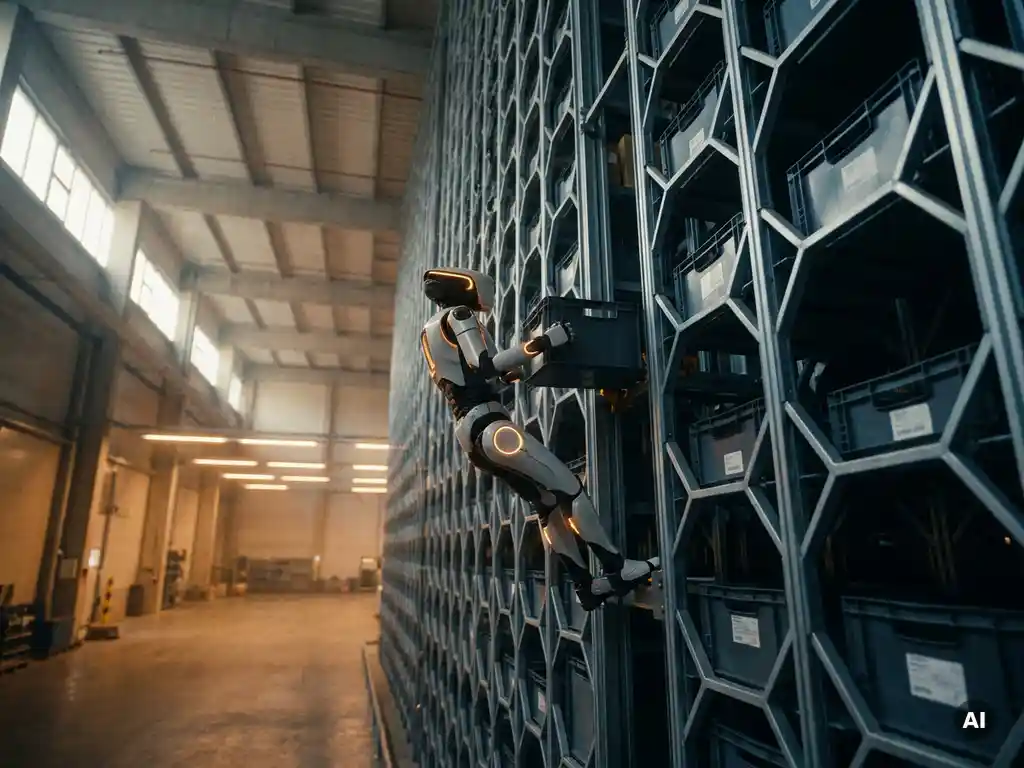
Bin-based storage is a warehouse method where individual items or small product groups are stored in standardized containers, called bins or totes, within a structured grid or rack system. Robots retrieve these bins and deliver them directly to human operators at picking stations, eliminating the need for workers to walk the warehouse floor. The sections below answer the most common technical questions about how robotic bin storage works in practice.
How do robots physically access and retrieve bins in a storage system?
In a robotic bin-based AS/RS, autonomous robots navigate horizontally beneath or across a storage grid to position themselves at the correct tower or column, then climb vertically to reach the precise bin location. The retrieval happens in one continuous motion: the robot deposits a previously carried bin and retrieves the requested one during the same vertical cycle, eliminating empty trips and reducing cycle time.
This goods-to-person picking model means the robot does the travel, not the operator. Once the robot reaches the correct storage position, it extracts the tote and carries it back to a workstation where a human picks the required item. Because every storage location is directly accessible, there is no need to move other bins out of the way to reach a specific tote. This direct-access architecture is a significant operational advantage over systems that require reshuffling or digging through stacked inventory.
The physical movement splits into two distinct axes. Horizontal navigation happens beneath the grid structure, allowing robots to reposition freely without interfering with storage towers. Vertical access happens inside each tower, where detachable climber units ascend and descend to the exact shelf position. This separation of horizontal and vertical movement keeps the system modular and avoids the bottlenecks common in crane-based retrieval systems, where a single machine services an entire aisle.
What types of goods are best suited for bin-based storage?
Bin-based storage is best suited for small to medium-sized items that are picked individually or in small quantities, where order accuracy, speed, and storage density matter more than bulk handling. Products that fit into standardized totes and are ordered frequently in varying combinations are the strongest match for this storage model.
In practice, this covers a wide range of sectors and product types. Common applications include:
- E-commerce and omnichannel fulfillment: High SKU counts, frequent single-item orders, and fast dispatch requirements align well with goods-to-person picking from tote-based systems.
- Pharmaceuticals and healthcare: Products requiring batch traceability, precise inventory control, and reliable retrieval accuracy benefit from the direct-access model.
- Fashion and apparel: High SKU complexity, seasonal variation, and the need to manage returns efficiently make bin-based storage a strong fit.
- Spare parts and industrial components: Items with irregular demand patterns but high accuracy requirements are well served by a system where every location is independently accessible.
- Food and grocery fulfillment: Dense, high-velocity picking environments with strict rotation requirements are manageable when the control system handles inventory logic automatically.
- FMCG and retail supply: Promotional peaks and fluctuating volumes are easier to absorb when throughput can scale without infrastructure changes.
Products that are too large or heavy for standardized totes, or that are handled in full pallet quantities, are generally better served by pallet-based AS/RS or conventional racking. Bin-based robotic storage delivers its strongest return where SKU variety is high and order profiles are fragmented.
How does bin-based storage compare to traditional shelving and pallet racking?
Bin-based robotic storage delivers significantly higher storage density and faster, more accurate retrieval than traditional shelving or pallet racking, but it requires a higher upfront investment and is better suited to high-velocity, high-SKU environments. Traditional shelving and pallet racking are lower-cost and more flexible for large or irregularly shaped goods, but they depend on human travel and manual picking, which limits throughput and introduces error.
Storage density and space utilization
Conventional shelving uses floor space efficiently at low heights but rarely exploits the full vertical volume of a warehouse. Pallet racking can go tall, but access requires forklifts and wide aisles, consuming significant floor area. Robotic bin storage converts cubic volume into usable positions by eliminating access aisles within the storage zone and utilizing the full building height. Systems built on hexagonal geometry, for instance, can achieve space utilization rates well above what conventional cubic rack arrangements deliver, because the geometry itself minimizes wasted volume between storage positions.
Picking speed and accuracy
Manual picking from shelves or pallet racking requires workers to walk to product locations, which is time-consuming and physically demanding at scale. Error rates rise with fatigue and complexity. In a goods-to-person model, the robot brings the correct bin to the operator, who picks from a stationary workstation. This reduces travel time to near zero, improves ergonomics, and allows the control system to enforce pick accuracy through software rather than relying solely on human attention.
The trade-off is that traditional racking handles irregular items, bulk quantities, and infrequent access more cost-effectively. For warehouses with stable, low-SKU inventory and predictable demand, the additional complexity of an automated bin system may not be justified. The decision comes down to order profile, SKU count, and throughput requirements.
What software controls robot coordination in a bin-based AS/RS?
A dedicated warehouse control system, often called a Warehouse Control System (WCS) or an AS/RS-specific control platform, manages robot coordination in a bin-based automated storage and retrieval system. This software handles task assignment, robot routing, inventory location tracking, collision avoidance, and integration with external warehouse management systems (WMS) through standard APIs.
In practice, the control system acts as the operational brain of the entire robotic bin storage environment. When an order arrives, the software identifies the relevant tote locations, assigns retrieval tasks to available robots, sequences movements to avoid conflicts, and directs completed totes to the correct workstation. All of this happens in real time, across potentially hundreds of simultaneous robot operations.
Key software functions in a robotic bin AS/RS include:
- Inventory logic: Tracking exactly which tote sits at which location and updating that record with every storage and retrieval event.
- Task orchestration: Assigning jobs to robots dynamically based on current position, battery status, and system load.
- Traffic management: Coordinating horizontal robot movement beneath the grid to prevent collisions and minimize wait times.
- Safety management: Monitoring robot status, detecting faults, and isolating units without stopping the wider system.
- WMS integration: Communicating with external order management and warehouse management platforms through standard interfaces, so the AS/RS fits into existing IT infrastructure without custom development.
The quality of this software layer directly determines system reliability and throughput consistency. A distributed control architecture, where no single software component or robot represents a single point of failure, is important for maintaining stable performance during peak demand periods.
How does storage capacity scale independently from throughput in robotic bin systems?
In a well-designed robotic bin-based AS/RS, storage capacity and throughput are controlled by two separate variables: the physical size of the storage structure and the number of robots operating within it. Adding more storage locations expands capacity; adding more robots increases throughput. Neither change requires rebuilding or redesigning the other component.
This independent scalability is a meaningful departure from traditional AS/RS architectures, where storage and throughput are tightly coupled. In a mini-load crane system, for example, adding more storage height or length requires adding more cranes or extending existing ones, which affects the entire mechanical layout. In a shuttle system, more storage levels typically mean more shuttle vehicles and more infrastructure per level. In both cases, scaling one dimension forces changes to the other.
In a modular robotic bin system, the storage structure can be extended horizontally by adding towers within the same architectural framework, without changing the robots or the control logic. Throughput can be increased by deploying additional autonomous units that operate in parallel across the same grid. Because robots navigate independently rather than sharing a fixed track or crane path, adding units produces roughly linear throughput gains without mechanical redesign.
This separation also means scaling can happen during live operations. Extending the structure or adding robots does not require a system shutdown, which is a practical advantage for warehouses that cannot afford extended downtime. The result is a warehouse automation system that grows with operational demand rather than requiring operators to predict and build for peak capacity from day one.
How Hexxabotics helps with bin-based storage
Hexxabotics delivers a next-generation bin-based AS/RS built specifically to address the limitations covered throughout this article. The system combines a hexagonal vertical storage grid, autonomous Hexxabots, and standardized totes into one architecture designed for independent scalability, direct tote access, and operational resilience.
- Every storage location is directly accessible, with no digging or reshuffling required
- Robots perform deposit and retrieval in a single vertical cycle, minimizing empty travel
- Storage capacity and throughput scale independently, without structural redesign
- No in-rack electrification simplifies installation, maintenance, and relocation
- The control system integrates with existing WMS platforms through standard APIs
- Distributed robot operation eliminates single points of failure and maintains throughput during peak demand
- The system supports a range of applications from e-commerce picking to pharma, FMCG, and 3PL logistics
If you are evaluating robotic bin storage for a new or existing facility, learn more about Hexxabotics and how the hexagonal AS/RS architecture can be matched to your specific throughput and capacity requirements.
Related Articles
- Hoe ontwerp je een magazijn voor zowel bulk- als stuksgewijze orderverzameling?
- How does SKU count affect the complexity of warehouse layout planning?
- What is goods-to-person fulfillment and how does it change warehouse design?
- What is swarm robotics and how is it used in logistics?
- How does free-roaming robot technology reduce warehouse downtime?