
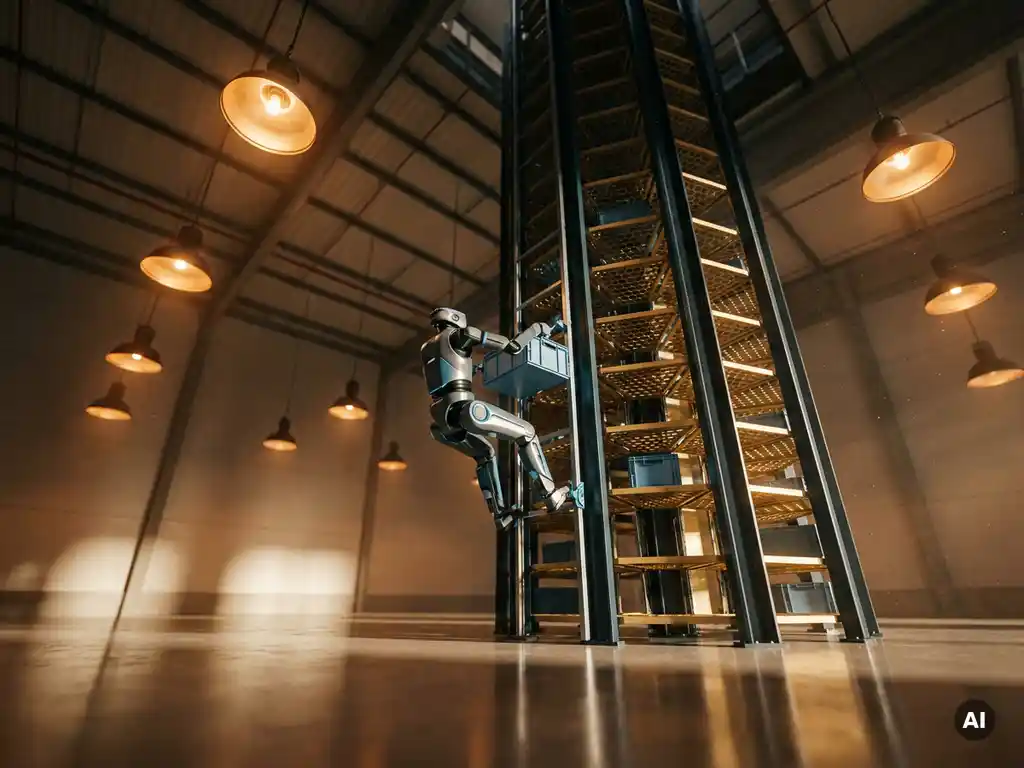
Goods-to-person fulfillment is a warehouse operating model in which automated systems retrieve stored inventory and bring it directly to a stationary operator workstation, rather than having workers walk through aisles to find products. Instead of people traveling to goods, the goods travel to people. This fundamental reversal reduces unproductive travel time, concentrates human effort on value-adding tasks, and creates the conditions for higher, more consistent pick rates. The sections below answer the most common questions about how GTP systems work, what they demand from warehouse design, and when they make operational sense.
How does a goods-to-person system actually move inventory?
A goods-to-person system moves inventory by using automated storage and retrieval technology to locate the correct tote, bin, or carrier, extract it from its storage location, and transport it to a fixed operator workstation where a person completes the pick. The operator never leaves the workstation. The system handles all physical travel through the storage volume.
The specific mechanism depends on the underlying technology. In grid-based robotic systems, autonomous robots navigate horizontally across a storage grid and lift totes from below. In vertical carousel or vertical lift module systems, a motorized carrier rotates or elevates stored trays to a presentation window. In AS/RS shuttle systems, independently operating shuttles retrieve carriers from racking lanes and deliver them to conveyor networks that feed workstations.
What these approaches share is a separation of roles: the automated system handles the physical movement of inventory through three-dimensional storage space, while the operator focuses on picking, scanning, verification, and exception handling at a single ergonomic point. The result is a controlled, repeatable process rather than a variable one that depends on how quickly an individual can walk and locate a product.
What warehouse layout changes does goods-to-person require?
Goods-to-person fulfillment requires a warehouse layout that prioritizes cubic storage density over aisle access. Because operators no longer walk to pick locations, the wide aisles that conventional person-to-goods warehouses need for human navigation can be eliminated or dramatically reduced. Storage systems can be packed more tightly, and the building height can be exploited more fully.
The most significant layout shift is from a floor-space orientation to a cubic-space orientation. Conventional racking is designed around horizontal reach and visibility. GTP systems are designed around vertical density, with automated mechanisms handling access to every level. A building that previously stored inventory up to four or five meters can, with the right AS/RS technology, utilize the full structural height, sometimes up to 16 meters, without requiring any manual access at height.
Operator workstations become a deliberate design element rather than an afterthought. These stations need to be positioned at the interface between the automated storage zone and the downstream order flow, with ergonomic presentation heights, scanning infrastructure, and clear outbound conveyor or trolley lanes. The number of workstations and their placement directly affects throughput capacity, so their design is a planning decision rather than a furniture choice.
Replenishment flows also change. Rather than restocking individual pick faces throughout the warehouse, replenishment in a GTP environment typically means loading totes or carriers into the automated storage system at defined induction points. This concentrates replenishment activity at fewer locations and makes it easier to plan and staff.
What types of goods-to-person systems exist?
The main types of goods-to-person systems are robotic grid AS/RS, vertical lift modules, vertical carousels, horizontal carousels, shuttle-based AS/RS, and autonomous mobile robot (AMR) tote delivery systems. Each type differs in storage density, throughput capacity, footprint, and the kinds of products it handles most effectively.
- Robotic grid AS/RS: Autonomous robots operate across a storage grid, retrieving totes and routing them to workstations. Systems can be designed with direct access to every location or with a grid model that requires repositioning totes to reach buried inventory.
- Vertical lift modules (VLMs): A motorized extractor shuttles between shelving columns inside a closed unit and presents trays at an operator window. Well suited to smaller footprints and parts storage.
- Vertical carousels: Shelving rotates on a vertical loop to bring the correct shelf to the operator. Simpler mechanically but lower in density than VLMs.
- Horizontal carousels: Pods of shelving rotate horizontally. Often deployed in banks of two or three, with an operator picking from one while the others rotate to the next position.
- Shuttle-based AS/RS: Independent shuttle vehicles operate within racking lanes at multiple levels, retrieving carriers and feeding conveyor systems that connect to GTP workstations. Suited to high-throughput, high-SKU environments.
- AMR tote delivery: Autonomous mobile robots pick up shelving units or totes and drive them to a stationary operator. Lower infrastructure cost but generally lower storage density than fixed-structure systems.
The right choice depends on SKU count, order profile, building height, available footprint, required throughput, and budget. Many larger operations combine more than one technology to match different SKU behaviors to the system best suited to handling them.
How does goods-to-person fulfillment affect pick rates and throughput?
Goods-to-person fulfillment increases pick rates by eliminating the travel time that dominates conventional warehouse picking. In a traditional person-to-goods environment, operators can spend more than half their working time walking between locations. GTP removes that travel entirely, concentrating operator time on the actual pick action and allowing workstations to run at a sustained, predictable pace.
The throughput impact is significant in two ways. First, individual operator productivity rises because each pick cycle is shorter and more consistent. Second, throughput becomes more predictable because the system controls the pace of inventory presentation rather than leaving it subject to individual walking speed, congestion in aisles, or difficulty locating a product.
Throughput capacity in a GTP operation scales differently from a conventional one. In a person-to-goods warehouse, adding throughput typically means adding more operators covering more floor space. In a GTP environment, throughput can be increased by adding more workstations or, in robotic systems, by adding more robots to increase the rate at which totes reach the presentation point. Storage capacity and throughput performance can be scaled more independently, which gives operations more flexibility as demand grows.
It is worth noting that workstation design, software orchestration, and the speed of the storage system itself all affect realized pick rates. A GTP workstation that presents inventory slowly, or a control system that sequences orders poorly, will underperform its theoretical capacity. The automation layer and the software layer need to be designed together to achieve the throughput the hardware is capable of delivering.
When does goods-to-person make sense versus person-to-goods picking?
Goods-to-person fulfillment makes the strongest operational case when order volumes are high, SKU counts are large, labor is difficult to recruit or retain, storage space is constrained, or accuracy requirements are demanding. Person-to-goods picking remains more appropriate for very low order volumes, very large or heavy items that cannot be toted, or operations where the economics of automation cannot be justified.
The clearest indicators that GTP is worth evaluating are:
- High pick volume relative to floor space: When a warehouse is processing large numbers of order lines from a dense SKU range, travel time in a person-to-goods model becomes a significant efficiency drain.
- Labor availability or cost pressure: GTP reduces the number of operators needed per unit of throughput and makes each operator’s output more consistent, which matters when recruiting is difficult or labor costs are rising.
- Accuracy and traceability requirements: Presenting one tote at a time to a workstation with integrated scanning creates a controlled pick environment that reduces mis-picks and supports audit trails, which is particularly relevant in pharmaceutical, healthcare, and regulated product environments.
- Building height available but floor space limited: GTP systems paired with high-density AS/RS can exploit vertical space that conventional racking cannot practically use for manual picking.
- Peak demand volatility: When order volumes spike seasonally or during promotions, GTP systems can maintain consistent throughput more reliably than manual operations that depend on temporary staffing.
Person-to-goods picking retains its place for bulky, irregular, or very heavy items that cannot pass through automated storage systems, and for operations where order volumes are simply too low to justify the capital investment in automation infrastructure.
How does goods-to-person integrate with warehouse management systems?
Goods-to-person systems integrate with warehouse management systems through software interfaces, typically APIs, that allow the WMS to direct the automated storage system to retrieve specific totes and present them at the correct workstation at the right moment in the order sequence. The WMS holds inventory logic and order priorities; the GTP system executes the physical retrieval.
In practice, the integration layer is often more layered than a simple WMS-to-machine connection. Larger operations frequently use a Warehouse Execution System (WES) or Warehouse Control System (WCS) sitting between the WMS and the physical automation. The WES handles real-time orchestration: sequencing retrieval requests, managing workstation queues, balancing robot or shuttle workload, and coordinating multiple automation zones so that order lines from different systems converge into a single completed order.
Standard APIs and communication protocols have made integration less complex than it was in earlier generations of warehouse automation. Most modern AS/RS platforms publish documented interfaces that allow connection to major WMS platforms without requiring fully bespoke development. That said, the quality of the integration still has a material effect on system performance. A GTP system that receives poorly sequenced retrieval requests from its software layer will not perform as well as one where the orchestration logic is well designed.
For operations combining multiple automation technologies, such as a high-speed dispenser for fast-moving SKUs alongside a robotic AS/RS for slower or more variable inventory, the orchestration layer becomes especially important. Each technology handles what it does best, and the software ensures that the outputs converge into a coherent order flow rather than independent automation islands that happen to share a building.
How Hexxabotics supports goods-to-person fulfillment
Hexxabotics is an AS/RS platform built specifically to support goods-to-person operations in environments where storage density, direct access, and independent scalability matter. The system combines a hexagonal vertical storage grid with autonomous Hexxabots that navigate horizontally beneath the grid and climb vertically inside towers to retrieve totes in a single continuous motion, then route them to GTP workstations.
- Every storage location is directly accessible, with no reshuffling or digging required to reach any tote
- The structure can utilize building height up to 16 meters, converting unused vertical space into productive storage
- Storage capacity and throughput scale independently: extend the structure to add capacity, add robots to increase retrieval speed
- No electrification is required inside the rack structure, reducing infrastructure complexity and simplifying maintenance
- The system integrates with WMS and WES platforms through standard APIs, fitting into existing warehouse software environments
- Multiple autonomous robots distribute operational capability, so the system is not dependent on a single central machine
If you are evaluating goods-to-person automation for your warehouse operation and want to understand how a direct-access robotic AS/RS could fit your specific environment, learn more about Hexxabotics and get in touch with the team to discuss your requirements.
Related Articles
- What is a GMP-compliant warehouse and how is it certified?
- What is serialization in pharmaceutical supply chain management?
- What is the impact of mezzanine floors on warehouse storage and workflow?
- How do you build a TCO model for warehouse automation?
- How does a hexagonal grid system change warehouse logistics?