
Serialization in pharmaceutical supply chain management is the process of assigning a unique identifier to each individual unit of medicine, creating a digital record that can be tracked from the point of manufacture to the point of dispensing or sale. This identifier, typically encoded as a barcode or data matrix, allows every party in the supply chain to verify the authenticity and movement history of a product. The sections below answer the most common questions about how pharmaceutical serialization works, what regulations drive it, and what challenges companies face when implementing it.
How does serialization work in a pharmaceutical supply chain?
Pharmaceutical serialization works by assigning a unique serial number to each saleable unit of medicine at the point of manufacture. That number, combined with other product data, is encoded on the packaging and registered in a database. Every time the unit changes hands, the serial number is scanned and the transaction is recorded, creating a complete, verifiable chain of custody from factory to patient.
In practice, the process begins on the production line, where packaging equipment prints and applies a unique identifier to each carton or bottle. The identifier is typically encoded as a 2D data matrix code and contains the product’s GTIN (Global Trade Item Number), the serial number itself, the batch or lot number, and the expiry date. This data combination is what makes each unit distinct from every other unit of the same product.
As the product moves downstream, each actor in the supply chain scans the code at key handoff points. A wholesaler receiving a shipment scans each unit to confirm it matches what was declared by the manufacturer. A pharmacy or hospital receiving stock does the same. At the final point of dispensing, the code is verified against a central or regional repository to confirm the product is legitimate and has not already been dispensed elsewhere. If the verification fails, the product is quarantined and investigated.
The result is a complete, auditable digital trail for every individual medicine pack, which is fundamentally different from tracking batches or pallets in aggregate.
What regulations require pharmaceutical serialization?
Pharmaceutical serialization is mandated by several major regulatory frameworks around the world, most notably the EU Falsified Medicines Directive (FMD), the US Drug Supply Chain Security Act (DSCSA), and China’s drug traceability requirements. These regulations share the common goal of preventing counterfeit and falsified medicines from reaching patients, though they differ in scope, technical requirements, and enforcement timelines.
EU Falsified Medicines Directive (FMD)
The FMD, which came into full effect in 2019 for most prescription medicines, requires manufacturers to apply a unique identifier and an anti-tampering device to each pack. Wholesalers and pharmacies must verify packs against the European Medicines Verification System (EMVS), a network of national repositories. The regulation places specific obligations on every party in the supply chain, including wholesalers and distributors, who must scan and verify products at defined points in the process.
US Drug Supply Chain Security Act (DSCSA)
The DSCSA establishes a phased framework for drug traceability in the United States. It requires manufacturers, wholesale distributors, dispensers, and repackagers to exchange transaction information, transaction history, and transaction statements for each prescription drug product. Full interoperability, meaning electronic unit-level traceability across the entire supply chain, has been a key milestone in the DSCSA implementation roadmap. The Act also requires trading partners to investigate and report suspect or illegitimate products.
What data is captured in a pharmaceutical serial number?
A pharmaceutical serial number does not operate in isolation. It is always accompanied by a standardized set of data elements that together form the unique identifier for a single medicine pack. The four core data elements required under most major regulatory frameworks are the Global Trade Item Number (GTIN), the serial number, the batch or lot number, and the expiry date.
- GTIN: Identifies the specific product, including its formulation, strength, and pack size. Every unit of the same product type shares the same GTIN.
- Serial number: A unique alphanumeric string that distinguishes one individual pack from every other pack of the same product. No two packs with the same GTIN should carry the same serial number.
- Batch or lot number: Links the pack to the production batch from which it originated, enabling targeted recalls and batch-level investigations.
- Expiry date: The date after which the product should not be dispensed, enabling expiry management across the supply chain.
Together, these four elements are encoded in a 2D data matrix code printed on each pack. When scanned, the code transmits all four data points simultaneously, allowing verification systems to confirm the product’s identity and status in a single operation. Some regulatory frameworks and internal track-and-trace systems also capture additional data such as country of destination, manufacturing site, or handling conditions, but the four core elements described above form the universal minimum.
What’s the difference between serialization and aggregation in pharma?
Serialization assigns a unique identifier to each individual medicine pack. Aggregation creates a documented relationship between individual packs and the larger units that contain them, such as cases, pallets, or shipments. Serialization answers the question “what is this specific pack?” while aggregation answers “which packs are inside this case or on this pallet?”
To illustrate the difference: a manufacturer serializes each individual carton of medicine with a unique code. When those cartons are packed into a shipping case, aggregation records which serial numbers are inside that case. When cases are loaded onto a pallet, aggregation records which cases are on that pallet. The result is a parent-child hierarchy of identifiers that allows a wholesaler to scan a single pallet barcode and know, without opening the cases, which individual medicine packs it contains.
Aggregation is not universally mandated by all regulations, but it delivers significant operational benefits. Without aggregation, every individual pack must be scanned at each point of transfer, which is time-consuming for high-volume shipments. With aggregation, scanning the outer case or pallet code is sufficient to account for all the packs inside, provided the aggregation data is accurate and up to date. For pharmaceutical wholesalers and distributors handling large volumes of product, aggregation can substantially reduce the time and labor required at goods-in and goods-out processes.
The two processes are complementary rather than alternatives. Serialization is the foundation; aggregation is the operational layer built on top of it that makes high-volume supply chain management practical.
How does serialization prevent counterfeit drugs from entering the supply chain?
Pharmaceutical serialization prevents counterfeit medicines from entering the supply chain by making it possible to verify, at any point in the distribution process, that a specific pack is genuine, has a legitimate manufacturing history, and has not already been dispensed. A counterfeit product either lacks a valid serial number or carries one that does not match the records held in the verification repository, triggering an alert before the product reaches a patient.
The prevention mechanism works through several interlocking controls. First, only licensed manufacturers can register serial numbers in the official repository systems. A counterfeiter cannot simply print a convincing-looking barcode; the number must exist in the database and be associated with the correct product, batch, and expiry data. Second, each serial number can only be verified as active once. When a pharmacy scans a pack at the point of dispensing, the system marks it as dispensed. If the same number appears again, the system flags it as a potential duplicate, which is a strong indicator of counterfeiting or diversion. Third, the anti-tampering device required alongside the unique identifier under frameworks such as the FMD provides a physical layer of protection that complements the digital verification.
Serialization also supports post-market surveillance. If a suspect product is identified, regulators and manufacturers can use the serial number data to trace exactly where the product entered the supply chain, which trading partners handled it, and where similar products from the same batch were distributed. This makes it significantly harder for falsified medicines to circulate undetected and much easier to contain a problem once it is identified.
What are the main challenges of implementing pharmaceutical serialization?
Implementing pharmaceutical serialization is technically and operationally complex. The main challenges involve integrating serialization systems with existing manufacturing and warehouse infrastructure, managing data at scale, ensuring supply chain partners are aligned, and maintaining compliance as regulations evolve. No single challenge is insurmountable, but underestimating the scope of any one of them can delay implementation or create compliance gaps.
Technology and infrastructure integration
Serialization requires changes at the production line level, where packaging equipment must be capable of printing, applying, and verifying unique codes at speed without creating bottlenecks. Existing lines may need hardware upgrades, camera-based verification systems, and new software interfaces. Warehouse management and enterprise resource planning systems must also be updated to capture, store, and transmit serialization data at every point of movement. For organizations managing large and varied product assortments, coordinating these changes across multiple systems is a substantial technical undertaking.
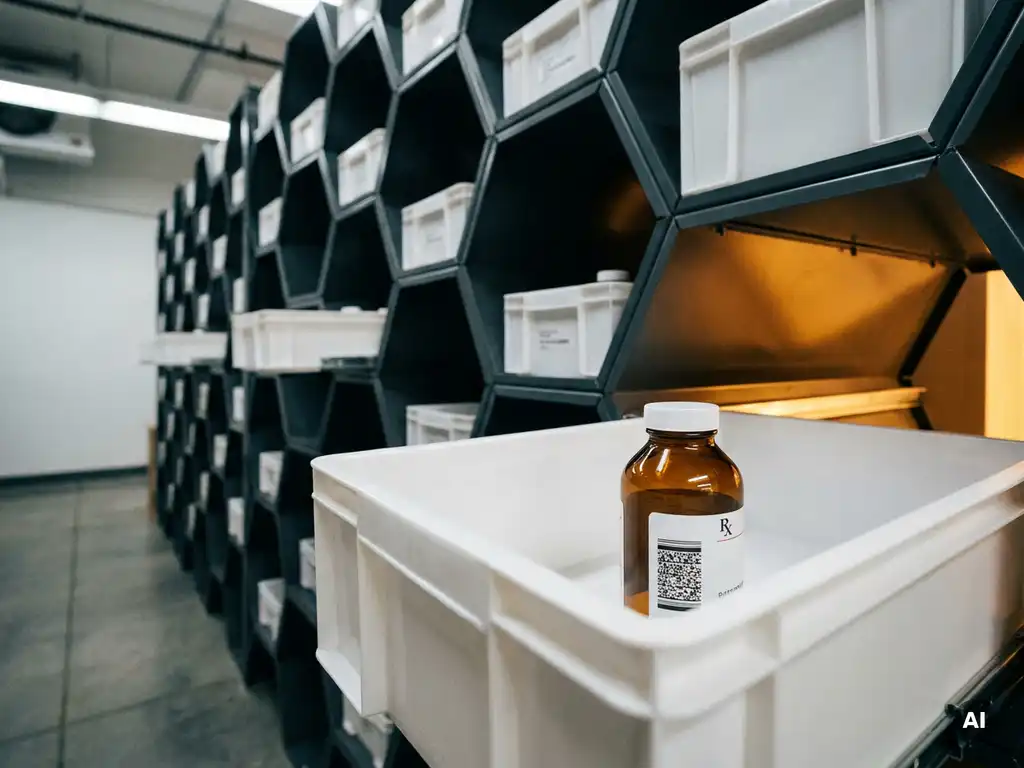
Within distribution and storage operations, the ability to retrieve individual serialized units quickly and accurately becomes important. Environments where products are stacked or stored without direct individual access can create practical difficulties when a specific serial number or batch needs to be located or quarantined. Storage architectures that provide direct access to individual totes or units, rather than requiring other inventory to be moved to reach a target product, support the kind of precise inventory control that serialization and batch traceability demand.
Data management and partner alignment
Serialization generates large volumes of data. Each pack produces a record at manufacture, at each point of transfer, and at the point of dispensing or verification. Across a pharmaceutical wholesaler handling tens of thousands of SKUs, the volume of serialization transactions accumulates rapidly. Systems must be capable of storing, querying, and transmitting this data reliably, including to national or regional verification repositories where required by regulation.
Partner alignment is equally demanding. Serialization only functions as a chain-of-custody tool if every party in the supply chain participates correctly. A manufacturer that does not transmit complete serialization data, a wholesaler that does not scan at goods-in, or a pharmacy that bypasses verification creates a gap in the audit trail. Achieving consistent compliance across a supply chain that may involve dozens of trading partners, each with different systems and operational maturity, requires sustained coordination, training, and governance.
Regulatory complexity and ongoing change
Pharmaceutical serialization regulations are not static. Requirements have been updated, deadlines extended, and new obligations introduced as implementation experience has accumulated. Organizations operating across multiple markets face the additional complexity of managing different regulatory requirements simultaneously, since the FMD, DSCSA, and other national frameworks differ in their technical specifications and compliance obligations. Keeping systems and processes aligned with evolving requirements is an ongoing investment rather than a one-time implementation project.
How Hexxabotics supports pharmaceutical serialization and compliance
Hexxabotics provides high-density AS/RS storage designed to support the precise inventory control that pharmaceutical serialization demands. For pharmaceutical wholesalers and distributors managing serialized inventory across thousands of SKUs, the system offers several capabilities directly relevant to compliance and operational accuracy:
- Direct individual access: Every storage location is directly retrievable without moving other inventory, which supports accurate retrieval of specific serialized units, batches, or lots without disrupting surrounding stock.
- Batch and expiry management: The system is designed to support batch-controlled inventory workflows, including FEFO (First Expiry, First Out) processes, which are essential for pharmaceutical operations managing expiry dates at the individual unit level.
- Integration with orchestration software: Standard APIs allow the Hexxabotics Control System to connect with WMS, WES, and WCS platforms, enabling serialization data and inventory records to flow across the broader fulfillment architecture.
- Scalable capacity without redesign: Storage capacity and throughput can be scaled independently, allowing pharmaceutical operations to grow their serialized inventory without rebuilding their compliance infrastructure.
If you are evaluating automated storage solutions for a pharmaceutical distribution or fulfillment environment where serialization compliance, batch traceability, and direct inventory access are priorities, contact Hexxabotics to discuss how the system can be configured for your specific operational requirements.
Related Articles
- How does humidity control affect pharmaceutical product stability in storage?
- What is goods-to-person fulfillment and how does it change warehouse design?
- How do you design a warehouse for robotic picking systems?
- How do robots and human workers collaborate in hybrid warehouses?
- What is swarm robotics and how is it used in logistics?