
CAPEX and OPEX represent two fundamentally different ways to finance warehouse automation. CAPEX (capital expenditure) means purchasing the system outright as a long-term asset, while OPEX (operational expenditure) means paying for automation as an ongoing service or subscription. The right model depends on your company’s financial strategy, balance sheet priorities, and how much flexibility you need as your operation scales.
Both models are widely used in warehouse automation projects in 2026, and understanding how each affects your total cost, ROI timeline, and operational freedom is essential before committing to an AS/RS investment. The sections below break down each model and address the most common questions engineers and operations leaders ask when evaluating warehouse automation financing.
Which cost model is better for warehouse automation projects?
Neither CAPEX nor OPEX is universally better for warehouse automation. The right model depends on your company’s financial structure, growth trajectory, and risk tolerance. CAPEX delivers lower total cost over time if you have a long planning horizon and stable volumes. OPEX offers more flexibility and preserves capital if your operation is scaling rapidly or if committing to a large upfront investment is not strategically viable.
In practice, the decision often comes down to three factors: access to capital, the speed at which your storage and throughput requirements are likely to change, and how your finance team treats depreciation versus operating expenses on the balance sheet.
- Stable, high-volume operations with predictable demand typically benefit from CAPEX ownership, since the system is amortized over many years and total cost is lower.
- Fast-growing or seasonal operations often prefer OPEX structures because they can scale without committing to infrastructure that may need to change within two to three years.
- 3PL providers and contract logistics operators frequently favor OPEX because it allows them to align automation costs with client contract durations.
The most important thing to avoid is choosing a model purely based on upfront cash flow without modeling the full lifecycle cost. An OPEX arrangement that looks attractive in year one can become significantly more expensive than a CAPEX purchase by year five or six.
How does CAPEX financing work for an AS/RS system?
Under a CAPEX model, the company purchases the AS/RS system outright and records it as a fixed asset on the balance sheet. The total investment covers hardware, software, installation, and commissioning. The asset is then depreciated over its useful life, typically between seven and fifteen years depending on accounting policy and system type, spreading the financial impact across multiple reporting periods.
For an AS/RS investment, CAPEX financing usually involves one of the following approaches:
- Direct purchase using internal capital reserves or approved capital budget.
- Equipment financing or leasing with ownership transfer, where the company makes structured payments but holds the asset on its balance sheet from the start.
- Project financing tied to a broader facility investment, such as a new distribution center build-out.
The advantage of CAPEX ownership is long-term cost efficiency. Once the system is paid for, ongoing costs are limited to maintenance, software licensing, and energy. For systems designed with low infrastructure complexity, such as those without in-rack electrification or fixed mechanical lifting systems, maintenance costs tend to be predictable and manageable over the asset’s lifetime.
The main challenge with CAPEX is the upfront commitment. Large AS/RS investments require significant budget approval processes, and once the system is installed, changing the configuration involves additional capital outlay. This is why modular, independently scalable systems are particularly valuable in a CAPEX context: you can expand storage capacity or add throughput without triggering a full redesign or a new capital project.
What does an OPEX model look like in warehouse automation?
An OPEX model in warehouse automation means paying for the system’s use as a recurring operational expense rather than owning it as a capital asset. This is typically structured as a Robotics-as-a-Service (RaaS) or Automation-as-a-Service arrangement, where the vendor or a financing partner retains ownership of the equipment and the customer pays a monthly or annual fee that covers hardware, software, maintenance, and often performance guarantees.
OPEX arrangements in warehouse automation generally include:
- A fixed or variable monthly fee based on storage positions, throughput volume, or a combination of both.
- Maintenance and support included in the contract, removing the need for in-house technical teams to manage the hardware.
- Software updates and control system upgrades covered by the service provider.
- Flexibility clauses that allow scaling up or down as operational requirements change.
The OPEX model is particularly attractive for companies that want to automate quickly without large upfront capital approval processes. It also shifts the financial risk of technology obsolescence to the vendor. If a newer generation of robotic hardware becomes available, the service provider absorbs the upgrade cost rather than the warehouse operator.
The trade-off is total cost. Over a ten-year horizon, cumulative OPEX payments often exceed what a direct CAPEX purchase would have cost. The premium you pay is for flexibility, reduced risk, and the ability to keep automation costs within the operating budget rather than the capital budget.
How do CAPEX and OPEX affect warehouse automation ROI calculations?
CAPEX and OPEX affect ROI calculations differently because they change both the cost baseline and the timeline over which returns are measured. In a CAPEX model, ROI is typically calculated as the net benefit of automation divided by the total upfront investment, with the payback period representing how many years it takes for operational savings to recover the initial outlay. In an OPEX model, ROI is measured against the ongoing cost of the service versus the labor and operational costs it replaces.
ROI under a CAPEX model
CAPEX ROI calculations center on payback period and net present value (NPV). The key inputs are the total system cost, annual labor savings, throughput improvements, error reduction, and any facility cost savings from higher storage density. Payback periods for AS/RS investments typically range from three to seven years depending on labor costs, throughput volumes, and how much of the building height the system utilizes. Systems that convert full vertical space into usable storage, rather than leaving cubic volume idle, tend to deliver faster payback because they generate more storage revenue per square meter of floor space.
ROI under an OPEX model
OPEX ROI calculations are simpler in structure but require careful attention to the total cost of service over the contract term. The primary comparison is between the monthly service fee and the monthly cost of the manual or semi-automated process it replaces. Because OPEX payments continue indefinitely, the ROI calculation must account for the full contract duration and any renewal terms. A system that delivers positive ROI in year two under CAPEX may not deliver equivalent returns under OPEX until year four or five, depending on the service fee structure.
One factor that often improves ROI under both models is the ability to scale throughput independently of storage capacity. When adding more robots to an existing structure increases picks per hour without requiring new infrastructure, the incremental cost of throughput growth is low, which strengthens the overall return regardless of which financing model is in place.
Can warehouse automation systems be structured as both CAPEX and OPEX?
Yes, hybrid financing structures are increasingly common in warehouse automation. A hybrid model typically involves purchasing the core infrastructure under CAPEX while financing the robotic units and software under an OPEX or subscription arrangement. This approach allows companies to own the structural assets that have long useful lives while treating the more technology-dependent components as operational costs that can be refreshed or scaled without triggering new capital projects.
In practice, hybrid structures work well when the system architecture separates passive infrastructure from active robotic components. Systems where the storage structure contains no embedded electronics, motors, or fixed lifting mechanisms are well suited to this approach because the passive structure has a much longer and more predictable useful life than the robotic units operating within it. The robots, control software, and any performance-based services can then be structured as OPEX without affecting the capital asset on the balance sheet.
Another common hybrid approach is to use CAPEX for an initial deployment and then fund subsequent capacity expansions or throughput additions through OPEX or equipment financing. This preserves the cost efficiency of ownership for the core system while giving operations teams the flexibility to respond to growth without waiting for new capital budget cycles.
When evaluating a hybrid structure, the key questions to resolve are how ownership and maintenance responsibilities are divided between the company and the vendor, how the contract handles system upgrades or replacements, and whether the OPEX component is treated as a true operating lease or a finance lease under current accounting standards, since the distinction affects how it appears on the balance sheet.
How Hexxabotics helps with CAPEX and OPEX planning in warehouse automation
Hexxabotics is designed from the ground up to support both CAPEX and OPEX financing models, and its architecture directly addresses the cost drivers that matter most in either scenario. Key advantages include:
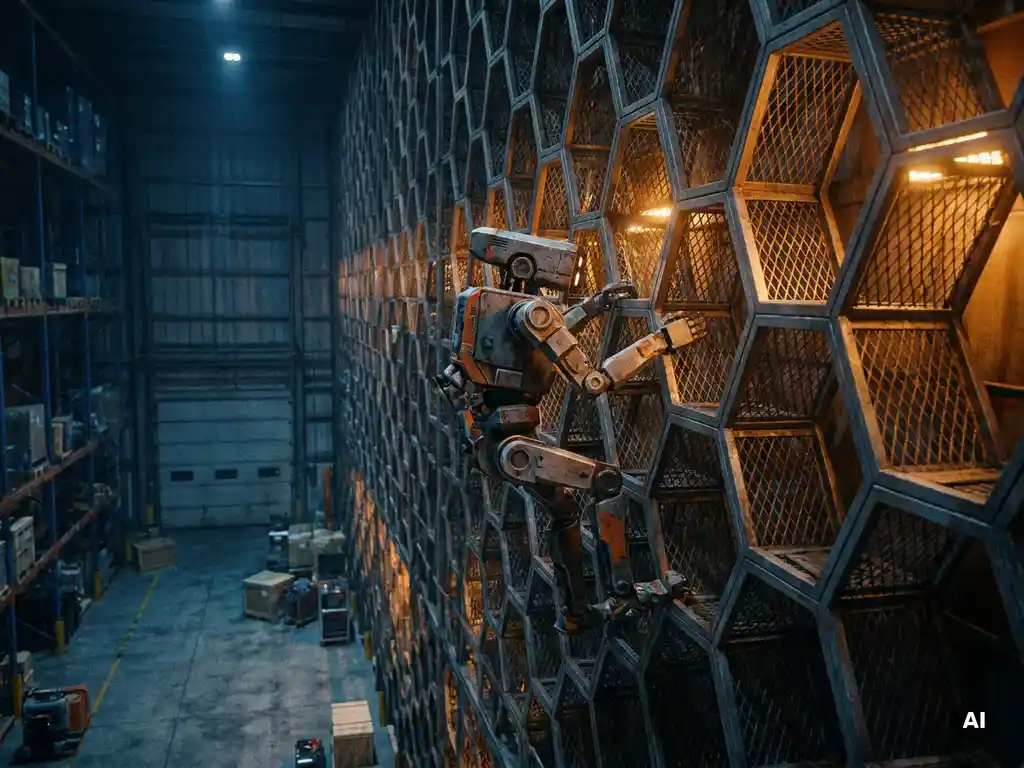
- Lower CAPEX baseline: The hexagonal structure uses minimal steel and contains no embedded electronics, motors, or fixed lifting systems, reducing the upfront hardware cost compared to conventional AS/RS designs.
- Predictable OPEX: No in-rack electrification means fewer failure points, lower energy consumption, and simpler maintenance, making ongoing operational costs easier to forecast.
- Independent scalability: Storage capacity and throughput scale separately. Adding locations or adding robots does not require structural redesign, which keeps incremental CAPEX or OPEX additions small and manageable.
- Hybrid-ready architecture: The passive steel structure and active robotic units are cleanly separated, making it straightforward to structure the system across CAPEX and OPEX components.
- Relocatable and reconfigurable: The system can be moved or reconfigured as operational needs change, protecting the asset value in a CAPEX model and reducing lock-in risk in an OPEX arrangement.
If you are evaluating warehouse automation financing options and want to understand how a high-density AS/RS system fits your specific cost model, explore Hexxabotics or learn more about the company to connect with a specialist who can walk through the numbers with you.
Related Articles
- What are the data integrity requirements for pharmaceutical warehouse systems?
- What are the most common reasons pharmaceutical warehouses fail inspections?
- What is pharmaceutical warehousing and why does it matter?
- How does product mix complexity affect warehouse design decisions?
- How do you design a warehouse layout that supports multiple shifts?