
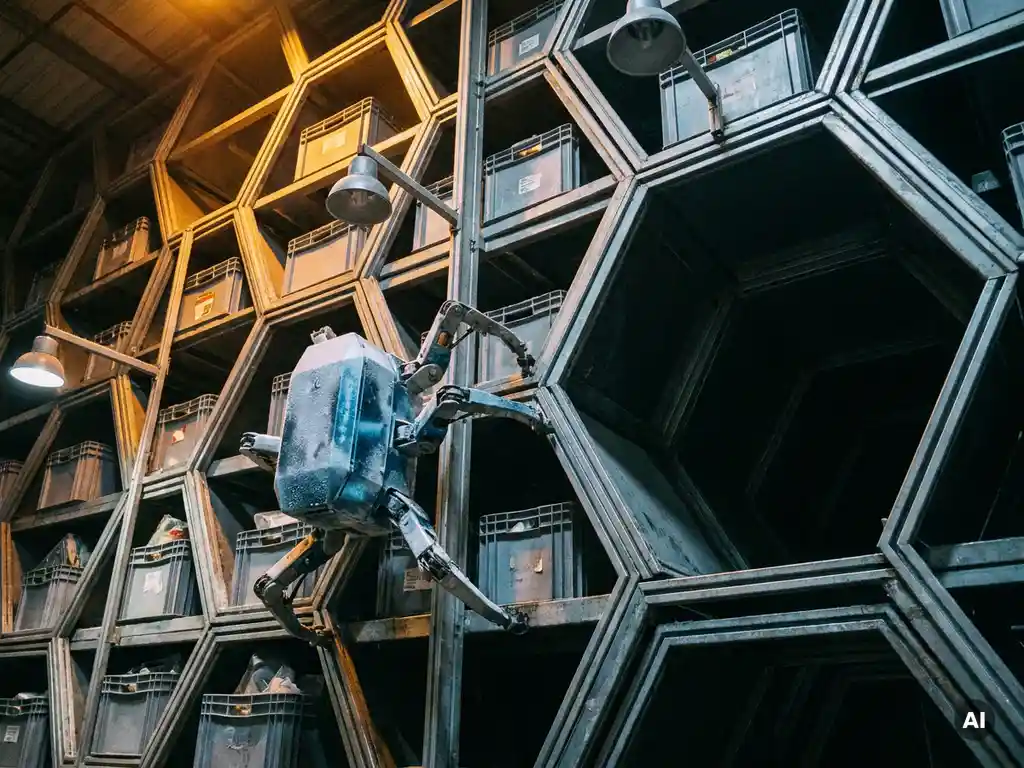
Warehouse automation stops being cost-effective when the capital investment, operational complexity, and infrastructure requirements outweigh the labor savings and throughput gains a facility can realistically achieve. This tipping point depends on order volume, SKU complexity, available floor space, and how well the chosen system can scale without requiring costly redesigns. The sections below break down each factor in detail so you can evaluate where your operation stands.
What factors make warehouse automation financially viable?
Warehouse automation becomes financially viable when a combination of high order volume, repetitive picking patterns, rising labor costs, and constrained floor space creates a clear economic case for replacing manual processes. No single factor determines viability on its own. The strongest business cases emerge when several conditions align at the same time.
The most important financial drivers include:
- Labor cost and availability: When wages are high, turnover is frequent, or qualified workers are hard to recruit, automation delivers faster payback by reducing dependence on headcount.
- Order volume consistency: Systems that run at high utilization recover their capital cost faster. Facilities processing large volumes of similar transactions daily are better candidates than those with highly variable demand.
- Storage density requirements: If floor space is expensive or physically limited, a system that converts vertical cubic volume into usable storage locations generates direct cost savings on real estate.
- Error and accuracy costs: High rates of picking errors, mis-shipments, or returns create measurable financial drag. Automated systems with direct-access retrieval eliminate the reshuffling and human error that cause these problems.
- Scalability of the chosen system: Systems that require full infrastructure rebuilds to grow in capacity or throughput carry a hidden cost premium. Architectures that allow independent scaling of storage and throughput preserve financial viability over time.
Operational fit matters as much as raw economics. A system that is technically capable but poorly matched to your SKU mix, tote sizes, or workflow will underperform against its projected ROI, regardless of how strong the initial business case appeared.
At what order volume does automation start paying off?
There is no universal order volume threshold at which warehouse automation becomes profitable, but most operations begin to see a viable payback case when they process several hundred to a few thousand order lines per day on a consistent basis. Below that level, the capital cost of automation is difficult to amortize against realistic labor savings within a reasonable timeframe.
Volume alone is not the only metric. The nature of the orders matters significantly. A facility processing 500 orders per day with high SKU diversity and single-item picks has a very different automation profile than one processing 500 orders per day with multi-item, pallet-level picks. Goods-to-person systems, including AS/RS technologies, are particularly well suited to high-frequency, small-item picking environments where the cost per pick in a manual operation is high.
Seasonal or promotional spikes also affect the calculation. If your peak demand is two to three times your average volume, you need to evaluate whether the system you are investing in can handle that peak without requiring duplicate infrastructure. Systems with distributed robot fleets that scale throughput linearly by adding units are better positioned to handle variable demand than those built around centralized cranes or conveyors with fixed capacity ceilings.
How do you calculate the ROI of a warehouse automation system?
The ROI of a warehouse automation system is calculated by comparing the total cost of ownership over the system’s operational life against the measurable savings and revenue gains it generates. A complete ROI analysis covers both direct financial savings and indirect operational improvements.
Calculate total cost of ownership
Total cost of ownership includes the initial capital expenditure, installation and commissioning costs, ongoing maintenance, software licensing, energy consumption, and the cost of any future expansions. Systems that require in-rack electrification, fixed conveyor infrastructure, or centralized lifting equipment carry higher maintenance and energy costs over time. A system with passive steel structures and no embedded motors or powered racks has a structurally lower total cost base.
Quantify the savings and gains
On the benefit side, calculate direct labor cost reduction, reduced error rates and return processing costs, real estate savings from higher storage density, and throughput gains that enable revenue growth without adding floor space. Indirect gains include improved inventory accuracy, faster order cycle times, and reduced dependency on seasonal labor. When calculating break-even, divide the net capital investment by the annualized savings to determine the payback period. A payback period of three to five years is generally considered acceptable for warehouse automation investments, though this varies by industry and company cost of capital.
What hidden costs make warehouse automation less cost-effective?
Hidden costs are one of the most common reasons warehouse automation investments underperform against their original business cases. These costs are rarely captured in vendor quotes but accumulate significantly over the system’s operational life.
The most impactful hidden costs include:
- Integration complexity: Connecting an AS/RS or robotic system to an existing warehouse management system (WMS) or ERP often requires significant custom development, testing, and ongoing maintenance. Systems that use standard APIs reduce this burden considerably.
- Downtime during installation: Many systems require partial or full operational shutdowns during installation. The cost of lost throughput during this period is rarely included in ROI projections.
- Infrastructure modification: Some systems require reinforced floors, new power supply infrastructure, or structural modifications to the building. These costs belong in the capital calculation but are frequently underestimated at the proposal stage.
- Scaling costs: Traditional AS/RS architectures link storage capacity and throughput so tightly that increasing one requires rebuilding the other. When a facility grows, the cost of adding capacity to a rigid system can approach the cost of the original installation.
- Maintenance and spare parts: Systems with embedded electronics in the rack structure, centralized cranes, or fixed vertical conveyors carry higher maintenance costs and longer repair times than distributed architectures where individual units can be serviced or replaced without stopping the system.
- Relocation costs: If a facility moves or reorganizes, systems that cannot be reconfigured or relocated without major engineering effort represent a stranded asset risk.
When does warehouse automation stop making financial sense?
Warehouse automation stops making financial sense when the cost of acquiring, operating, and eventually scaling the system exceeds the operational savings it generates, or when the system’s rigidity prevents it from adapting to changes in the business. Several specific scenarios push automation into negative financial territory.
Low and unpredictable order volumes are the clearest signal. If a facility cannot sustain the utilization rates needed to amortize the capital investment, the system will never reach break-even. Automation is a fixed-cost investment that requires consistent volume to justify itself.
Highly variable SKU profiles also reduce cost-effectiveness. Operations that regularly introduce new product dimensions, change packaging formats, or handle irregular items may find that the standardization requirements of automated systems create more friction than they eliminate. Most AS/RS technologies are optimized for standardized totes, and operations with extreme product diversity face ongoing adaptation costs.
Automation also loses its financial case when the system architecture forces you to rebuild in order to grow. If adding 20% more storage capacity requires structural redesign, or if handling a seasonal throughput spike requires purchasing and integrating entirely new conveyor infrastructure, the total cost of scaling erodes the original ROI calculation. This is a structural limitation of systems where capacity and throughput are architecturally linked rather than independently adjustable.
Finally, automation stops making sense when the total cost of ownership is underestimated at the point of investment. Systems with high in-rack electrification, centralized mechanical components, or proprietary software that limits WMS integration tend to generate cost surprises over time that were not visible in the original business case.
Which warehouse operations are hardest to automate cost-effectively?
Some warehouse operations present structural challenges that make cost-effective automation difficult regardless of the technology applied. Understanding these limits helps set realistic expectations when evaluating automation investments.
Operations with extremely high SKU diversity and irregular product dimensions are among the hardest to automate cost-effectively. When products vary widely in weight, shape, and fragility, the standardization that most AS/RS systems require becomes a constraint rather than an advantage. Tote-based systems address part of this challenge by containing diverse products within a standard unit, but the picking and replenishment steps at the boundaries of the system still require flexibility that is expensive to automate reliably.
Low-volume, high-mix operations with unpredictable order patterns are similarly difficult. The capital investment in automation is hard to justify when average daily throughput is low, and the system sits underutilized for significant portions of the day or year.
Receiving and putaway operations that involve irregular inbound flows, mixed pallet configurations, and vendor-specific packaging also resist cost-effective automation. The upstream variability makes it difficult to achieve the consistency that automated systems require to operate efficiently.
Returns processing is another area where automation cost-effectiveness is limited. The condition assessment, repackaging, and routing decisions involved in reverse logistics require judgment and flexibility that automated systems handle poorly relative to their cost.
How Hexxabotics helps with warehouse automation cost-effectiveness
Hexxabotics is designed to address the specific factors that most often cause warehouse automation investments to underperform financially. The system’s architecture directly tackles the hidden costs, scaling rigidity, and infrastructure complexity that erode ROI in traditional AS/RS deployments.
- Independent scalability: Storage capacity and throughput scale separately. Add locations to grow capacity. Add autonomous Hexxabots to grow throughput. No structural redesign is required in either case.
- No in-rack electrification: The passive steel structure contains no embedded motors, powered racks, or fixed vertical conveyors. This reduces maintenance costs, eliminates failure-prone components, and simplifies infrastructure requirements.
- 100% direct access: Every storage location is directly accessible without digging or reshuffling, which eliminates the throughput degradation and picking delays that reduce cost-effectiveness in cube-based systems.
- Distributed resilience: There is no single point of failure. If one robot unit stops, the system continues operating at reduced capacity rather than shutting down entirely.
- Standard API integration: The Hexxabotics Control System connects to existing WMS and ERP platforms through standard interfaces, reducing integration cost and complexity.
- Relocatable and reconfigurable: The modular architecture can be moved or reconfigured, reducing the stranded asset risk that affects less flexible systems.
If you are evaluating whether your operation has reached the point where automation delivers a genuine return, explore the Hexxabotics system or learn more about the company to understand how the architecture is built to preserve cost-effectiveness as your operation grows.
Related Articles
- How do you integrate autonomous mobile robots into an existing warehouse?
- What are the benefits of autonomous mobile robots in warehousing?
- How do 3PL providers choose between leasing and buying automation equipment?
- What is the difference between an AMR and an AGV in warehousing?
- What is an autonomous mobile robot in warehousing?