
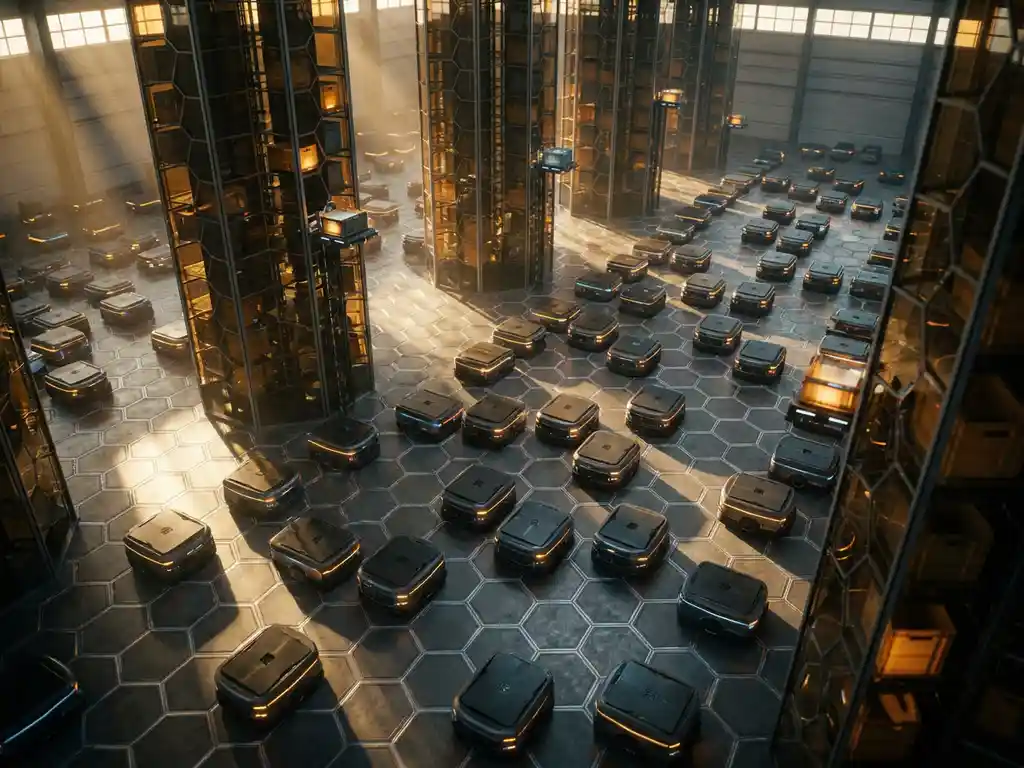
Multi-agent robot coordination is important in fulfillment centers because it directly determines how fast, reliably, and efficiently orders can be picked and dispatched. When multiple autonomous robots operate within the same storage system, coordinating their movements eliminates conflicts, prevents idle time, and ensures that throughput scales with demand rather than being capped by a single machine or centralized mechanism. The sections below unpack the most common questions engineers and operations teams ask when evaluating or deploying multi-robot systems in warehouse environments.
How does multi-agent robot coordination actually work in a warehouse?
Multi-agent robot coordination in a warehouse works by assigning tasks to individual autonomous robots through a central control layer, which tracks each unit’s position, status, and workload in real time. The control system distributes storage and retrieval assignments dynamically, routing robots along paths that avoid collisions while minimizing travel time and maximizing overall throughput.
In practice, the coordination layer operates continuously in the background, making decisions at millisecond intervals. Each robot reports its position and state back to the system, which uses this data to recalculate routes and reassign tasks as conditions change. This is fundamentally different from a scripted or fixed-route system, where robots follow predetermined paths regardless of what other units are doing.
The intelligence in multi-agent coordination comes from the software, not the hardware. Robots themselves do not need to communicate with each other directly. Instead, they each receive instructions from the control system, which acts as the single source of truth for the entire fleet. This architecture keeps individual robots mechanically simple while allowing the fleet as a whole to behave intelligently and adapt to real-time conditions such as peak demand surges or a unit going offline for charging.
What happens when multiple robots compete for the same location?
When multiple robots in a warehouse system are assigned to the same storage location simultaneously, the coordination software resolves the conflict before either robot reaches the target. Priority rules, queue logic, and real-time path planning ensure that only one robot accesses a given location at a time, while the other is redirected to a different task or placed in a holding pattern without stopping the overall system.
This conflict resolution is one of the most critical functions of any warehouse automation system running multiple autonomous units. Without it, robots would either collide, block each other indefinitely, or require manual intervention to resolve gridlock situations. Well-designed coordination software handles these scenarios automatically, typically by assigning a priority score to each task based on factors such as order urgency, robot proximity, and current queue depth.
In systems where every storage location is directly accessible without reshuffling, conflict resolution becomes simpler because the system never needs to move one tote to reach another. This eliminates an entire category of sequencing conflicts that plague cube-storage or deep-lane systems, where accessing a blocked item requires repositioning multiple others first.
How does robot coordination affect throughput in a fulfillment center?
Robot coordination directly determines throughput in a fulfillment center because the efficiency of the coordination layer sets the ceiling on how many picks per hour the system can sustain. Poor coordination creates idle robots, redundant travel, and bottlenecks at high-demand locations. Effective coordination keeps every robot in productive motion, which translates directly into higher picks per hour without adding more hardware.
Throughput in a multi-robot system is not simply a function of how many robots are deployed. A fleet of twenty poorly coordinated robots can underperform a fleet of ten well-coordinated ones. The coordination software must balance task distribution evenly across the fleet, avoid sending multiple robots to the same zone simultaneously, and minimize empty travel between assignments.
Dual-cycle operation is one coordination strategy that significantly improves throughput efficiency. Instead of completing a retrieval, returning empty, and then starting a deposit cycle, a robot is assigned a deposit task on the return journey. This eliminates empty trips and roughly doubles the productive output of each unit without increasing the number of robots or the speed at which they move. The Hexxabotics system is built around this principle, with Hexxabots completing full deposit-and-retrieve cycles in one vertical interaction, which removes wasted travel from the equation entirely.
What’s the difference between centralized and decentralized robot coordination?
Centralized robot coordination uses a single control system to manage all robots, making every routing and task decision from one point. Decentralized coordination distributes decision-making across individual robots or local clusters, allowing each unit to make independent choices based on local information. The key difference is where intelligence lives: in a central brain or distributed across the fleet.
Centralized coordination
In a centralized model, a master control system has full visibility of every robot’s position and status, and it issues instructions to each unit. This approach makes it easier to optimize globally, resolve conflicts before they occur, and maintain a consistent inventory state. The trade-off is that the central system becomes a potential single point of failure. If it goes offline, the entire fleet stops. Centralized systems also require robust, low-latency communication infrastructure to keep up with a large, fast-moving fleet.
Decentralized coordination
In a decentralized model, robots make local decisions using onboard logic and peer-to-peer communication. This makes the fleet more resilient to communication failures and reduces the processing burden on any single system. The challenge is that global optimization becomes harder. Without a complete picture of the entire fleet’s state, individual robots can make locally sensible decisions that create system-wide inefficiencies. Decentralized approaches work well in environments with lower robot density or simpler task structures.
Most modern fulfillment center deployments use a hybrid approach: a central control layer handles task assignment and conflict resolution, while individual robots execute their assigned paths with onboard autonomy. This combines the global optimization advantages of centralized control with the resilience benefits of distributed execution.
How does a multi-robot system integrate with a warehouse management system?
A multi-robot system integrates with a warehouse management system (WMS) through standard APIs that allow the two platforms to exchange order data, inventory status, and task confirmations in real time. The WMS generates pick and replenishment orders, which are passed to the robot coordination layer, which then assigns and executes those tasks autonomously before reporting completion back to the WMS.
The integration architecture matters significantly for operational reliability. A well-designed interface keeps the WMS as the source of truth for inventory and order logic, while the robot coordination system handles all physical execution decisions. This separation of concerns means that changes to order management workflows do not require reconfiguring the robot fleet, and changes to the physical system do not require modifications to the WMS.
Standard API protocols such as REST or message-queue-based interfaces make integration faster and reduce the need for custom development on either side. Systems that require proprietary middleware or deep WMS customization create long-term maintenance complexity and slow down deployment timelines. When evaluating AS/RS systems, the ease and standardization of the WMS integration layer are often as important as the hardware specifications themselves.
When should a fulfillment center scale its robot fleet?
A fulfillment center should scale its robot fleet when throughput demand consistently exceeds current capacity during normal operations, not just during peak periods. If robots are running at maximum utilization for extended periods, queue depths are growing, or order lead times are slipping, these are reliable signals that the fleet size no longer matches the operational load.
The timing of scaling decisions depends heavily on how the underlying system architecture handles growth. In systems where storage capacity and throughput are tightly coupled, adding robots may require structural changes to the rack infrastructure, which makes scaling expensive and disruptive. In systems designed with independent scalability, additional robots can be introduced without modifying the existing structure, which allows scaling to happen incrementally and during live operations.
Proactive scaling ahead of a known demand increase, such as a new product launch, a seasonal peak, or a new customer contract, is generally more effective than reactive scaling after throughput problems have already appeared. The lead time for deploying additional autonomous units should be factored into the planning cycle. If the system architecture supports it, adding robots is far faster and less costly than expanding physical infrastructure, making fleet scaling the preferred lever for throughput growth in well-designed multi-agent systems.
How Hexxabotics handles multi-agent robot coordination at scale
Hexxabotics is designed from the ground up to support distributed, multi-agent robot coordination without the structural complexity that limits traditional AS/RS systems. The Hexxabotics Control System manages robot coordination, inventory logic, and safety across the entire fleet, while each Hexxabot operates autonomously within the grid. Key capabilities include:
- Independent throughput scaling: Additional Hexxabots can be added to increase picks per hour without modifying the rack structure or halting operations
- Direct access to every location: No reshuffling or sequencing conflicts, which simplifies coordination logic and eliminates a major source of throughput loss
- Distributed system resilience: No centralized crane or single point of failure; if one robot goes offline, the rest of the fleet continues operating
- Dual-cycle operation: Robots complete deposit and retrieval in one vertical interaction, eliminating empty trips and maximizing productive output per unit
- Standard API integration: The system connects to external warehouse management systems through standard interfaces, reducing integration complexity and deployment time
If you are evaluating how multi-agent coordination fits your fulfillment operation, get in touch with Hexxabotics to discuss your throughput requirements and how the system scales to meet them.