
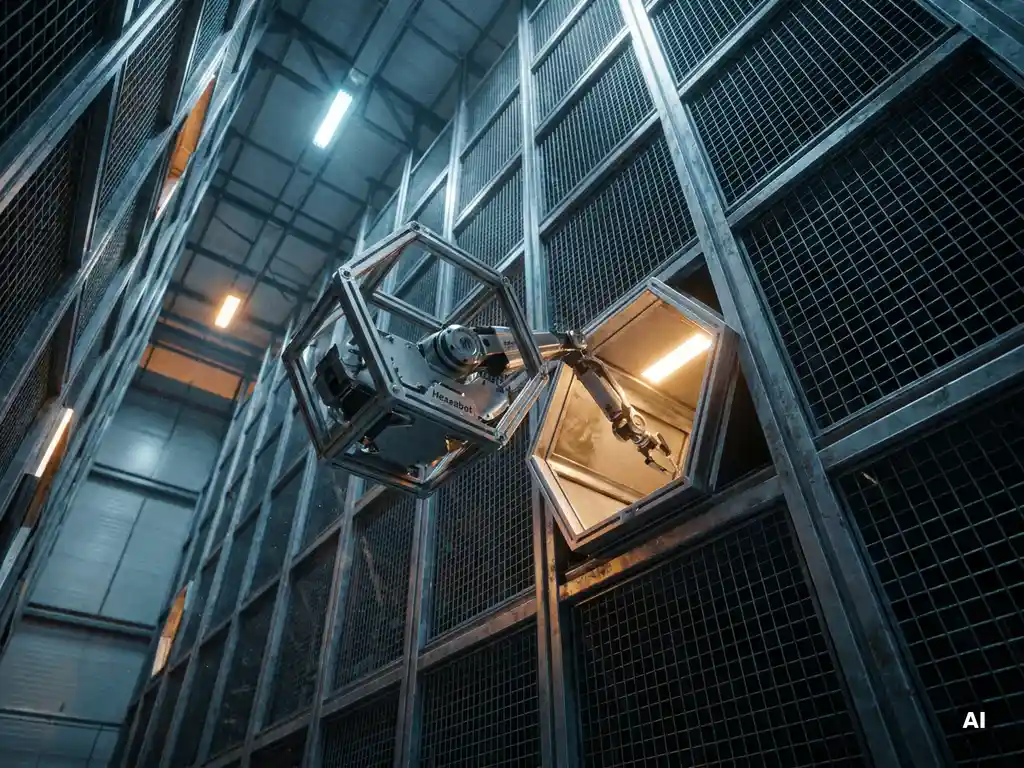
Robot navigation accuracy is critical in automated storage systems because even small positional errors can cause failed tote insertions, mechanical jams, or system downtime that cascades across an entire operation. In high-density three-dimensional environments, where storage locations are tightly packed and robots operate at height, a misalignment of just a few millimeters can mean the difference between a smooth retrieval cycle and a costly fault. The sections below break down the specific consequences, root causes, and technical solutions that define precision in modern AS/RS environments.
What happens when robots navigate inaccurately in a storage system?
When robots navigate inaccurately in a storage system, the immediate result is a failed storage or retrieval event. The robot attempts to insert or extract a tote from a position it has not aligned with correctly, causing a mechanical collision, a dropped load, or a blocked location. In a dense, automated environment, this single failure can halt multiple robots and trigger a cascade of system errors.
Beyond the immediate mechanical failure, inaccurate navigation creates a ripple effect across operations. The warehouse management system logs the failed transaction, which may require manual intervention to resolve. If the misaligned robot is operating within a shared grid, other autonomous units may be rerouted or queued, reducing overall throughput. In worst-case scenarios, a tote that has been partially inserted or knocked out of position can physically obstruct adjacent storage locations, multiplying the scope of the original error.
Operational reliability in automated storage systems depends on robots executing precise, repeatable movements across thousands of cycles per day. A navigation accuracy problem that appears minor in isolation becomes a systemic risk at scale, particularly when the system is running at peak demand and has no tolerance for unplanned stops.
How does navigation accuracy affect storage density?
Navigation accuracy directly determines how tightly storage locations can be packed within a given footprint. The more precise a robot’s positional control, the smaller the mechanical tolerances required between adjacent totes and structural elements. Wider safety margins to compensate for navigation uncertainty translate directly into wasted space and lower storage density per square meter.
In three-dimensional AS/RS environments that utilize full building height, this relationship becomes even more pronounced. Vertical storage structures are engineered to minimize dead space between locations. If robots require larger buffer zones because their positioning is inconsistent, the structural design must accommodate those buffers, reducing the number of storage positions the same footprint can support.
High navigation accuracy also enables the use of standardized tote dimensions with minimal clearance. When every robot in the fleet reliably reaches the same position within a tight tolerance window, system designers can engineer storage locations around the tote geometry rather than around robot variability. The practical result is more usable storage within the same physical volume, which directly improves the economics of the installation.
What causes navigation errors in warehouse robots?
Navigation errors in warehouse robots are caused by a combination of sensor drift, mechanical wear, environmental variability, and software coordination failures. No single factor operates in isolation. Most real-world navigation faults emerge from the interaction between physical degradation over time and the system’s ability to detect and correct for that degradation before it causes an operational failure.
Sensor and hardware sources
Encoders, cameras, and positioning sensors accumulate small measurement errors over time, a phenomenon known as drift. In mobile robots that traverse long distances across a warehouse floor, even a minor consistent error in wheel odometry can compound into a meaningful positional offset by the time the robot reaches its target. Mechanical wear on drive components, uneven floor surfaces, and vibration from other equipment all contribute to this category of error.
Environmental and software sources
Ambient conditions, including temperature fluctuations, lighting changes, and reflective surfaces, can degrade the performance of optical and lidar-based navigation systems. On the software side, coordination errors between multiple robots operating within the same grid, or between the robot’s onboard logic and the central control system, can result in a robot arriving at a location with correct global positioning but incorrect local alignment relative to the specific tote slot. Latency in communication between the control system and individual robots is a less obvious but equally real source of precision failures under high-throughput conditions.
How do AS/RS robots maintain positional accuracy over time?
AS/RS robots maintain positional accuracy over time through a combination of continuous sensor recalibration, reference point correction, predictive maintenance protocols, and software-based error compensation. No mechanical system remains perfectly calibrated indefinitely, so sustained accuracy depends on the system’s ability to detect drift early and correct for it before it reaches the threshold that causes operational faults.
Many modern AS/RS robots use fixed reference markers embedded in the storage structure to periodically verify and reset their positional baseline. Each time a robot passes a known reference point, its onboard navigation system compares its recorded position against the ground truth provided by that marker and applies a correction if a discrepancy is detected. This approach prevents small errors from accumulating into large ones across extended operating periods.
At the fleet management level, the warehouse automation control system plays an equally important role. By monitoring the positional data reported by all robots in real time, the control system can identify units that are beginning to show systematic offset patterns and flag them for recalibration or maintenance before a fault occurs. This predictive approach to accuracy management is what separates systems designed for sustained high-density operation from those that perform well only when new.
What’s the difference between horizontal and vertical navigation accuracy in 3D storage systems?
In three-dimensional storage systems, horizontal navigation accuracy refers to a robot’s ability to position itself correctly beneath the right storage tower or column within the floor-level grid, while vertical navigation accuracy refers to its ability to stop at the correct height within a tower to access a specific storage level. Both dimensions matter, but they involve different mechanical challenges and failure modes.
Horizontal navigation
Horizontal movement typically occurs across a flat surface, and robots can use a combination of floor-embedded guides, optical tracking, or structured-light systems to maintain lane discipline. Errors at this level usually result in the robot approaching the wrong column entirely, which is a coarse failure that control systems can detect and correct before a retrieval attempt is made. The challenge is speed: horizontal traversal must be fast to support high throughput, and maintaining accuracy at speed requires robust sensor fusion.
Vertical navigation
Vertical positioning is mechanically more demanding. Robots climbing inside a storage tower must stop at precise height intervals that correspond to individual tote levels. The forces acting on a climbing robot, including gravity, inertia during deceleration, and any lateral load from the tote being carried, all create conditions that can introduce positional error at the moment of insertion or extraction. Vertical accuracy requirements are therefore typically tighter than horizontal ones, and the consequences of error are more immediate because the robot is already physically engaged with the storage structure when the failure occurs.
How does robot navigation accuracy scale with fleet size?
Robot navigation accuracy becomes harder to maintain uniformly as fleet size grows because larger fleets introduce more sources of variability, more inter-robot coordination demands, and a wider statistical distribution of individual unit performance. A system that achieves consistent accuracy with five robots does not automatically maintain that consistency with fifty, unless the underlying architecture is designed to support distributed precision at scale.
The primary scaling challenge is coordination. When many robots operate simultaneously within the same storage grid, the control system must manage not only each robot’s individual positioning but also the spatial relationships between robots to prevent conflicts. Path planning algorithms that work efficiently at small fleet sizes can introduce latency at larger ones, and that latency can affect the timing precision of individual robots as they approach storage locations.
A second scaling challenge is maintenance consistency. As fleet size grows, the probability that at least one robot is operating with degraded sensor performance at any given moment increases. Systems that rely on centralized correction mechanisms can become bottlenecks. Architectures that build recalibration and error correction into each robot’s individual operating logic, rather than depending on a central system to manage accuracy for the entire fleet, are better suited to maintaining positional precision as the number of autonomous units increases. Distributed operation, where each robot functions reliably as an independent unit within a shared coordination framework, is the architectural principle that makes accurate navigation scalable rather than fragile.
How Hexxabotics addresses robot navigation accuracy in automated storage
Hexxabotics has designed its autonomous AS/RS system around the specific accuracy demands of high-density three-dimensional storage. Several aspects of the architecture directly address the navigation precision challenges described throughout this article:
- Direct vertical access: Every storage location is independently accessible without reshuffling, which means each retrieval cycle involves a single, precise vertical interaction rather than a sequence of movements that compound positional error.
- No in-rack electrification: The passive hexagonal tower structure contains no embedded motors or lifting systems, eliminating the mechanical variability that powered rack components introduce into positioning accuracy.
- Distributed robot operation: Hexxabots operate as independent units within the grid. If one unit develops a positioning issue, the system continues operating without a single point of failure affecting overall accuracy or throughput.
- Scalable fleet architecture: Throughput scales by adding robots without rebuilding infrastructure, and the coordination logic is designed to maintain consistent accuracy as fleet size grows.
- Intelligent control system: The Hexxabotics Control System manages robot coordination and inventory logic in real time, providing the centralized oversight needed to detect and respond to positioning anomalies before they cause operational failures.
If you are evaluating AS/RS solutions where navigation accuracy, storage density, and scalable throughput are engineering priorities, learn more about Hexxabotics and how the system is built to deliver consistent precision across every storage and retrieval cycle.
Related Articles
- How does automated slotting optimization reduce travel time in warehouses?
- What are the safety risks of fully automated warehouse environments?
- How do AGVs navigate safely around warehouse workers?
- What industries benefit most from AMR-based warehouse automation?
- What is a dark warehouse and how does it operate?